
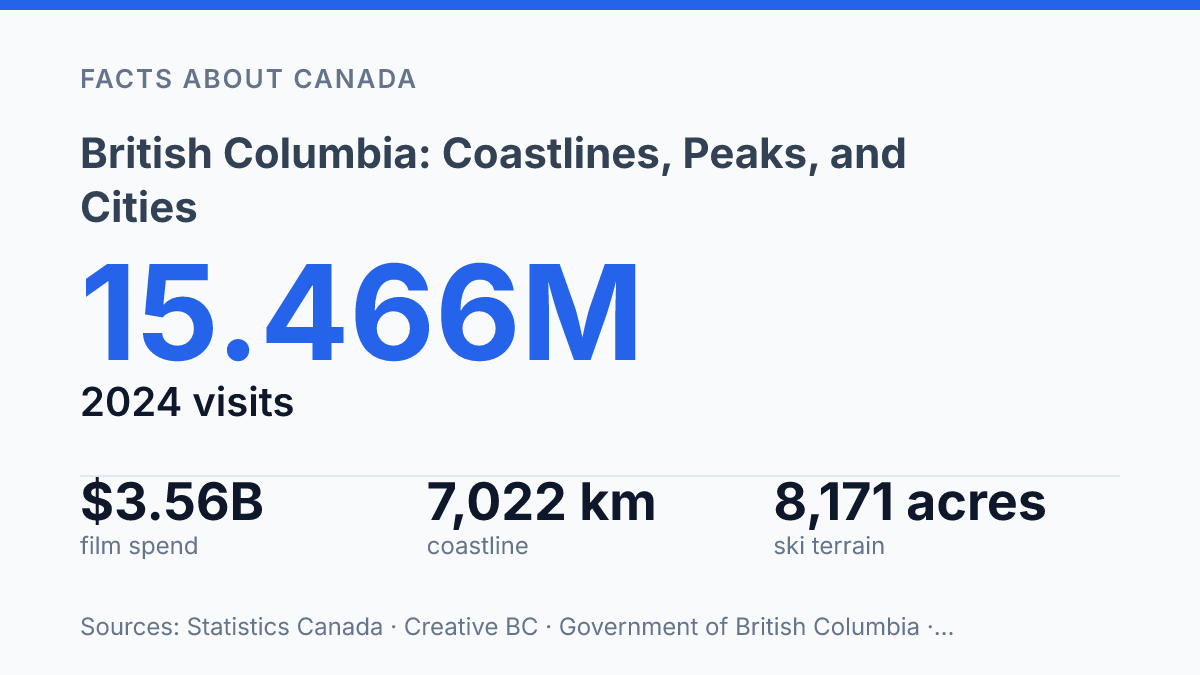
British Columbia drew 15,466,000 visits to Vancouver, Coast and Mountains in 2024. The real shock is how fast the place changes under your feet.
A coast with 7,022 kilometres of edges sits against a mountain system about 300 kilometres wide. Rain can reach 440 centimetres a year on the Pacific side, yet parts of the coast and Fraser River valley get more than 180 frost-free days.
That contradiction shapes the whole trip. Glacier National Park rewards people who read trail distances before breakfast. Whistler Blackcomb turns scale into sport, and Highway 99 climbs from sea level to Whistler’s 670 metres in about two hours.
Vancouver adds a different kind of geography: a border-city film economy where $3.56 billion in 2024 production spending depends heavily on foreign shoots. In my view, that’s what makes the province harder to reduce to postcard scenery. The best parts sit where beauty, weather, money, and access collide.
Pacific shoreline and mountain spine
British Columbia is Canada’s westernmost province and sits on the Pacific Ocean, with a coast cut by islands, fjords, and deep inlets. Yet the shoreline isn’t an easy front door. Much of it is steep, broken, wet, and hard to cross without ferries, bridges, or careful routing through narrow valleys.
Source: Government of British Columbia, 2024 Financial and Economic Review.
Glacier National Park and outdoor travel
A 13-kilometre hike to Asulkan Cabin can start near a highway and still feel like a hard commitment by lunch. Glacier National Park in southeastern British Columbia gives quick access to glaciers, cedar forest, avalanche paths, and rock walls. But it doesn’t make those places gentle.
Parks Canada lists the Asulkan Trail as a 13-kilometre return trip, Balu Pass as 10 kilometres, and Avalanche Crest as 4 kilometres. Those numbers look modest on paper. On the ground, elevation, exposure, and sudden weather changes make distance a poor measure of effort.
The park includes hiking and biking routes inside its boundaries, but hikers get the deeper menu. Bikes fit best on designated routes and road-linked access, not every high mountain path. That tradeoff matters if you’re planning a mixed outdoor trip with different fitness levels.
Overnight travel works because the park has campgrounds that support early starts and multi-day plans. Illecillewaet and Loop Brook are the practical names to know for frontcountry camping near classic trail access. They help you stay close to the terrain instead of treating the park as a quick stop between towns.
Comfort has limits here. A campsite doesn’t cancel out steep trail grades, bear-country routines, cold nights, or the need to book and pack with care. In my view, that friction is the point. The park feels memorable because it asks something from you.
The demand is real, too. Parks Canada’s Open Government attendance data grouped Mount Revelstoke and Glacier national parks at 768,430 visits in the 2023–24 fiscal year.
That figure shows how much traffic the corridor absorbs. The experience still depends on timing, preparation, and honest judgment about your own limits.
Whistler Blackcomb and the Sea-to-Sky route
Few ski areas can make a credible claim to being both a weeklong destination and a day-trip extension of Vancouver. Whistler Blackcomb does, and scale is the reason. The resort reports 8,171 acres of terrain, more than 200 marked runs, 16 alpine bowls, 3 glaciers, and 36 lifts.
That size gives the resort its pull. It also raises expectations.
Visitors don’t come only for a chairlift and a village stroll. They expect dependable snow, deep terrain, lessons, rentals, restaurants, and enough variety to justify the cost of getting there.
The resort’s global profile sharpened during the 2010 Winter Olympics, when Whistler hosted events as part of the Games. That role still matters for branding. It gave the area an international stage without turning the town into a museum of one sporting event.
Highway 99, better known here as the Sea-to-Sky Highway, is the thread that makes the whole corridor work. Destination Vancouver says the route starts at sea level, follows Howe Sound, and reaches Whistler at 670 metres, or 2,200 feet, in about two hours without long stops. That climb is part of the drama.
The views get the attention. The road has a harder job. It moves workers, weekend skiers, airport arrivals, food deliveries, hotel staff, and construction crews between a global city and a mountain economy that can’t run on scenery alone. In my honest opinion, the drive matters most when you treat it as infrastructure, not just a postcard.
That tension defines the route. On a clear day, you may want to stop at every lookout… yet the same highway is also a commuter line, a supply route. The main access point for a resort that depends on steady movement.
Beauty sells the trip. Reliability keeps it functioning.
Vancouver’s film economy and border location
Most places borrow Vancouver on screen before they ever learn its name. As British Columbia’s largest city, it sells a clean skyline, glass towers, rain-dark streets, and mountain backdrops that can stand in for Seattle, New York, Tokyo, or a fictional future. That polished image is real, but it’s also a product.
Creative BC estimates $3.56 billion in film and television production spending across the province in 2024, spread over 372 projects. The sharper detail sits inside that total: foreign production made up $3.08 billion, or 86.5% of volume.
That means the city’s screen economy isn’t just local creativity at work. It depends heavily on outside studios choosing this coast over somewhere else.
That dependence creates tension. Vancouver looks self-contained from a distance, but its media power comes from being plugged into U.S. schedules, crews, financing, and distribution. When exchange rates, tax credits, or studio decisions shift, the work can move fast. In my humble opinion, that vulnerability is exactly what makes the industry worth watching, not a footnote to tourism.
The border position matters just as much as the skyline. The city sits near the province’s southern line with the United States.
It functions as a gateway rather than an endpoint. People, goods, scripts, gear, and production money can move between Canadian and American systems with relative ease.
Trade gives the same geography a harder edge. Vancouver’s identity isn’t only beaches, towers, and mountain views. It’s a city built around access: to Pacific routes, inland markets.
The U.S. corridor just to the south. The surprise is that its glossy image rests on practical movement. Cameras and cargo both need that.
Why the Detours Matter More Than the Distance
Plan this province like a chain of thresholds, not a checklist. Vancouver may be the airport, the studio hub. The border city. It shouldn’t be treated as the pause before the “real” terrain begins.
The smart move is to build slack into every route. A two-hour Sea-to-Sky drive can swallow half a day once weather, trail stops, and Howe Sound pullouts enter the picture. In 2024, foreign production made up 86.5% of B.C.’s film volume.
That dependence says something useful about travel here too. The province sells access, but access is fragile.
In my honest opinion, the best plan leaves room for the thing you didn’t book, because the most memorable turn may be the one you nearly drove past.
Frequently Asked Questions
Q: What is British Columbia best known for?
A: British Columbia is known for its Pacific coastline and mountain ranges. That mix gives you beach views, alpine scenery, and city access in one trip. In my humble opinion, that’s the province’s biggest draw, and it’s hard to beat.
Q: What can you do in Glacier National Park in British Columbia?
A: Glacier National Park has hiking and biking trails, plus campgrounds. It’s a strong pick if you want outdoor time without a lot of setup. The park rewards active travelers… but it also works for a slower overnight stay.
Q: Is Whistler Blackcomb good for skiing?
A: Yes. Whistler Blackcomb is one of the province’s top ski resorts. It hosted the **2010** Winter Olympics. That history matters. The real reason people go is simple: the terrain is built for serious skiing and snowboarding.
Q: How do you get from Vancouver to Whistler?
A: The Sea-to-Sky Highway connects Vancouver with Whistler. It’s a scenic drive. The trip is part of the experience, not just the transfer. Give yourself extra time, because the views can slow you down in the best way.
Q: Why do people visit Vancouver when exploring British Columbia?
A: Vancouver stands out for its film industry and its location near the province’s southern U.S. border. That makes it a practical base for city time before or after mountain trips. You get urban energy first, then the coast and peaks just beyond it.