
In 2025, Edmonton grew by 3.4%, the fastest pace among Canadian cities with more than 1 million people. That’s not a footnote. It changes how you read the city’s map, its economy, and even its landmarks.
A place that began as Fort Edmonton in 1795 now sits on the North Saskatchewan River as Alberta’s capital, a logistics hub. A construction story unfolding in real time. But the city isn’t just government offices and cold-weather clichés.
Its airport moves millions of passengers. Its inland port connects deep into North America. Its most recognizable mall pulls visitor numbers that many downtowns would envy.
In my honest opinion, the useful way to understand this city is not as one thing, but as a set of pressures: geography, trade, politics, growth, and identity all pushing at once.
Where Edmonton sits and why that matters
Canada’s northernmost provincial capital feels less like a compact seat of power than a spread-out city built around distance.
The city sits in central Alberta, on the North Saskatchewan River at 53°32’43” N, 113°29’24” W, according to City of Edmonton / Why Edmonton. That river placement matters. It gives the city a natural corridor through the prairie, not just a scenic edge on a map.
Its political role came early in the province’s life. In 1905, Alberta became a province. The city became the provincial capital.
That decision still shapes the place. Government offices, courts, universities, and public institutions give it a formal weight that visitors notice fast.
But the city doesn’t behave like a tight administrative capital. It spreads. Wide roads, separated districts, industrial land, river valley breaks, and suburban growth all stretch daily life across a large area. In my view, that contrast is the key to understanding how people use the city: it can feel official downtown, then suddenly open and horizontal a few minutes later.
The metro scale adds to that effect. The census metropolitan area is now roughly 1.4 million people, which puts it well beyond a government town and closer to a regional anchor for northern and central Alberta.
You feel that in commuting patterns, shopping trips, hospital networks. The way nearby communities tie into the city for work and services.
So its location is not trivia. The river gives it shape, the capital status gives it authority. The prairie layout gives it room.
The tradeoff is clear: reach and space come with longer distances. That defines everyday life as much as any landmark does.
How the city grew from trading post to capital
The fur trade gave the city its origin story. The railways gave it scale.
Fort Edmonton began in 1795 as a trading post tied to the Hudson’s Bay Company. That mattered.
The fort drew goods, labour, routes, and authority into one place. It also turned a seasonal exchange point into a fixed commercial centre with staying power.
Still, romance can distort the story. A fur-trade post sounds like destiny, but cities don’t grow on symbolism alone. They grow when people and freight can move cheaply, reliably, and often. In my honest opinion, commerce, not frontier myth, is the real explanation for how this place scaled.
The city’s formal leap came later. It incorporated as a city in 1904, according to the City of Edmonton, after decades of settlement, land speculation, and institutional growth.
That timing matters because it shows the shift from company post to civic machine. Streets, services, banks, newspapers, and government offices needed a municipal framework.
Rail changed the pace. The Canadian Pacific Railway connected the region to wider markets. The Canadian Northern Railway intensified that pull.
One line made access easier. two railway systems made growth harder to ignore. Grain, timber, livestock, machinery, and people could move at a scale the old trail-and-river economy couldn’t match.
That created a sharper kind of power. Transport links made the city useful beyond its immediate surroundings. Merchants could serve rural districts. Builders could bring in materials.
Politicians and institutions had a practical reason to gather there. The capital role didn’t emerge from charm alone. It rested on a place that had become connected, commercially active, and administratively ready.
The result was a city with an origin story rooted in trade and a modern rise driven by infrastructure. The fort explains the beginning. The railways explain the acceleration.
What drives Edmonton’s economy today
No single private employer carries the local economy the way the provincial state does. The Government of Alberta anchors thousands of administrative, policy, legal, technology, and procurement jobs in the capital. That matters more than it sounds.
Public payrolls don’t boom like drilling activity. They don’t vanish as quickly when oil prices drop either.
Energy still sets the city’s rhythm. Corporate offices, engineering firms, equipment suppliers, environmental consultants, and field-service companies tie the city to Alberta’s oil and gas sector without making it a one-industry town.
The nuance matters: the rigs may sit elsewhere. A lot of the planning, financing, dispatching, maintenance, and technical work happens here.
That balance creates a useful tension. Commodity swings can hit confidence fast, especially for firms tied to capital spending in the oil patch. But government, health care, education, utilities, and professional services give the labour market a steadier base. In my humble opinion, that mix is the real story, not the lazy label of “oil city.”
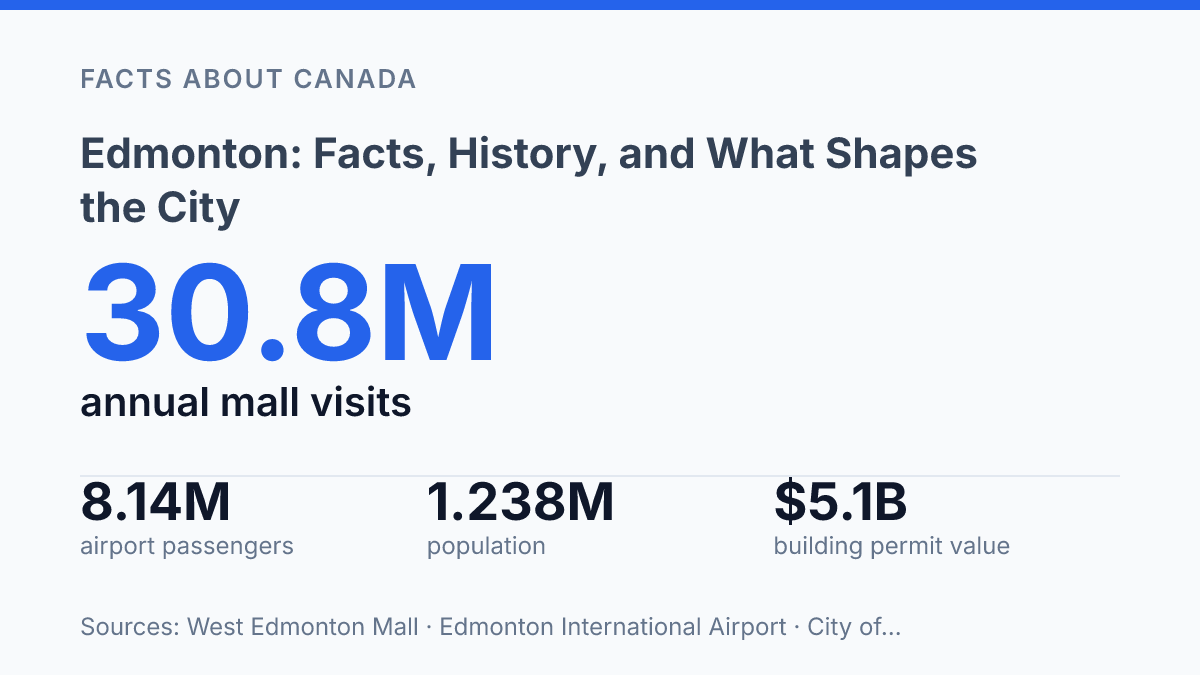
Construction has become the most visible pressure gauge. According to the city’s financial annual report, building-permit values rose 29.3% to $5.1 billion in 2025, and housing starts reached 15,902, up 17.9% from 2024. Those numbers show more than cranes on the skyline.
They signal population pressure, investor demand. A housing market trying to catch up.
The business base is broad enough to soften the edges. The municipal 2025 Business Census counted 29,894 businesses employing 575,197 people, with small businesses making up most establishments outside public administration. You see the pattern: public-sector stability, energy-linked expertise, construction growth, and everyday service firms all pulling at once. Not equal in size.
Equal in importance? No. But each helps explain why the city keeps adding jobs even when Alberta’s resource economy gets rough.
The landmarks and events people actually recognize
West Edmonton Mall turned shopping into a spectacle when it opened in 1981, then kept adding reasons for people to visit even if they weren’t there to buy anything. It remains one of North America’s largest malls, with 5.3 million square feet, more than 800 stores and services, 16 attractions, two hotels, and over 100 dining venues, according to the mall’s own 2026 figures. That scale can feel absurd, but that’s exactly why people remember it.
The mall’s real trick is that it works as both a retail centre and an indoor amusement district. A waterpark, theme-park rides, mini golf, ice, hotels, and chain stores sit under the same roof. In my view, the place matters less as a mall than as a symbol of the city’s habit of making practical things strangely oversized.
Edmonton Fringe Festival gives the city a different kind of recognition: messy, live, experimental, and built around performers rather than polished landmark architecture. Founded in 1982, it became one of North America’s major fringe theatre events and a serious fixture on the arts calendar. The contrast is sharp.
One anchor is a mega-mall with controlled lighting and mapped entrances. The other thrives on pop-up stages, low-budget risk. The possibility that a show might be brilliant or fall apart in front of you.
What people miss is how neatly those two reputations fit together. The city doesn’t separate useful institutions from oddball attractions as cleanly as visitors expect. You see that in places like the Muttart Conservatory, where a public garden is housed in glass pyramids, and in the Neon Sign Museum, where old commercial signs become street-level history.
That mix gives the city its most recognizable texture. Big-ticket visitor magnets pull attention first, but smaller, stranger civic spaces make the memory stick.
The result isn’t a postcard city. It’s a place where a theatre festival, a giant mall, public collections, and eccentric local landmarks all share the same mental map.
What the growth numbers make harder to ignore
The next question isn’t whether the city has momentum. It clearly does. The harder question is whether its systems can keep up with the scale they’ve invited.
Capital status arrived in 1905, but today’s pressure comes from housing, transport, airports, small firms, and freight links that stretch far beyond Alberta. Port Alberta gives the region reach, with 16 rail intermodal and storage facilities tying local growth to continental trade. That sounds like strength. It also raises the stakes.
In my humble opinion, the city’s future will be judged less by its biggest landmarks than by how well daily life works between them. Growth is impressive on paper. It becomes real when people can afford to stay.
Frequently Asked Questions
Q: Why is Edmonton known as Alberta’s capital?
A: Edmonton became Alberta’s capital in 1905, when the province was created. Edmonton was chosen for its position and its role as a growing administrative center. In my view, that’s the detail that still shapes how the city works today.
Q: What makes Edmonton different from Calgary?
A: Edmonton has a more government-centered identity, while Calgary leans harder into energy and corporate life. That difference shows up in the pace of the city and the way each one feels to live in. People compare them all the time. The contrast is sharper than most expect.
Q: Is Edmonton a good place to live?
A: Yes, if you want a city with space, jobs. A strong public sector. The tradeoff is the weather, which can be a real test in winter. 1.0 million people call the metro area home. It feels like a major city without the crush of a giant one.
Q: What are the biggest history milestones in Edmonton?
A: The Fort Edmonton trading posts, the arrival of the railway. The 1905 capital decision all changed the city fast. Each one pulled Edmonton in a new direction. The surprising part is how quickly a frontier settlement turned into a provincial hub.
Q: What shapes Edmonton’s identity today?
A: Government, education, health care, and major events all shape the city’s identity now. The economy is broader than people think. That doesn’t mean it’s evenly balanced. In my honest opinion, what people miss most is how much the river valley still anchors daily life.