
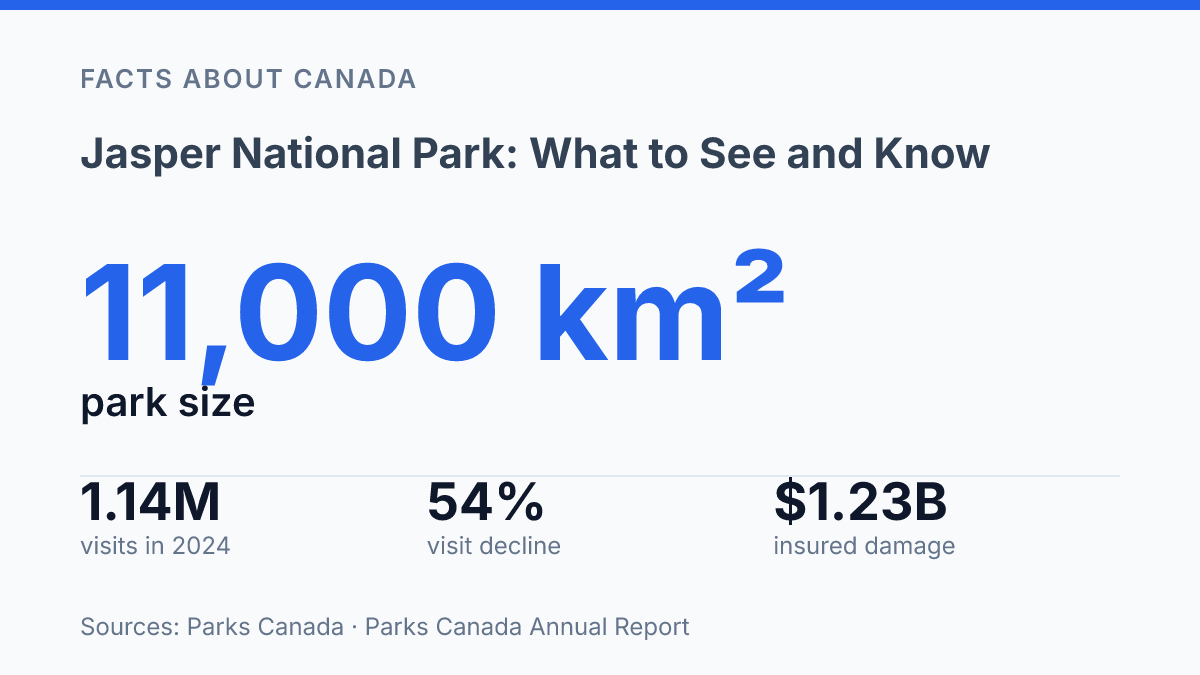
Jasper National Park covers more than 11,000 km², making it the largest national park in the Canadian Rockies, but its scale is now only part of the story. The July 2024 wildfire reshaped access, infrastructure, and expectations after lightning ignited three fires south of the townsite, forcing evacuations that affected about 5,000 residents and 20,000 visitors and seasonal workers.
Park visitation fell from 2,482,818 in 2023 to 1,135,410 in 2024, a decline of roughly 54%, which shows how sharply the event disrupted travel and local operations. Understanding Jasper today means reading the map and the recovery notices together: the Icefields Parkway still links Lake Louise and Jasper across 232 km, wildlife remains central to the park experience, and seasonal choices vary widely as campgrounds reopen while some roads and trails remain closed.
Where the park is and why it matters
At over 11,000 km², Jasper National Park is the largest national park in the Canadian Rockies, positioned in western Alberta 370 km west of Edmonton and 404 km northwest of Calgary, while the 232 km Icefields Parkway links Lake Louise with the town of Jasper, according to Parks Canada. That scale matters because the park is not a single scenic corridor but a broad protected mountain system, with river valleys, icefields, forests, alpine terrain, and wildlife habitat held within one federal conservation area.
Major places and wildlife to watch for
Spirit Island is one of the park’s most photographed places precisely because it is small, remote, and framed by the long glacial basin of Maligne Lake. The lake draws attention for its colour and scale, while nearby Maligne Canyon shows a narrower expression of the same water-shaped terrain through limestone walls and deep channels. Pyramid Lake, closer to the townsite, offers a gentler setting of forested shoreline and mountain reflections, making it one of the more accessible places to understand the park’s lake-and-peak character without travelling far into the backcountry.
Athabasca Falls is notable less for its height than for the force of water compressed through hard quartzite and limestone. The result is a compact, loud, and visibly erosive site where potholes, spray, and sculpted rock make river power easy to read at close range. Together with Maligne Lake, Spirit Island, and Pyramid Lake, it represents one of the core visual contrasts of the area: broad alpine-fed lakes, steep canyons, fast rivers, and open valley viewpoints often occur within the same travel day.
Wildlife viewing is closely tied to habitat rather than chance alone. Parks Canada identifies 53 mammal species in the park, but those animals are not distributed evenly across the terrain.
Valley floors and lower slopes tend to be the most visible places for elk, black bears, and sometimes moose, especially where meadows, wetlands, shrubs, and forest edges meet. Subalpine forests and avalanche paths support a different mix of movement and feeding, while alpine slopes and cliffs are more closely associated with mountain goats, which are adapted to steep, exposed ground.
Large mammals give the park much of its public identity, but they also require caution and realistic expectations. Grizzly bears and black bears may be seen from roads or trails, yet sightings are never guaranteed, and the same proximity that makes an encounter memorable can make it unsafe.
Elk can also become aggressive, particularly during calving or rutting periods, while moose are powerful animals that should not be treated as passive because they appear slow-moving. The most reliable wildlife experience is often not a close view, but an understanding of how each species fits into the park’s valley, subalpine, and alpine zones.
Things to do in each season
The same valleys that support the widest choice of trails and water activities in July can become quiet enough in winter for the night sky to be one of the main reasons to visit. Summer generally provides the broadest access window, with hiking, canoeing on cold mountain lakes, wildlife viewing from roadsides and open valley areas, and rides on the Jasper SkyTram all fitting into the season’s longer daylight hours. Even then, access is not automatic: lingering snow at higher elevations, storms, temporary closures, or service disruptions can change what is practical on a given day.
Spring is a transitional season rather than a smaller version of summer. Lower-elevation paths often become usable before alpine routes, while thawing ground, unstable snow, and wet trail surfaces can limit movement higher up. Wildlife observation and photography can be rewarding as animals move through valley areas after winter, but that same seasonal movement makes closures and non-approach behaviour especially relevant.
Autumn compresses the activity window but often improves conditions for quieter hiking, late-season paddling where launches remain open, and evening sky watching. Jasper was designated a Dark Sky Preserve in 2011 by the Royal Astronomical Society of Canada, and the annual Jasper Dark Sky Festival in October reflects that status through astronomy programming and public viewing events. The designation indicates a strong commitment to limiting light pollution; it does not guarantee clear skies, so cloud, moon phase, smoke, and weather still shape what can be seen.
Winter changes the park from a broad-access hiking destination into a more selective cold-weather area. Cross-country skiing and snowshoeing become the main trail-based activities where routes are open and conditions are suitable, while clear nights can offer stronger stargazing because darkness lasts longer and visitor numbers are lower. The tradeoff is constraint: snowpack, avalanche exposure, icy roads, reduced services, and seasonal closures can make winter planning more dependent on current reports than summer planning.
Practical details for visiting responsibly
The 2024 fire changed practical trip planning in Jasper from routine booking to checking recovery status before committing to specific roads, trails, or campgrounds. Natural Resources Canada reports that lightning ignited three fires on July 22, 2024, about 22 km south of the townsite, leading to evacuation orders affecting roughly 5,000 residents and 20,000 visitors and seasonal workers. Parks Canada later reported that 755 town structures were protected, about 30% of town structures were lost, and 255 agency infrastructure assets were destroyed or damaged, which explains why closures and advisories are part of normal trip preparation rather than a minor administrative detail.
Entry and overnight use are administered by Parks Canada, and visitors generally need a valid national park entry pass when entering or stopping in the park. Pass options include daily admission and the annual Discovery Pass, while campground reservations, backcountry permits, and commercial tour bookings are separate from park entry. This distinction matters because proof of admission supports park operations, visitor services, and recovery work, but it does not guarantee access to closed sites or roads.
Current conditions should be checked close to the travel date because recovery is uneven across the park. According to Parks Canada’s 2026 recovery update, 77% of pre-wildfire frontcountry campground inventory and all backcountry campground inventory were expected to be available in 2026, while Cavell Road and Maligne Canyon remained closed for the season. The same context is visible in visitation data: Jasper recorded 1,135,410 visits in 2024, down about 54% from 2023, according to Parks Canada’s annual reporting, showing how strongly the wildfire disrupted access and travel patterns.
Wildlife rules are also practical safety measures, not just conservation guidance. Parks Canada directs visitors to remain at least 100 m from bears and other carnivores and at least 30 m from large hoofed animals, and roadside wildlife viewing restrictions apply year-round where stopping creates risk. In frontcountry areas, food, garbage, toiletries, cooking gear, pet food, and scented products should be locked in a hard-sided vehicle, trailer, or wildlife-proof storage unit whenever they are not in active use.
In the backcountry, food and scented items belong in designated lockers, cables, or poles where provided, with waste packed out and cooking areas kept away from sleeping areas. These practices reduce the chance of animals receiving food rewards, which is central to both visitor safety and long-term wildlife protection.
What recovery changes about planning a visit
Jasper’s next visitor season will not be defined only by scenery or reopening dates. Parks Canada’s 2026 recovery schedule points to a park where access is returning unevenly: most frontcountry camping is expected back, backcountry inventory is scheduled to be available, yet places such as Cavell Road and Maligne Canyon remain closed.
That unevenness matters because the park is also managing sensitive wildlife habitat, including caribou ranges that cover about 86% of the protected area. The practical consequence is clear: a well-planned trip now depends on current Parks Canada notices as much as on weather, distance, and season.
Frequently Asked Questions
Q: What is the best time of year to visit Jasper National Park?
A: The most popular months are June through September, when roads, trails, and many visitor services are fully open. Summer offers the easiest access to lakes, viewpoints, and wildlife viewing, while winter brings different conditions for skiing, snowshoeing, and cold-weather scenery. Seasonal road closures and weather can affect access, so timing depends on the activities that matter most.
Q: How many days are needed to see Jasper National Park?
A: A short visit of two to three days can cover several major sights, but it leaves limited time for hiking and slower travel. Four to five days allows room for scenic drives, boat trips, and a few longer trails without rushing. Longer stays are useful for travellers who want to combine main viewpoints with less-visited areas.
Q: What are the must-see attractions in Jasper National Park?
A: Maligne Lake, Athabasca Falls, Pyramid Lake, and the Icefields Parkway area are among the most frequently visited sites. These locations show the park’s mix of glaciers, lakes, waterfalls, and mountain scenery in a relatively compact area. Wildlife viewing and short hikes also rank high for many visitors.
Q: Can wildlife be seen in Jasper National Park?
A: Yes, wildlife sightings are common, especially elk, deer, bighorn sheep, and sometimes bears or wolves. Early morning and evening usually offer the best chances, since many animals are more active then. Distance and caution are essential because feeding or approaching wildlife can be dangerous for people and animals.
Q: Do visitors need a park pass for Jasper National Park?
A: Yes, entry requires a Parks Canada pass for anyone stopping in the park, even for a short visit. Passes are typically available for daily or longer stays, depending on the length of the trip. The pass system helps support park maintenance, visitor services, and conservation work.