
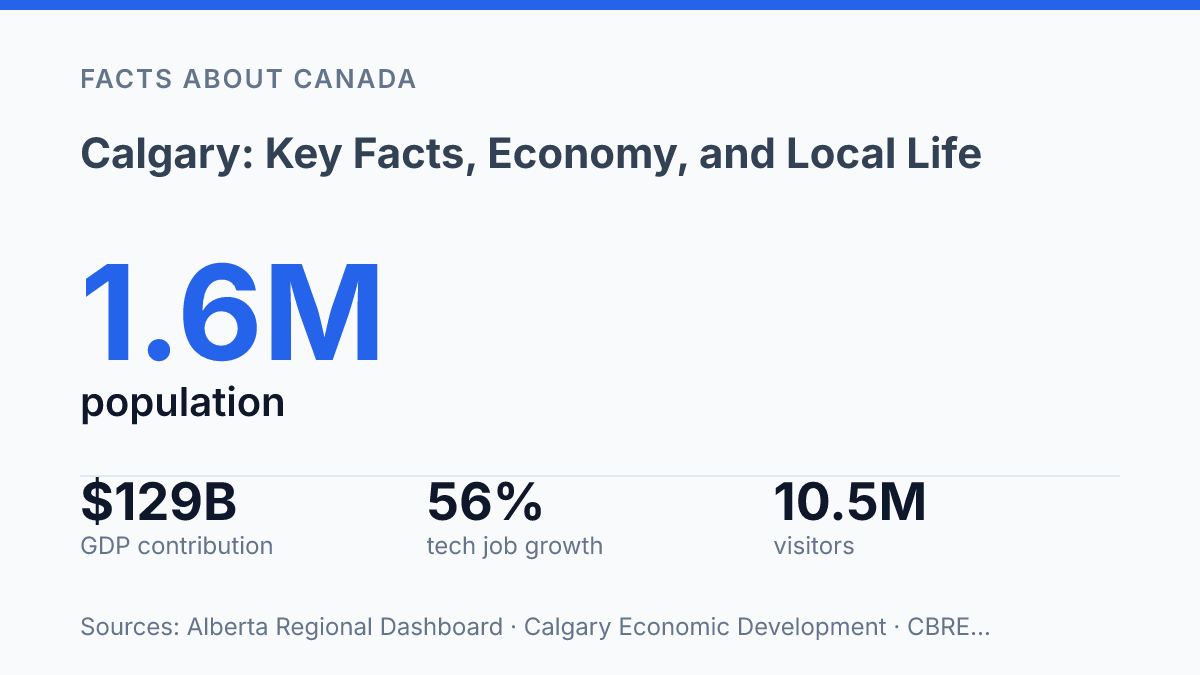
Calgary reached 1.6 million residents in 2025, a 19.4% increase over five years, which makes its growth the central fact behind its economy, housing market, transport network, and public services. The city is often associated with energy, ranching imagery, and the Stampede, but recent data points to a more complex urban economy: 221 head offices, 29,824 head-office jobs, and the fastest tech-job growth rate among 50 ranked North American markets from 2022 to 2025.
Its role also extends beyond business, with 10.5 million visitors recorded in 2025 and transit ridership rising sharply after the pandemic period. The useful way to understand the city is to connect location, employment, culture, weather, and everyday infrastructure, because each helps explain why growth is both an advantage and a source of pressure.
Where Calgary is and why it matters
Few Canadian cities combine prairie scale with mountain proximity as clearly as Calgary, which sits in southern Alberta at the meeting point of the Bow and Elbow rivers. The location gives the city a dual geographic character: it is part of the open plains of southern Alberta, yet it also sits within practical reach of the foothills and the Rocky Mountain corridor. That helps explain why the “prairie city” label is only partly descriptive; river valleys, western approaches, and metropolitan expansion all shape how the place functions.
The 2021 Census counted 1,306,784 residents in the central municipality of the Calgary census metropolitan area, placing it at the core of Alberta’s largest urban population. This makes it Alberta’s largest city and one of the principal urban centres in Western Canada, with a scale that affects provincial planning, labour markets, transportation networks, and public services. Its size also gives it national relevance beyond its provincial role, because large western metropolitan regions help anchor population growth outside Ontario and Quebec.
Recent population data show that this role is still expanding rather than stabilising. According to the Alberta Regional Dashboard, the local population reached 1.6 million in 2025, up 2.53% year over year and 19.4% over five years. Growth on that scale changes the meaning of the city’s geography: proximity to rivers, foothills, highways, and regional employment centres is not just descriptive, but part of why the metropolitan area continues to draw people and investment.
How the local economy is shaped
Head offices explain more of Calgary’s modern economy than its ranching image: in 2024, Statistics Canada counted 221 head offices employing 29,824 people in the city, compared with 2,635 workers in agriculture, forestry, fishing and hunting at the 2021 Census. That imbalance shows how strongly the local economy is organized around corporate management, finance, engineering, legal work, and specialized business services rather than primary production alone.
Energy remains the best-known anchor because many major oil and gas firms keep head offices or substantial operations in the city. Companies with a local presence include Suncor, Cenovus, Canadian Natural Resources, and Enbridge, alongside contractors, consultants, pipeline specialists, and engineering firms that serve the sector. This concentration gives the city a distinctive headquarters economy: decisions, capital planning, technical design, and professional advisory work often sit close together, creating demand for accountants, lawyers, geoscientists, software workers, and project managers.
The scale of that business base is visible in national output figures. The city contributed $129 billion to Canada’s GDP that year, according to the local economic development agency’s economic snapshot, making it one of the country’s major metropolitan economic engines. The same snapshot reported that 68% of the workforce had post-secondary education and 36% were immigrants, a combination that supports both corporate services and expanding knowledge-based work.
Diversification has become more measurable as technology, logistics, and tourism have grown alongside energy. CBRE’s Scoring Tech Talent report ranked the city first among 50 North American markets for tech-job growth rate, with tech employment up 56% from 2022 to 2025. Logistics also benefits from the city’s role as a distribution and freight-management centre, supported by rail, road, and air cargo connections.
Tourism adds a separate source of spending: the local tourism agency reported 10.5 million visitors in 2025 and $3.3 billion in visitor spending, up from $2.9 billion the previous year. The result is not a replacement of the energy base, but a broader job market in which corporate services, digital work, goods movement, and visitor spending reduce reliance on a single sector over time.
What daily life and culture look like
For ten days each July, the city’s most visible civic ritual turns western dress, rodeo events, midway crowds, concerts, and corporate hosting into a shared public calendar. The Calgary Stampede remains the clearest expression of the city’s ranching and frontier image, but its contemporary scale is also urban and international: the 2025 event drew just under 1.5 million attendees, and Statistics Canada reported higher U.S. and overseas air arrivals in the same month. That combination helps explain why the event functions as both cultural symbol and tourism engine rather than simply a local fair.
Neighbourhood life is more varied than the Stampede image suggests. Kensington, just outside the downtown core, is associated with smaller-scale retail streets, cafés, restaurants, and pedestrian activity that give it a village-like role within the larger city.
Inglewood, one of the older commercial districts, is known for independent shops, music venues, galleries, and heritage buildings, so it often represents continuity between older urban fabric and newer creative businesses. Downtown has a different rhythm, shaped by office towers during the workday and by restaurants, performance spaces, hotels, and event venues outside business hours.
Cultural institutions reinforce that split identity between western heritage and a modern arts scene. The Glenbow provides a major home for art, historical collections, and public exhibitions, while Studio Bell, home of the National Music Centre, places music history, performance, and recording culture in a prominent East Village building.
Arts Commons supports theatre, orchestral music, dance, festivals, and touring productions, making the central district more than an employment zone. These venues matter because they make cultural life less dependent on one annual event and give residents year-round access to formal arts programming.
The result is a civic culture with two strong signals that do not always speak to the same audience. Western branding remains highly visible in July and in visitor marketing, yet everyday cultural life is also shaped by neighbourhood dining, live music, contemporary exhibitions, and downtown performance spaces. The city’s public identity is strongest when those elements are understood together rather than treated as competing descriptions.
Weather, transport, and practical living conditions
A winter week can move from deep cold to slushy streets within hours when chinook winds spill over the foothills. The city’s dry continental climate brings cold winters, warm summers, low humidity, and large temperature swings, while chinooks can raise temperatures quickly enough to change road conditions, clothing choices, and outdoor maintenance routines in a single day. That variability is a practical feature of local life rather than an occasional anomaly: winter planning often has to account for snow, ice, thawing, and refreezing in close succession.
Climate adaptation is becoming a more visible part of everyday planning as hotter summers become more likely. The City’s 2024 Climate Projections report estimates that days of 29°C or higher could rise from a historical average of 6.8 per year to a median of 26.5 days per year by the 2050s. This does not remove winter as the dominant seasonal constraint, but it broadens the practical concerns for housing, shade, cooling, public health, and outdoor work.
Public transport is anchored by Calgary Transit, which operates buses and the CTrain light rail system across major corridors. According to the City mobility report, transit ridership increased from 57 million trips in 2022 to 101.1 million in 2024, showing a strong return of demand after earlier disruptions. Rail service is most useful for trips aligned with its corridors, especially downtown-oriented travel, while bus coverage remains essential for neighbourhood access and cross-town movement not served directly by light rail.
Regional access adds to the city’s practical livability without turning daily life into a tourist itinerary. The Rocky Mountains are close enough to support regular weekend recreation and seasonal outdoor activities, while Calgary International Airport provides a major air link for domestic and international travel. For residents and newcomers, those connections matter in ordinary ways: family visits, work travel, freight movement, and access to nature all sit within reach of the urban base.
Housing conditions are another practical measure of livability, and the rental market shows easing with clear unevenness. The City housing trends page reported that the rental vacancy rate rose from 4.6% in 2024 to 5.1% in 2025, but availability was higher in the top rent quartile at 6.7% than in the lowest rent quartile at 4.4%. That split suggests that choice may improve faster for higher-cost units than for the most price-sensitive renters.
What the next phase of growth will test
The next phase of growth will be judged less by headline population gains than by how evenly the city absorbs them. A larger labour pool, stronger tourism base, and expanding technology sector can widen opportunity, but they also raise the cost of weak planning around housing, transit, heat adaptation, and public services.
The most practical reading of the evidence is that scale has become the city’s defining condition. If rental vacancies ease mainly at the higher end of the market, or if transit demand keeps rising faster than capacity, growth will feel uneven even when the economic indicators remain strong.
Frequently Asked Questions
Q: What is Calgary best known for?
A: Calgary is best known as a major city in southern Alberta with a strong energy sector, a large business services base, and close access to the Canadian Rockies. It also has a prominent cultural identity shaped by annual events, outdoor recreation, and a fast-growing metropolitan area.
Q: How big is Calgary compared with other Canadian cities?
A: Calgary is one of Canada’s largest cities by population and economic output, which gives it a regional role well beyond municipal boundaries. Its metro area supports a broad labour market and attracts migration from other parts of Canada and abroad.
Q: What drives Calgary’s economy?
A: Energy remains a central part of Calgary’s economy, especially corporate headquarters, finance, engineering, and related professional services. The city has also expanded into technology, logistics, construction, and health services, which has made the economy more diversified than in previous decades.
Q: What is daily life like in Calgary?
A: Daily life in Calgary is shaped by a mix of urban neighbourhoods, suburban growth, and strong participation in outdoor activities. The city’s infrastructure, parks, and access to nearby natural areas influence commuting, housing patterns, and leisure time.
Q: Is Calgary a good place to live and work?
A: Calgary is often viewed as an attractive place to live and work because it combines a large job market with relatively easy access to recreation and family-oriented neighbourhoods. Employment prospects can be strong, but housing costs, winter weather, and sector-specific job volatility remain practical considerations.