
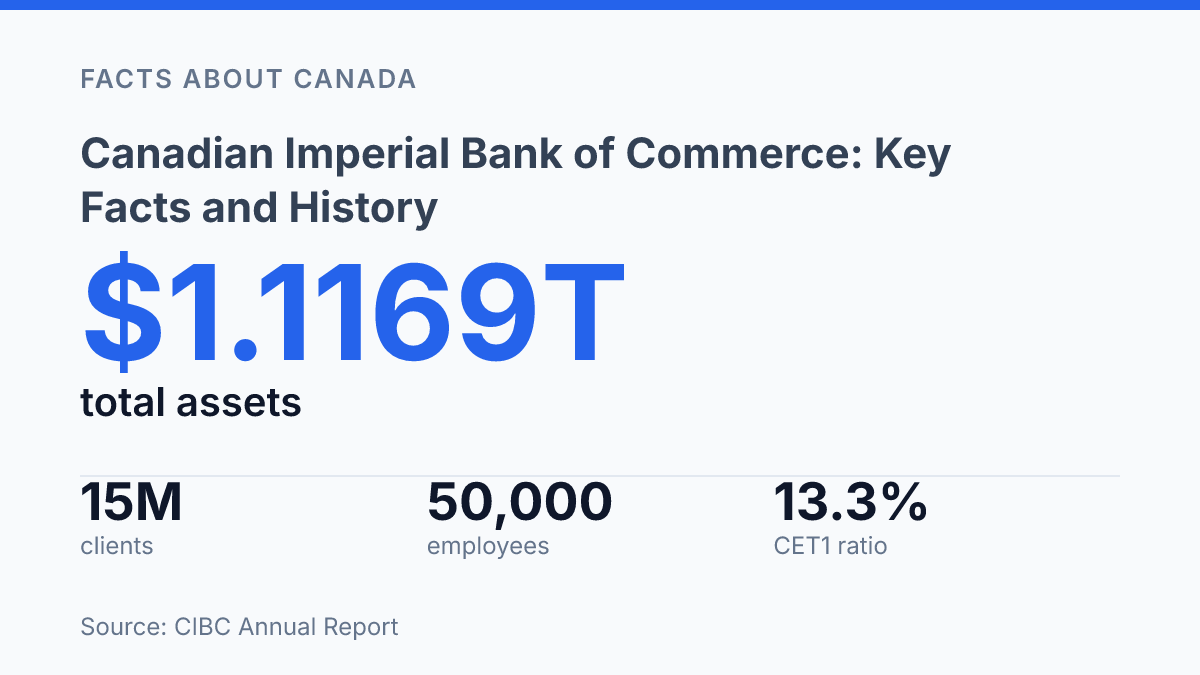
The Canadian Imperial Bank of Commerce ended fiscal 2025 with $1.1169 trillion in assets, placing it among Canada’s largest financial institutions by balance-sheet scale. Its present form dates to a 1961 amalgamation, but one of its predecessor banks, The Canadian Bank of Commerce, opened in 1867, the same year as Confederation. That combination of historic roots and modern scale makes CIBC a useful case study in how Canadian banking developed from regional branch networks into nationally regulated, globally connected financial groups.
The bank’s head office at 81 Bay Street in Toronto’s CIBC Square places it within the country’s main financial district, while its 15 million clients span personal banking, business, public-sector, institutional, and cross-border markets. The key facts behind CIBC show not only what the bank is, but why its lending, deposits, wealth operations, and regulatory status matter.
What CIBC is and where it is headquartered
CIBC’s official head office is not a symbolic downtown address but a specific tower complex at 81 Bay Street in Toronto’s Financial District. The institution is a Canadian multinational banking and financial services corporation, with its central corporate base at CIBC Square, a major office development beside Union Station and close to the core of Canada’s capital markets activity.
The current corporate brand is CIBC, while the full legal name remains Canadian Imperial Bank of Commerce. That distinction matters because the shorter brand is used in most customer-facing, investor-facing, and public communications, whereas the legal name identifies the incorporated bank in formal documents and regulatory filings.
CIBC’s current head office is 81 Bay Street, CIBC Square, Toronto, Ontario, M5J 0E7, according to its 2025 SEC Form 40-F filed for the fiscal year ended October 31, 2025. The location reinforces the bank’s close association with Toronto’s Financial District, but the institution should not be understood as only a Toronto bank. Its corporate base is in the city, while its operations extend across Canada and into international markets through a multinational banking structure.
How the bank grew into a major Canadian lender
The 1961 amalgamation gave CIBC a scale that neither predecessor could have matched alone, combining two established lenders at a moment when Canadian banking was becoming increasingly concentrated. According to CIBC’s 2025 Annual Information Form, Canadian Imperial Bank of Commerce was created through the merger of The Canadian Bank of Commerce and Imperial Bank of Canada. The Canadian Bank of Commerce had opened in 1867, while Imperial Bank of Canada was incorporated in 1875, so the new institution brought together nearly a century of accumulated banking relationships, branch networks, and commercial lending experience.
This merger fit a wider pattern in Canadian finance: large banks expanded by building national branch systems and, at key moments, by combining with other institutions. Canada did not develop a banking system dominated by thousands of small local banks to the same degree as the United States; instead, a smaller group of federally regulated banks came to serve customers across provinces. That structure helped major lenders gather deposits from a broad base and allocate credit across regions, industries, and households.
Scale strengthened CIBC’s position as a national lender, but it also placed the bank in direct competition with a compact group of powerful peers. For decades, CIBC has been counted among Canada’s major banks alongside Royal Bank of Canada, Toronto-Dominion Bank, Bank of Nova Scotia, and Bank of Montreal. In that setting, size supports brand recognition, funding capacity, and resilience, while competition remains intense because the leading institutions often serve overlapping customer groups.
The result is a bank whose modern importance rests less on one founding moment than on the consolidation of long-established franchises into a large national platform. Its 1961 formation explains why CIBC entered the late twentieth century with the breadth expected of a major Canadian lender rather than the narrower reach of a regional institution. In a market dominated by six domestic systemically important banks, that early scale remains central to how CIBC is understood today.
Main business lines and customer base
Its largest reported operating segment in fiscal 2025 was Canadian Personal and Business Banking, not the more visible investment-banking arm. In its 2025 Annual Report, CIBC reported $12.031 billion of revenue from that segment, reflecting the central role of everyday banking, deposits, mortgages, credit cards, and small-business relationships in its earnings base. The same filing showed average loans and acceptances of $336.9 billion in the segment, indicating that household and smaller enterprise lending remain core to the bank’s operating model.
The bank’s main activities are organized around personal banking, business banking, wealth management, and capital markets. Personal banking serves retail customers through deposit accounts, residential lending, cards, and related financial services. Business banking covers small businesses and commercial clients that need operating accounts, credit, cash-management services, and financing.
Wealth management adds investment advice, private wealth, asset management, and administration services for individuals and institutions. Capital markets serves corporate, government, and institutional investors through activities such as advisory work, underwriting, trading, lending, and risk-management services.
Scale helps explain why these activities are treated as interconnected rather than separate businesses. As of October 31, 2025, the bank reported $1.1169 trillion in total assets and $808.1 billion in deposits, according to its 2025 Annual Report.
It also described its customer base as 15 million personal banking, business, public-sector, and institutional clients across Canada, the United States, and global markets, supported by 50,000 employees. Those figures place the bank’s retail and commercial operations alongside a large wealth and institutional platform rather than a narrow domestic branch-banking franchise.
This diversified structure can spread exposure across interest income, lending growth, advisory fees, asset-management revenue, and market-related activity. The same mix also means results are sensitive to more than one economic variable: interest-rate changes affect margins and borrower demand, credit quality affects loan losses, and capital markets revenue can rise or fall with issuance, trading volumes, and investor confidence. The customer base is therefore broad, but the bank’s performance still depends on conditions in household finance, business borrowing, investment markets, and institutional activity at the same time.
Why CIBC matters in Canadian banking
OSFI’s 2026 capital guideline places domestic systemically important banks such as CIBC under a 1% CET1 capital surcharge, a signal that its stability is treated as relevant to the wider financial system. Within Canada’s big-five banking group, CIBC is large enough to influence pricing, credit availability, and service standards in major product categories, but it operates in a peer set where scale and long-established customer relationships are common rather than exceptional. That combination makes its role significant without making it singularly dominant.
Its national relevance is visible in the mix of activities that connect it to households, businesses, and investors. At October 31, 2025, CIBC held $287.0 billion in residential mortgages, $21.6 billion in credit-card loans, and $237.4 billion in business and government loans, according to its audited consolidated financial statements. In wealth management, the bank reported $597.2 billion in assets under administration and $317.1 billion in assets under management, giving it a material role in investment advice, portfolio administration, and retirement-related financial planning.
The bank’s presence at CIBC Square in Toronto’s Financial District also reinforces its corporate prominence. The location places the institution within the country’s main concentration of banking, insurance, securities, and professional-services firms, which reflects how closely major Canadian finance is tied to Toronto’s institutional core. For CIBC, the symbolism is practical as well as visual: its brand, executive centre, capital-markets relationships, and national banking operations are linked to the same financial hub that anchors much of Canada’s banking sector.
What scale means under Canadian banking rules
CIBC’s significance is likely to be measured less by age alone than by how well a large balance sheet performs under stricter expectations for major banks. Its designation as one of Canada’s six domestic systemically important banks means that growth, lending concentration, capital strength, and liquidity are public-interest issues as well as business metrics.
The 2026 OSFI capital framework, including a 1% CET1 surcharge for D-SIBs, gives that status practical weight. With a reported 13.3% CET1 ratio and 132% liquidity coverage ratio in fiscal 2025, CIBC enters that framework from a position that can be evaluated in concrete regulatory terms rather than reputation alone.
Frequently Asked Questions
Q: What is Canadian Imperial Bank of Commerce known for?
A: Canadian Imperial Bank of Commerce is a Canadian multinational banking and financial services corporation. It is known for offering retail and commercial banking, wealth management, and capital markets services across Canada and in selected international markets. Its scale and diversification make it one of the country’s major financial institutions.
Q: Where is CIBC headquartered?
A: Canadian Imperial Bank of Commerce is headquartered at CIBC Square in Toronto’s Financial District. The location places its main offices in one of Canada’s core financial centres. That headquarters reflects the bank’s long-standing role in the national banking sector.
Q: Is CIBC only a Canadian bank?
A: No. Canadian Imperial Bank of Commerce is Canadian-based, but it operates as a multinational financial services corporation. That means it serves clients beyond Canada through international banking and business activities, although Canada remains its primary market.
Q: What type of services does CIBC provide?
A: Canadian Imperial Bank of Commerce provides a broad mix of banking and financial services. These generally include personal and business banking, wealth management, and markets-related services. The range of services allows the institution to serve both everyday consumers and larger commercial clients.
Q: Why is Canadian Imperial Bank of Commerce considered one of Canada’s major banks?
A: Canadian Imperial Bank of Commerce is considered a major bank because of its size, national presence, and diversified operations. Its headquarters in Toronto’s Financial District also places it among the country’s most prominent financial institutions. The combination of retail banking and broader financial services supports that status.