
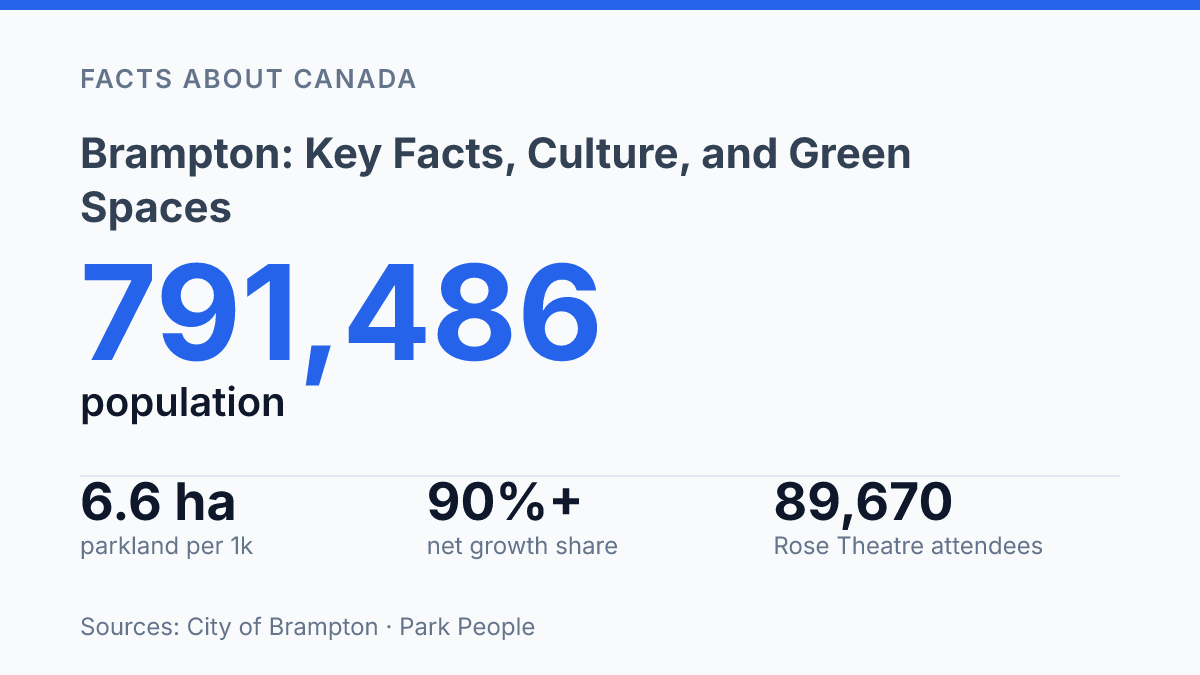
Brampton is not a minor satellite of Toronto; in 2024 the city estimated its population at 791,486, making it Canada’s seventh-largest city and the second-largest in the Greater Toronto Area. That scale changes how its cultural venues, heritage sites, and open spaces should be read: not as local extras, but as infrastructure serving a fast-growing urban centre. From 2016 to 2021, the city absorbed over 90% of Peel Region’s net population growth, placing unusual pressure on downtown institutions and neighbourhood public space.
The Rose, Garden Square, the Peel Art Gallery, Museum and Archives site, major parks, gardens, and registered historic homes together show how civic identity is built through use, preservation, and access. The central question is not only where these places are, but how they help a rapidly expanding city remain legible.
Where Brampton sits in the Greater Toronto Area
Brampton is not a small satellite of Toronto: in 2024, it was Canada’s 7th-largest city, Ontario’s 3rd-largest, and the 2nd-largest in the Greater Toronto Area, with an estimated population of 791,486, according to the City of Brampton, 2026/current page. That scale matters because it places the city among the country’s major urban municipalities rather than only within the category of suburban growth around Toronto.
Geographically, the city sits in southern Ontario within the Greater Toronto Area, the metropolitan region anchored by Toronto and shaped by closely linked labour, housing, transportation, and cultural networks. Its position gives it strong commuter and economic ties to the wider region, but those ties do not fully describe its role. A population of this size creates demand for local civic institutions, public spaces, employment areas, and cultural infrastructure within the city itself.
Within Peel Region, it is one of three local municipalities, alongside Mississauga and Caledon. This regional setting helps explain its mixed identity: Mississauga forms a large urban neighbour to the south, Caledon provides a more rural and small-town counterpoint to the north, and Brampton occupies a dense, fast-growing middle position between them. The result is a municipality often discussed through the language of GTA commuting, yet increasingly understood through its own demographic weight and civic centre.
That distinction provides the geographic frame for the city’s cultural and green-space assets. Its downtown core is not simply a stop within a larger metropolitan orbit; it functions as a local reference point for government, gathering, and identity within one of Canada’s larger cities by population.
Arts and heritage sites downtown
Nearly 89,670 people attended The Rose Theatre in 2024, a figure from the city’s 2026 adopted budget that shows the downtown venue functions as more than an architectural landmark. As the city’s major performing arts venue, The Rose anchors concerts, theatre, comedy, community presentations, and touring productions in a central civic setting. Its projected rise to 100,000 attendees by 2026 also indicates that demand for live cultural programming is being treated as part of regular public infrastructure rather than as an occasional downtown attraction.
Garden Square extends that cultural activity outdoors in front of the theatre. Opened with The Rose in 2006 and later revitalized in June 2015, the square includes a 24 ft by 14 ft LED screen and hosts seasonal programming from May to September, including big-screen movies and live events. Attendance has been smaller than at the theatre but rising, from 4,638 in 2022 to 5,640 in 2024, according to the city budget, which suggests a public space that is still building its audience through repeat programming and visibility.
Peel Art Gallery, Museum and Archives adds a different form of cultural weight because it connects art, local history, and archival records in one downtown institution. Its setting across 19th-century and contemporary buildings gives the site a physical contrast between preserved heritage and modern civic use. A 2026 city news release described the complex as 60,879 square feet, with 14,000 recorded artifacts, 29,000 archaeological objects, and 6,200 art-gallery pieces, making it one of the downtown core’s most substantial cultural assets.
The district’s heritage value is strongest when these institutions are active rather than simply preserved. Historic buildings and prominent civic architecture provide identity, but performances, screenings, exhibitions, and public gatherings explain why the area continues to matter in everyday public life and visitor appeal.
Parks, gardens, and historic homes
Park People’s 2024 Canadian City Parks Report found 6.6 hectares of parkland per 1,000 people in the city, the second-highest level among Canadian municipalities with more than 500,000 residents. The same report found that parks accounted for 16.1% of municipal land area, the highest share in that large-city peer group. Those figures help explain why local green space is not only a background amenity but a visible part of the city’s public life.
Gage Park is one of the clearest examples of that role because its floral gardens give a formal, maintained character to an everyday recreational space. Rather than functioning only as open lawn or passive parkland, it offers a landscaped setting associated with walking, sitting, seasonal visits, and civic gathering. Its appeal comes partly from this combination of ordinary use and ornamental design, which gives the park a recognizable identity within the city’s public spaces.
North of the centre, Historic Bovaird House adds a different layer to the green-space story by connecting landscape with preserved domestic architecture. The municipal heritage register identifies Bovaird House at 563 Bovaird Drive East as a circa-1852 two-storey Georgian-style house, designated under By-law #298-81 on December 14, 1981, and donated to the city in 1985. Although commonly presented as a Victorian home, its heritage value also reflects an older rural setting that predates much of the surrounding urban growth.
Taken together, Gage Park and Bovaird House show how recreation and heritage preservation can occupy the same civic category without serving the same purpose. One emphasizes public access to gardens and open space; the other preserves a built reminder of earlier settlement patterns. Their shared significance is that both broaden Brampton’s appeal beyond formal downtown cultural institutions by making history and landscape part of everyday local experience.
Why these places shape Brampton’s identity
No single landmark carries the city’s identity as clearly as the pattern formed by a theatre, an outdoor civic square, a public archive, a formal park, and a preserved nineteenth-century house. Downtown, The Rose Theatre, Garden Square, and PAMA make the centre more than a commercial or administrative district. They concentrate performance, public gathering, exhibitions, records, and heritage interpretation in a compact area, which gives the downtown experience a civic character rather than a purely retail one.
That concentration matters because each site represents a different kind of public life. The theatre anchors scheduled cultural activity, Garden Square turns open space into a shared event setting, and PAMA connects local history with art and archival memory. Taken together, they show how the city presents itself through institutions that are both public-facing and rooted in place.
Gage Park and Historic Bovaird House widen that picture beyond the city centre. The park places gardens, walking space, and seasonal use within the everyday rhythm of civic life, while the historic house preserves an older domestic and rural layer that would be less visible in a city defined only by growth and infrastructure. Their value is not simply that they are older or greener, but that they make continuity legible outside the main downtown cultural cluster.
The resulting identity is mixed rather than singular. The city is shaped by urban institutions that host performance, civic events, and collections, but also by green spaces and preserved heritage that slow the reading of the place down. This combination helps explain why its character cannot be reduced to one venue, one park, or one historic building; it rests on the relationship among them.
Where growth turns places into civic infrastructure
The next test for Brampton is less about whether it has recognizable landmarks than whether its public institutions can keep pace with the city they now serve. The planned January 1, 2028 transfer of the Peel Art Gallery, Museum and Archives to municipal ownership will place a major cultural collection more directly inside local civic planning.
Rising attendance at The Rose and Garden Square suggests growing public use, while the city’s high parkland ratio gives planners a rare asset in a region under development pressure. The practical consequence is clear: identity will be shaped not by preservation alone, but by how consistently these places remain funded, accessible, and connected to everyday city life.
Frequently Asked Questions
Q: What is Brampton known for?
A: Brampton is known as a city in Ontario’s Greater Toronto Area with a mix of cultural institutions and green spaces. Its arts profile includes the Rose Theatre downtown and the Peel Art Gallery, Museum and Archives, which spans 19th-century and contemporary buildings.
Q: What are the main attractions in downtown Brampton?
A: Downtown Brampton centres on the Rose Theatre, a major performing arts venue. In front of it, Garden Square hosts big-screen movies and live events, making the area a focal point for public gatherings and entertainment.
Q: Which parks and outdoor spaces are worth visiting in Brampton?
A: Gage Park is one of the city’s best-known green spaces and is noted for its floral gardens. It provides a central outdoor setting that contrasts with the more urban parts of the city.
Q: What can visitors see at the Peel Art Gallery, Museum and Archives?
A: The Peel Art Gallery, Museum and Archives brings together art, local history, and archival material in one site. Its location in both 19th-century and contemporary buildings also reflects the city’s blend of heritage and modern development.
Q: Are there any historic buildings to visit in Brampton?
A: Historic Bovaird House is a Victorian home located to the north of the city and is one of Brampton’s notable historic sites. It offers a glimpse into the area’s architectural past alongside the city’s newer cultural venues.