
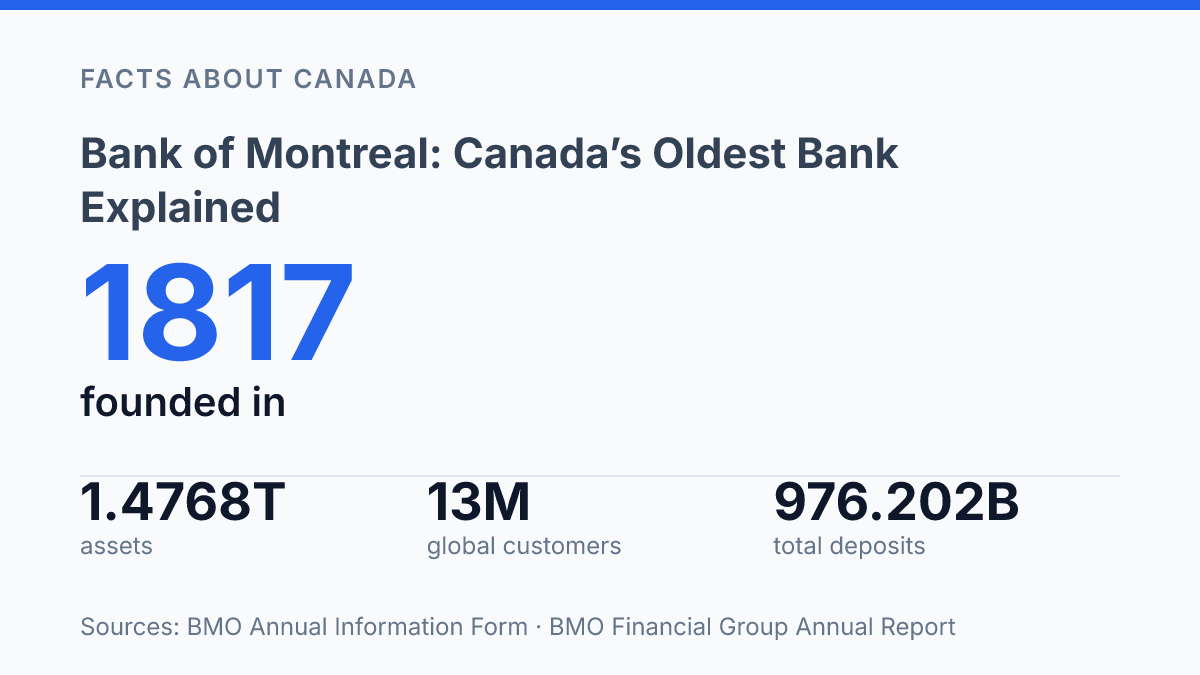
Bank of Montreal began operating in 1817, four years before its 1821 charter made it Canada’s first chartered bank; in 2025, the same institution reported C$1.4768 trillion in assets and about 13 million customers globally. That span is not just a longevity claim. It links early Canadian banking law, modern deposit gathering, wealth management, capital markets and cross-border expansion into one institution now ranked among North America’s largest banks by assets.
The scale is also visible outside BMO’s own reporting: Forbes placed the bank at No. 84 on its 2023 Global 2000 list, with US$858 billion in assets and US$62.5 billion in market value. Understanding BMO means looking at both sides of the record: the legal and commercial origins of a Canadian banking pioneer, and the present-day financial company built through deposits, lending, investment services and U.S. expansion.
How Montreal Bank began in 1817
The institution now known as BMO began 50 years before Canadian Confederation, under the simpler name Montreal Bank. It was founded in 1817 in Montreal, Quebec, at a time when formal banking institutions in British North America were still limited and closely tied to local commerce.
Source: BMO Annual Information Form.
What BMO does as a financial company
BMO’s scale is not just branch banking: for fiscal 2025 it reported C$1.4768 trillion in assets, according to BMO Financial Group’s 2025 annual report. BMO is the common abbreviation for Bank of Montreal, and the company is classified as a Canadian multinational investment bank as well as a broader financial services group. That dual description matters because it points to both geography and function: the institution is Canadian-based, operates across borders, and serves clients whose needs range from everyday banking to capital markets advice and financing.
The bank’s current structure shows how wide that role has become. In its Q2 2026 filing, BMO described four main operating segments: Canadian Personal & Commercial Banking, U.S. Banking, Wealth Management, and Capital Markets, with Corporate Services reported separately. This mix places household and small-business banking alongside activities designed for corporations, institutions, governments, and investors.
Investment banking and retail-style banking are related but not identical lines of business. Retail and personal-commercial banking usually centers on deposits, loans, payments, mortgages, credit cards, and services for individuals or smaller businesses.
Investment banking and capital markets work is more closely associated with corporate finance, securities issuance, advisory work, trading, and market access for larger organizations. Wealth management sits in another adjacent category, focused on investment administration, portfolio services, and financial planning for clients with investable assets.
Because a large financial group can operate across all these areas, its identity cannot be reduced to a branch network or to investment banking alone. The boundaries also vary by market and business unit: a commercial client may need deposit services in one context, foreign exchange or treasury support in another, and capital markets advice as it grows. BMO’s financial services role is therefore best understood as a diversified banking model that connects personal banking, business banking, wealth services, and institutional finance under one corporate group.
How it ranked in Forbes Global 2000 in 2023
BMO placed 84th among public companies worldwide on Forbes’s 2023 Global 2000 list, putting the Canadian bank inside a small group of firms with very large international scale. According to Forbes, the ranking associated BMO with US$37.6 billion in sales, US$8.29 billion in profit, US$858 billion in assets, and US$62.5 billion in market value. Those figures matter because they place the institution alongside the world’s largest listed companies rather than only within a national banking comparison.
The Forbes Global 2000 is a composite ranking, not a single-measure league table. It assesses public companies using four broad indicators: sales, profits, assets, and market value.
This structure gives the list a wider lens than rankings based only on revenue or market capitalization, which can favor different kinds of companies depending on their industry. For a bank, the inclusion of assets is especially relevant because balance-sheet scale is central to financial intermediation, while profit and market value add information about earnings and investor valuation.
A high position on the list signals size, visibility, and market presence, but it should not be read as a complete judgment of financial strength. Composite rankings cannot fully capture credit quality, capital adequacy, liquidity, regulatory exposure, or the risk profile behind a bank’s balance sheet. The ranking is therefore best understood as a global scale benchmark: it shows that BMO was large enough to rank among the world’s major public companies, while leaving more detailed assessments to financial statements, regulatory filings, and risk disclosures.
Why its history still matters today
Few corporate brand claims are as compact as saying BMO has served customers for 208 years, as its 2025 annual report states. That longevity gives the bank a form of public identity that is not only historical but also commercial: the oldest-bank association helps distinguish it in a sector where many institutions offer similar core services and operate under similar regulatory expectations.
A long operating history can shape recognition by keeping the same institution visible across generations of customers, employees, investors, and public institutions. It can also support perceptions of continuity, because a bank that has operated through repeated changes in law, technology, monetary systems, and economic cycles carries an institutional memory that newer firms cannot claim in the same way. This does not mean age proves superior service, safety, or performance; it means the founding story remains a durable reference point for understanding how the bank presents itself.
Modern banking credibility still depends on current conditions rather than heritage alone. Regulation, capital strength, risk controls, earnings quality, customer service, and strategic execution matter more to day-to-day confidence than a founding date. In that context, history functions best as one layer of identity, while present scale supplies another: BMO’s 2025 annual report said it served approximately 13 million customers globally and was the seventh-largest bank in North America by assets.
The bank’s relevance also extends beyond Canada, which makes the historical identity less narrowly national than it might first appear. On February 1, 2023, BMO completed its acquisition of Bank of the West, adding nearly 1.8 million customers and more than 500 branches, commercial offices, and wealth offices, according to its SEC-filed press release. That expansion shows how an institution rooted in Canadian banking history can still operate as a cross-border financial group, with heritage supporting recognition while current operations define its ongoing significance.
Why the 1821 charter still matters on a modern balance sheet
The bank’s age matters less as a claim to prestige than as evidence of institutional continuity under changing financial systems. A charter granted in Lower Canada in 1821 now sits behind a group with nearly C$1 trillion in deposits, large business and government funding, a growing wealth platform and a wider U.S. presence after the Bank of the West acquisition.
That continuity does not remove modern risks from credit cycles, interest rates or regulation, but it helps explain why BMO is assessed differently from a newer financial firm. Its history is most useful when treated as context for scale: an early legal foundation that still shapes how the bank is trusted, regulated and measured.
Frequently Asked Questions
Q: When was the Bank of Montreal founded?
A: The Bank of Montreal was founded in 1817 in Montreal, Quebec, under the original name Montreal Bank. That founding date makes it Canada’s oldest bank.
Q: Is BMO the same as the Bank of Montreal?
A: Yes. BMO is the commonly used abbreviation for the Bank of Montreal. The name is used across its banking and financial services operations.
Q: What type of company is the Bank of Montreal?
A: The Bank of Montreal is a Canadian multinational investment bank and financial services company. Its business spans traditional banking as well as broader financial services.
Q: Why is the Bank of Montreal historically significant?
A: Its significance comes from its early founding in **1817**, which places it at the beginning of Canadian banking history. That longevity gives it a distinct place among the country’s financial institutions.
Q: How large is the Bank of Montreal compared with other global companies?
A: In **2023**, the company held the **84th** position in the Forbes Global 2000. That ranking indicates a substantial global corporate presence, not just a domestic one.