
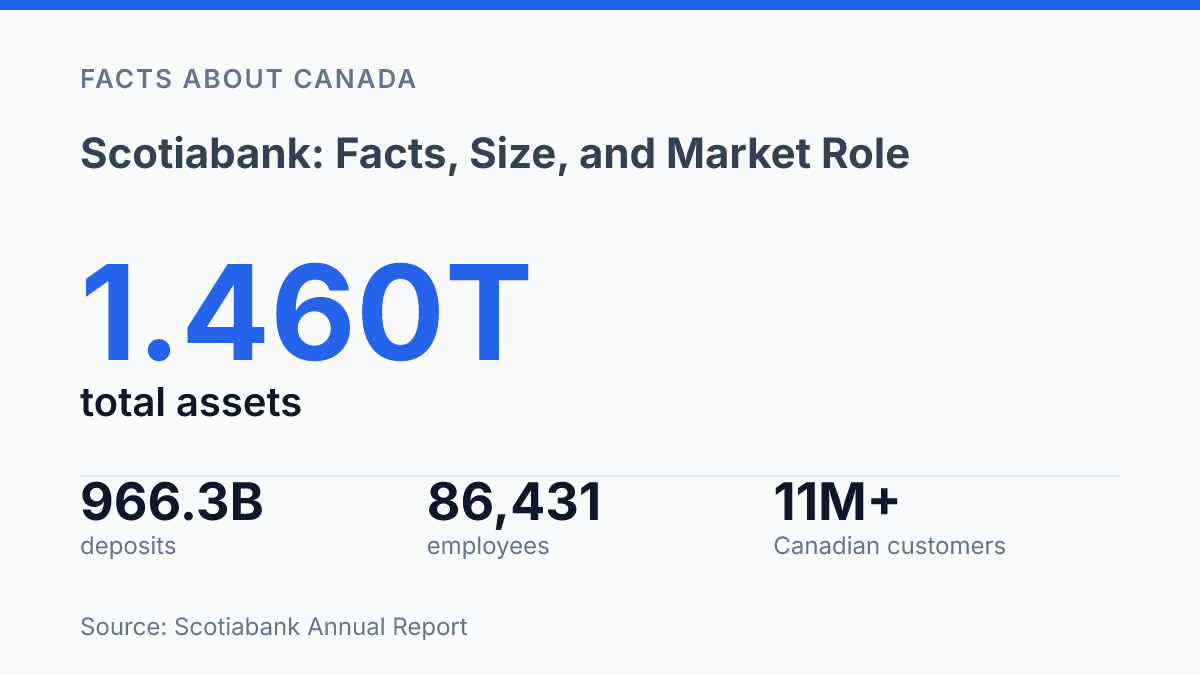
Scotiabank ended fiscal 2025 with C$1.460 trillion in assets, placing it just behind BMO’s C$1.477 trillion and making its rank among Canada’s largest banks closer than many simple lists suggest. The Bank of Nova Scotia is also unusual in a basic but often misunderstood way: its legal head office remains at 1709 Hollis Street in Halifax, while its executive offices and corporate headquarters operate from 40 Temperance Street in Toronto. Those details matter because size, location, and regulatory status each explain a different part of the bank’s role.
Its C$966.3 billion deposit base, more than 11 million Canadian Banking customers, and Forbes Global 2000 ranking of #102 in 2025 show an institution that is both domestic infrastructure and a global financial company. The key question is not only how large it is, but what that scale implies for Canadian finance.
What Scotiabank is and where it is based
A Canadian bank commonly identified with Toronto still has its legal head office in Halifax. The Bank of Nova Scotia operates as Scotiabank; in ordinary corporate description, it is headquartered in Toronto, Ontario, because its executive offices and corporate headquarters are located there. According to the Scotiabank, 2025 Annual Report, The Bank of Nova Scotia’s legal head office is at 1709 Hollis Street in Halifax, while its executive offices and corporate headquarters are at 40 Temperance Street, Toronto, Ontario.
That distinction is more than a technicality. The brand name is the one most customers, investors, and the public encounter, but the legal corporate name is the entity used in securities filings, regulatory materials, annual reports, and historical references. It also reflects the bank’s origins in Nova Scotia while recognizing that its senior corporate administration is centered in Canada’s largest financial hub.
The institution is a Canadian multinational banking and financial services company, meaning its corporate identity is domestic while its operations and market exposure extend beyond Canada. Within the Canadian system, it is counted among the country’s Big Five banks, the commonly used grouping for the largest and most influential national banking institutions. That status places the bank within the core of Canada’s financial system without requiring a discussion of relative size or international rank, which depends on separate measures such as assets, deposits, market value, or global index methodology.
How it ranks among Canada’s largest banks
A C$17 billion gap between BMO and the bank in fiscal 2025 shows why Canadian bank size rankings can move when measured by reported assets rather than by a broader market label. Recent fiscal 2025 disclosures placed Royal Bank of Canada at C$2.325 trillion in assets, TD Bank Group at C$2.095 trillion, BMO at C$1.477 trillion, and the bank at C$1.460 trillion, based on each institution’s latest annual financial reporting. On that asset-only snapshot, it ranked fourth, narrowly behind BMO, while still remaining in the top tier of Canadian banking by balance-sheet scale.
It is identified in baseline Canadian bank profiles as the third-largest Canadian bank by assets and the third-largest Canadian bank by deposits, behind the two larger peers, Royal Bank of Canada and TD Bank Group. That ranking conveys the bank’s domestic scale more clearly than a simple membership label because assets reflect the size of the balance sheet, while deposits show the extent of customer and institutional funding held by the bank. These measures are related, but they are not interchangeable, and rankings can differ when newer filings, fiscal year timing, or the selected metric changes.
As of October 31, 2025, the bank reported C$966.3 billion in deposits, up from C$943.8 billion a year earlier, according to its 2025 Annual Report. Deposits of that size indicate a large funding base across personal, commercial, and institutional banking activities, even without making claims about profitability or market share. The comparison with RBC and TD is therefore the most stable reference point: the bank sits behind Canada’s two largest banking groups, while remaining close enough to other major peers that its exact rank depends on the measure being used.
What its global ranking suggests
An 88th-place seat put Scotiabank inside the top 5% of the Forbes list of the world’s 2,000 largest public companies. In 2023, the bank held the 88th seat in the Forbes Global 2000, according to Forbes, which makes the ranking useful as an international reference point rather than a purely Canadian comparison.
The Forbes Global 2000 compares large listed companies worldwide using a composite view of sales, profits, assets, and market value. That structure matters because the ranking is not a direct league table of profitability alone. A bank can appear high on the list because it combines a large balance sheet, meaningful earnings, and public-market value, while another company with stronger margins but a smaller asset base may rank lower.
A top-100 position suggests scale that extends beyond a national banking profile. It indicates that the institution was large enough, across several business measures, to be grouped with major global corporations rather than only with domestic financial peers. For a bank, that usually reflects the breadth of lending, deposit-taking, capital markets activity, wealth management, or international operations captured in the data.
The ranking should still be read as a broad signal, not a full diagnosis of financial strength. It does not by itself explain asset quality, funding stability, operating efficiency, regulatory capital, or exposure to particular markets. Its main value is contextual: it shows that the bank’s size and market presence were significant on a worldwide public-company scale, while leaving more detailed judgments to financial statements and regulatory disclosures.
Why Scotiabank matters in Canadian finance
Systemic importance is the clearest reason the bank matters: the Office of the Superintendent of Financial Institutions lists the Bank of Nova Scotia among Canada’s six domestic systemically important banks, a regulatory category reserved for institutions whose distress could affect the wider financial system. On June 19, 2026, OSFI set the Domestic Stability Buffer for those banks at 3.0% of risk-weighted assets, underscoring that large Canadian banks are assessed not only as commercial enterprises but also as pillars of financial stability.
Its place among Canada’s Big Five gives that regulatory significance a market context. The group dominates core banking relationships across households, businesses, capital markets, and public-sector finance, so inclusion signals more than brand recognition.
In 2025, the bank’s Canadian Banking division served more than 11 million customers through 892 branches and 3,542 automated banking machines, according to its annual report. That scale helps explain why changes in its lending standards, deposit pricing, branch network, or risk appetite can be felt beyond its own balance sheet.
Toronto also anchors its Canadian role. With executive headquarters in the country’s main financial centre, the bank sits near major securities markets, institutional investors, regulators, law firms, accounting firms, and corporate head offices. This concentration matters because large-bank decisions in Canada are closely connected to capital formation, mortgage credit, business financing, and payment infrastructure.
The bank’s importance should not be read as purely domestic, however. Its multinational reach places Canadian banking activity inside a broader financial services operation, linking local deposits, lending, wealth management, and capital markets activity with operations outside Canada.
That combination is the key point: a major Canadian bank can be central to the national system while also being shaped by international earnings, risks, regulation, and competition. Domestic importance and global scale therefore reinforce each other rather than describing separate identities.
Why systemic importance changes the stakes
A bank of this size is measured not only by assets, deposits, or rank, but by how much ordinary financial activity depends on its continued stability. OSFI’s treatment of the Bank of Nova Scotia as one of Canada’s six domestic systemically important banks makes that point explicit: regulation assumes that its failure would carry wider consequences. The June 2026 reduction of the Domestic Stability Buffer to 3.0% also shows that systemic importance is not static; it is managed through changing capital expectations as conditions shift.
The practical consequence is clear: movements in the bank’s balance sheet, branch network, and global standing are not just corporate data points. They help indicate how risk, access, and confidence are distributed across Canadian banking.
Frequently Asked Questions
Q: How big is Scotiabank compared with other Canadian banks?
A: The Bank of Nova Scotia is one of Canada’s Big Five banks and ranks as the third-largest Canadian bank by assets and deposits. That position places it behind the two larger domestic peers while still making it a major national lender. Its scale gives it broad reach in retail banking, commercial banking, and wealth management.
Q: Where is Scotiabank headquartered?
A: Scotiabank is headquartered in Toronto, Ontario. The bank’s legal name is The Bank of Nova Scotia, and Scotiabank is the operating name used in the market. Its headquarters in Toronto reflects its role as a central institution in Canada’s financial sector.
Q: Is Scotiabank a Canadian bank?
A: Yes. Scotiabank is a Canadian multinational banking and financial services company. It is based in Canada but operates across international markets, which makes it more than a purely domestic bank. That international footprint is part of its business model and market role.
Q: What does Scotiabank’s Forbes Global 2000 ranking indicate?
A: In 2023, Scotiabank was ranked 88th in Forbes Global 2000. The ranking places it among the largest listed companies globally by a combination of financial measures, which signals substantial scale beyond Canada. It does not measure only bank size, but it is a useful indicator of overall corporate magnitude.
Q: What role does Scotiabank play in Canada’s financial system?
A: Scotiabank is a major participant in Canada’s banking system because it is one of the Big Five and the third-largest bank by assets and deposits. That scale supports a wide lending base and a significant presence in deposits, payments, and financial services. Its market role is therefore both systemic and competitive within Canadian banking.