
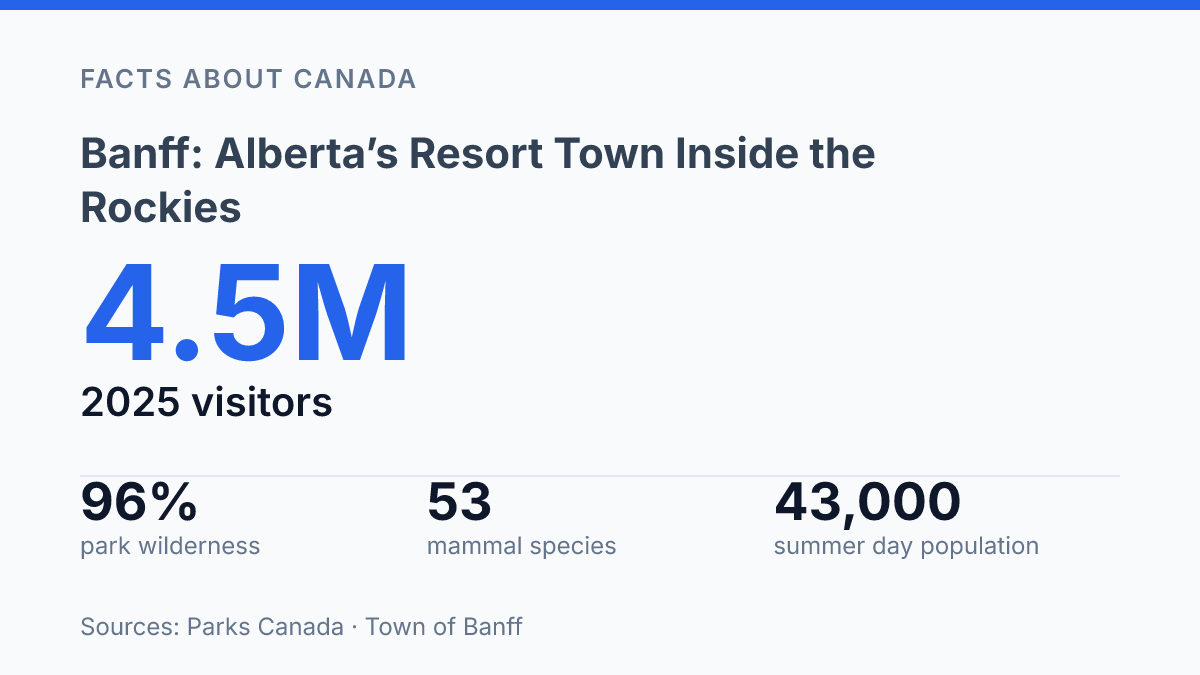
Banff occupies just 3.93 square kilometres inside a 6,641-square-kilometre national park, a scale contrast that explains much of the town’s character and tension. At 1,383 metres above sea level, the townsite is not simply a resort base surrounded by scenery; it is a concentrated urban pocket inside a protected area that Parks Canada records as 96% wilderness. That contrast became sharper in 2025, when the park received 4,515,168 visitors, up 7.14% from the previous year.
The result is a place where mountain views, commercial streets and wildlife habitat sit unusually close together. Understanding the town means reading several layers at once: its position within the park, the peaks that frame daily life, the role of Banff Avenue as a pressure point for visitors and residents, and the wider ecology that extends beyond the postcard image.
Where the town sits inside Banff National Park
A 3.93-square-kilometre townsite sits inside a protected mountain area more than 1,600 times larger. According to the town’s municipal profile, the townsite sits at 1,383 metres above sea level, while the surrounding national park spans 6,641 square kilometres, 96% of it classified as wilderness.
Banff is a resort town in Alberta, Canada, and it lies within Banff National Park, which covers about 6,500 square kilometres of protected land. That scale difference is central to the town’s identity: the built community is small and defined, while the park around it supplies the alpine setting, protected valleys, lakes, trails, and road access that make the place internationally recognizable.
Its position in the Canadian Rockies makes the town a gateway to mountain scenery and outdoor recreation rather than a standalone urban resort. Hotels, services, and streets are concentrated in the townsite, but the surrounding park determines much of what visitors come to see and do. This arrangement supports tourism and conservation at the same time, because access is focused through a compact community while the larger protected area remains subject to national-park limits.
The same protections that give the town its setting also constrain ordinary growth. Expansion cannot proceed in the same way it might in an unprotected municipality, so the town’s resort function depends on careful use of limited space inside a much larger conservation area.
Mountains that define the skyline
From many downtown sightlines, Mount Rundle appears as a long, slanting wall, while Mount Cascade rises more frontally above the valley, giving the town two very different mountain profiles within the same field of view. Together, Mt. Rundle and Mt.
Cascade dominate the skyline above the streets and hotel roofs, making the surrounding peaks part of the town’s daily visual frame rather than a distant backdrop. Both are part of the Rocky Mountains, and their prominence helps explain why the settlement is visually inseparable from its alpine setting.
The sense of scale comes partly from how close the mountains feel to the built environment. Parks Canada’s Mount Rundle scrambling guide lists the route’s elevation gain at 1,577 metres, and describes the ascent as following the mountain’s right-hand profile as seen from the town. That detail matters because it connects the familiar skyline shape to real vertical relief: the slopes seen from the streets are not decorative scenery, but steep terrain rising sharply above the valley floor.
This topography also shapes how the town is experienced at ground level. Long views down streets are frequently stopped or framed by rock faces, forested slopes, and ridgelines, so even ordinary commercial blocks sit within a much larger visual enclosure. The effect is a compressed sense of scale: buildings, sidewalks, and traffic occupy a narrow human layer, while the mountains provide the dominant proportions.
The same dramatic setting that gives the town its identity also narrows the practical space available for urban form. Steep slopes, valley geometry, and surrounding protected terrain concentrate development on limited lower ground, which helps explain why the built area feels compact and intensely framed. The skyline, in this sense, is not only scenic; it is one of the physical forces that defines where the town can exist and how it is perceived.
What Banff Avenue says about the town
On its busiest summer days, the 200 block of Banff Avenue carries 30,000–40,000 pedestrians, according to a 2024 municipal council report, a volume that makes the town’s main thoroughfare read less like a conventional local high street than a concentrated visitor economy.
Commercially, the avenue presents the town in compressed form. Boutiques and restaurants sit beside château-style hotels and souvenir shops, so daily commerce shares space with businesses designed around short stays, leisure spending, and keepsakes. That mix helps explain why the street serves two audiences at once: residents rely on the commercial core for work, errands, services, and social contact, while visitors encounter it as the easiest place to eat, shop, book activities, and orient themselves within the townsite.
Street management has become one way the town negotiates that dual role. Municipal records show that the 100 and 200 blocks were closed to vehicles on May 14, 2024, but residents later voted against making the summer pedestrian zone a recurring feature, with 1,328 No votes and 1,194 Yes votes. The result points to a practical tension rather than a simple divide: more pedestrian space can support foot traffic and patios, but downtown access also affects deliveries, mobility, commuting, and the routines of people who live or work nearby.
The economic value of a tourism-focused main street is measurable. During the 2023 summer pedestrian zone, 27 restaurants and cafes and 10 retailers participated, generating about $142,800 in sidewalk seating and retail display permit revenue, according to the town’s downtown pedestrian zone report. Those figures show how visitor demand can create jobs, street life, and municipal income, while also leaving the commercial core exposed to seasonal swings and changes in travel patterns.
Wildlife in the surrounding parkland
Elk grazing near valley edges and grizzly bears ranging through higher and lower habitats make wildlife presence one of the clearest markers that this resort community sits inside an active mountain ecosystem, not beside one. The surrounding parkland supports far more than the animals most often associated with postcards: according to Parks Canada, the protected area contains 53 mammal species, more than 311 bird species, 19 fish species, four amphibians, and one reptile. That breadth matters because large mammals, migratory birds, fish, and smaller species depend on connected habitats that extend well beyond the built townsite.
The protected area around the community stretches across thousands of square kilometres of valleys, forests, wetlands, alpine slopes, and river corridors. This scale gives wide-ranging animals such as grizzly bears the space needed for feeding, denning, seasonal movement, and genetic exchange, while also preserving habitat for species that are less visible but ecologically significant. Elk are especially noticeable because they can use open valley-bottom areas near human settlement, creating a visible reminder that the town occupies part of a broader wildlife range.
Wildlife is central to the area’s appeal, but its presence also explains why park management is unusually strong. A busy resort town concentrates people, roads, buildings, and services inside habitat used by animals that move according to food, season, and terrain rather than municipal boundaries. Careful management is therefore not an added layer to the visitor experience; it is part of what allows a heavily visited mountain town and a functioning protected ecosystem to coexist with reduced conflict.
Why scale should guide the next decisions
The resort town’s future will be shaped by how well small-area planning is matched to park-scale realities. A pedestrian block can change traffic patterns for a season, while a wildlife corridor or habitat rule can affect ecological movement for decades. Those timeframes do not carry equal weight, yet they meet on the same streets, trails and viewpoints.
Recent visitor counts make one point difficult to avoid: management cannot rely only on adding capacity where demand is most visible. It also has to protect the conditions that make the place function as part of a national park. The practical consequence is clear on the busiest summer days, when a townsite of 3.93 square kilometres must absorb resort-town expectations without becoming detached from the wilderness around it.
Frequently Asked Questions
Q: Where is Banff located in Canada?
A: Banff is a resort town in Alberta, inside Banff National Park. It sits in the Rocky Mountains, where the surrounding peaks shape much of the town’s setting and character.
Q: What makes Banff a resort town?
A: Banff combines visitor services with a compact mountain-town core. Banff Avenue brings together boutiques, restaurants, château-style hotels, and souvenir shops, which reflects its role as a tourism centre.
Q: Which mountains are most visible from Banff?
A: Mt. Rundle and Mt. Cascade are two of the most prominent peaks on the skyline. Both are part of the Rocky Mountains and form a defining visual backdrop for the town.
Q: How large is Banff National Park around the town?
A: The parkland around Banff covers 6,500 square kilometres. That scale gives the town immediate access to large protected areas rather than a small local park system.
Q: What wildlife can be seen near Banff?
A: The surrounding parkland is home to wildlife including elk and grizzly bears. Their presence is one reason the area is managed as protected habitat as well as a visitor destination.