
Ottawa became Canada’s capital after the Province of Canada moved its seat of government six times between 1841 and 1867, a record of instability that led Queen Victoria to choose a permanent capital in 1857. That decision was later fixed by the Constitution Act, 1867, with Parliament first assembling there on November 6 of that year. The result was not only a political compromise between rival colonial centres, but a city whose daily life is still shaped by federal land, institutions, employment, and ceremony.
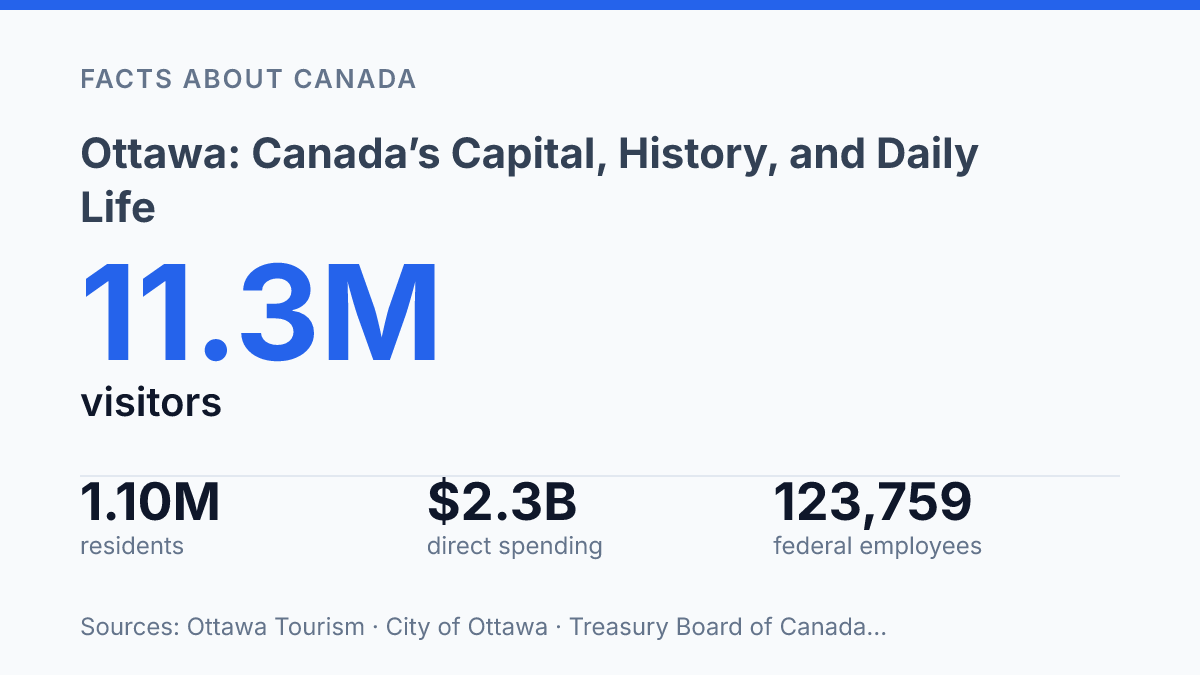
Its present scale adds another layer: the city reported 1,097,760 residents in 2024 across 2,796 km², making it both populous and geographically broad. Understanding the capital means reading these forces together, from Parliament Hill and federal workplaces to bilingual households, Indigenous communities, tourism, housing costs, and the practical conditions that define local life.
Why Ottawa became Canada’s capital
A capital that had moved six times between 1841 and 1867 became fixed only after Queen Victoria was asked in 1857 to choose a permanent seat: she selected Ottawa, the Constitution Act, 1867 later made it Canada’s seat of government, and Parliament first assembled there on November 6, 1867, according to Bank of Canada Museum, 2026; House of Commons. The decision answered a political problem as much as an administrative one. A permanent capital had to be acceptable to competing regional interests in the former Province of Canada, rather than appearing to favour one established colonial city too strongly.
Its position on the Ottawa River, where what is now Ontario meets Quebec, gave the choice a political and practical logic. The site sat between English-speaking and French-speaking regions, which helped it function as a compromise location in a country built around linguistic and provincial negotiation. It was also inland, a consideration that mattered in a century when security concerns still shaped public decisions and proximity to the United States could be viewed as a liability.
Parliament Hill turned that political selection into a durable administrative centre. By locating the legislature and core federal offices there, the capital concentrated the machinery of national government in one urban setting. Over time, that concentration encouraged departments, agencies, courts, diplomatic missions, archives, and ceremonial spaces to cluster nearby, making federal presence not just symbolic but operational.
This origin still affects how the city functions. The capital is not merely a place where national ceremonies occur; it is a working seat of government whose land use, employment patterns, security planning, and public architecture are shaped by federal needs. The 19th-century choice was rooted in geography and compromise, but its long-term effect has been to make the federal state one of the defining forces in the city’s daily life and economy.
Major institutions and civic landmarks
Few Canadian civic sites combine symbolic authority and public access as visibly as Parliament Hill, where the Peace Tower turns a working legislature into a national emblem recognizable far beyond the capital. Since 1927, the tower has served not only as a clock tower and skyline marker but also as a memorial space, with the Memorial Chamber linking federal ceremony to commemoration of wartime service. That combination helps explain why the precinct functions as both a seat of parliamentary business and a place of national ritual.
The federal presence extends well beyond the parliamentary precinct. The National Capital Commission says it owns or manages more than 11% of all land in the National Capital Region, including more than 1,600 properties and the six official residences. This scale matters because many civic landmarks are not isolated monuments; they form part of a planned federal capital district in which land, commemoration, ceremony, and public access are managed as national assets.
Cultural institutions give that public role a broader form. The National Gallery of Canada holds major collections of Canadian, Indigenous, and international art, making it a federal institution for visual culture rather than simply a local museum.
Across the river in Gatineau, the Canadian Museum of History performs a parallel function for historical interpretation within the same capital region. Their placement shows how the National Capital Region represents the country through culture as well as through government.
Several prominent sites in Ottawa express other branches and functions of national authority. Rideau Hall is the official residence and workplace of the governor general, so its grounds and ceremonial rooms are connected to honours, state visits, and constitutional duties.
The Supreme Court of Canada, west of Parliament Hill, gives the judiciary a visible institutional home as the country’s final court of appeal. Taken together, these landmarks show a capital defined by federal power, but not closed off by it: many of the same buildings and grounds also operate as public spaces for visitors, ceremonies, exhibitions, and civic memory.
Population, language, and local identity
Canada’s capital is not a small government town: the 2021 Census placed the municipality at 1,017,449 residents and the wider census metropolitan area at 1,488,307, according to Statistics Canada. That metropolitan figure matters because the capital functions as a cross-provincial urban region rather than as a single-city settlement. Municipal estimates have since put the city above 1.09 million residents, but the census remains the clearest national benchmark for comparing its scale with other Canadian urban centres.
Language is one of the main ways the capital differs from most provincial capitals. The city has official bilingual status, and English and French are both visible in municipal services, federal workplaces, public signage, cultural programming, and cross-river civic life.
Census evidence gives a more precise picture than the label alone: in 2021, 36.4% of residents reported knowledge of both official languages, while 60.6% reported English only, 1.4% French only, and 1.5% neither English nor French. This supports the city’s bilingual identity without implying that bilingualism is universal in daily conversation.
The relationship with Gatineau is central to that identity. Together, the Ontario and Quebec sides form the Ottawa–Gatineau census metropolitan area and sit within the wider National Capital Region, a planning and civic frame that reflects how employment, institutions, media, family ties, and public events often operate across the provincial boundary. Gatineau also strengthens the French-language presence of the metropolitan area, while the Ontario side remains predominantly English-speaking in many everyday settings.
Demographically, the city’s identity extends beyond the English-French frame. Statistics Canada counted 26,395 Indigenous residents in the municipality in 2021, representing 2.6% of the population, including First Nations, Métis, and Inuit residents.
This figure is modest as a share of the total population but significant in absolute terms, especially for a national capital whose public institutions increasingly acknowledge Indigenous histories, rights, and contemporary communities. The result is a local identity shaped by federal symbolism, cross-border metropolitan life, and uneven but highly visible bilingualism.
Economy, climate, and practical living conditions
The capital’s labour market is unusually anchored by one employer group: as of March 31, 2026, the National Capital Region had 123,759 federal public service employees, according to the Treasury Board of Canada Secretariat. That scale gives the local economy a steadier base than many similarly sized cities, because public administration sustains demand for office work, legal services, consulting, communications, translation, security, and procurement. The same dependence also means that federal staffing decisions, hybrid-work rules, and departmental budgets can be felt well beyond government workplaces.
Technology and education broaden that base rather than replacing it. The technology sector includes firms in software, telecommunications, defence, cybersecurity, and related professional services, with private-sector employment often linked to federal clients as well as global markets.
The University of Ottawa and Carleton University add a different kind of economic weight: they employ academic and administrative staff, attract domestic and international students, support research activity, and shape demand for transit, rentals, food services, and cultural programming. Their presence also affects the city’s population mix by drawing younger residents and short-to-medium-term migrants who may stay after graduation.
Winter is one of the clearest practical constraints on daily life. Environment and Climate Change Canada climate normals for the capital’s airport station put the January daily mean near -10 C, with average daily lows around -15 C; January snowfall averages about 54 cm, and the annual snowfall normal is roughly 175 cm.
Snow therefore functions as a routine operating condition, not an occasional disruption. Commuting times, sidewalk access, bus reliability, cycling choices, outdoor events, and school or workplace scheduling can all be affected by storm timing, freeze-thaw cycles, and snow-clearing capacity.
The physical scale of the municipality adds to those practical demands. The City’s 2024 annual report listed 6,043 km of roads, a reminder that winter maintenance covers a large urban and suburban network.
Housing costs also form part of the daily picture without defining the whole city: CMHC’s 2025 Rental Market Report placed the local purpose-built rental vacancy rate at 3.0%, with average two-bedroom rent at $1,926. The result is a city with relatively stable institutional employment, but everyday routines that are strongly shaped by season, distance, and the cost of securing suitable housing.
What the capital role changes on the ground
The capital role changes how ordinary civic questions should be interpreted. A housing figure, a transit debate, a winter maintenance budget, or a shift in office attendance does not sit only inside municipal policy; it often intersects with federal employment, National Capital Commission land, tourism cycles, and the symbolic demands placed on a national seat of government. That makes the city more dependent on coordination than many places of similar size.
The next phase will likely be measured less by new landmarks than by how well public institutions, employers, and housing systems adapt to population growth and changing work patterns. The practical consequence is clear: decisions made for the capital are also decisions made for a living city.
Frequently Asked Questions
Q: What is Ottawa best known for?
A: Ottawa is best known as Canada’s federal capital and the seat of national government. It is also recognized for its museums, parliamentary buildings, and bilingual public life. That combination gives the city both political importance and a distinct cultural profile.
Q: Is Ottawa a good city for families and newcomers?
A: Ottawa is often seen as a practical choice for families and newcomers because it combines public services, neighbourhood schools, and a comparatively steady labour market. The city also has a large public sector presence, which helps shape employment and civic infrastructure. Its size makes many amenities accessible without the scale and congestion of Canada’s largest metro areas.
Q: What is the climate like in Ottawa?
A: Ottawa has a four-season climate with cold winters, warm summers, and marked temperature swings between seasons. Snow and ice are common in winter, which affects commuting and outdoor activity. Summer months tend to support festivals, riverfront use, and more active city life.
Q: How does public transportation work in Ottawa?
A: Ottawa’s transit network is centred on buses and light rail, with service designed to connect suburban areas to the core. Transit performance can vary by route and time of day, so commuting patterns are a major factor in daily travel. The system matters because it shapes access to downtown jobs, schools, and services.
Q: What are the main things to see and do in Ottawa?
A: The city’s main attractions include Parliament Hill, national museums, and the Rideau Canal. These sites reflect both Ottawa’s governmental role and its historical development. Seasonal activities, especially skating on the canal in winter and festivals in warmer months, also shape the visitor experience.