
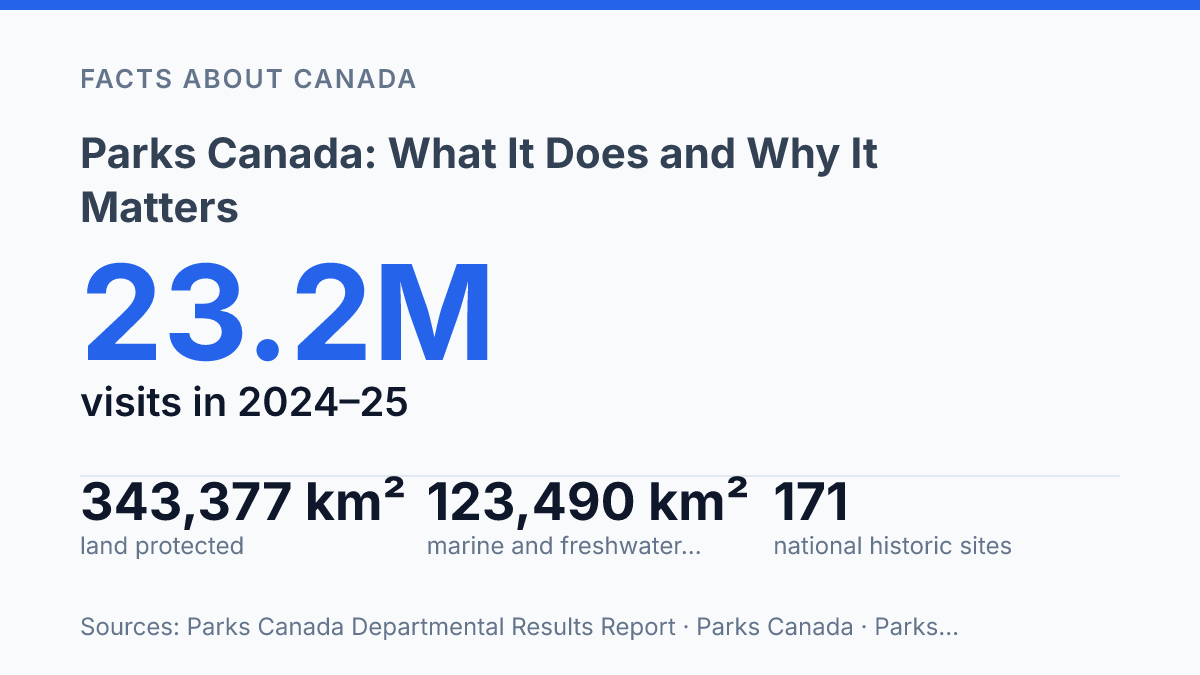
Parks Canada administers 171 national historic sites, 48 national parks, five national marine conservation areas, and one national urban park, a portfolio large enough to make the agency both a conservation manager and a custodian of public memory. Its footprint now includes about 343,377 km² of protected land and 123,490 km² of protected marine and freshwater ecosystems, yet its work is measured as much by condition as by size. In 2024–25, the agency recorded 23.2 million visits while also reporting that ecological integrity was maintained or improved in 80% of assessed national park ecosystems, below its 92% target.
Those numbers frame the central tension behind the agency’s mandate: protecting places that Canadians are also encouraged to visit, learn from, and share in governing. The article examines that mandate through management scope, access, partnerships, and the role of protected places in conservation and public memory.
What the agency manages across Canada
A single federal agency is responsible for places as different as Banff’s mountain ecosystems, a Norse archaeological site in Newfoundland, and a freshwater marine park in Georgian Bay. Created in 1911, Parks Canada is responsible for national parks, national historic sites, and national marine conservation areas, a mandate that joins ecological protection with stewardship of places connected to human history. That combination makes the agency’s estate broader than a parks system in the narrow recreational sense.
As of 2026, the Parks Canada Agency About page says the agency administers 171 national historic sites, 48 national parks, 5 national marine conservation areas, and 1 national urban park. National parks include large terrestrial protected areas such as Banff National Park, where management is centred on mountain ecosystems, wildlife habitat, and long-term ecological condition. National historic sites include places such as L’Anse aux Meadows National Historic Site, where the federal role is tied to archaeological evidence, interpretation of past societies, and the physical care of cultural resources.
Marine and freshwater areas add a third dimension to the mandate. Fathom Five National Marine Park, for example, is associated with island environments, submerged features, and freshwater ecosystems, so its management differs from both a land-based park and a commemorative historic site. The same agency may therefore be caring for forests, grasslands, archaeological remains, historic buildings, shipwrecks, species habitat, and cultural objects, but the standards used to protect them are not identical.
This scope explains why the agency’s work cannot be reduced to preserving scenery. Natural places often require attention to ecological processes and environmental change, while cultural places require documentation, conservation of materials, and decisions about how historical significance is maintained over time. The shared federal framework gives these places a common administrative home, but their day-to-day stewardship depends on the kind of place being protected and the values it was established to conserve.
How protection and public access are balanced
In 2024–25, the agency recorded 23.2 million visits while reporting that ecological integrity was maintained or improved in only 80% of monitored national park ecosystems, below its 92% target, according to the 2025 Departmental Results Report. That pairing shows the central operational tension: protected places are intended to be experienced by the public, but heavy use must be managed so that access does not undermine the resources people come to see.
Protection is enforced through practical rules that shape daily visitor behaviour. Wildlife measures commonly include bans on feeding animals, requirements to store food securely, leash rules for pets, and temporary area closures when breeding, migration, or conflict risks are high.
Habitat conservation can involve keeping visitors on marked trails, limiting off-road travel, restricting campfires during dry periods, restoring damaged vegetation, and controlling invasive species before they displace native plants or alter food webs. At cultural and archaeological sites, preservation rules prohibit removing artifacts, touching fragile remains, or entering unstable structures, while staff may use barriers, controlled routes, and conservation treatments to reduce wear.
Public access is supported through infrastructure and interpretation rather than left unmanaged. Trails concentrate foot traffic on durable routes; campsites reduce dispersed impacts; guided programs explain wildlife safety, cultural history, and conservation work; and interpretive signs turn rules into context by explaining why a wetland, nesting area, ruin, or shoreline needs distance and care. These services make visits safer and more educational, and entrance and service fees help support visitor operations, but they also create maintenance demands where use is concentrated.
Pressure is not uniform across the system, which is why management responses vary by place and season. Overcrowding can lead to trail widening, soil compaction, litter, and disturbance to wildlife near roads or viewpoints. Invasive species may spread through contaminated footwear, boats, firewood, or vehicle movement.
Wildfire can abruptly reset access decisions, as seen when Jasper National Park was closed from late July through mid-October 2024, contributing to a 7% drop in national park visits that year. Shoreline erosion creates a different kind of problem: managers must protect natural processes and cultural resources while deciding whether to reroute paths, relocate facilities, or restrict access to vulnerable edges.
Who the agency works with
In 2024–25, federal reporting identified 77 places where Indigenous Peoples used protected lands and waters according to traditional and modern practices, a practical measure of partnership rather than ceremony. According to the 2025 Departmental Results Report, that figure rose from the previous year and exceeded the agency’s target, showing that access, stewardship, harvesting, ceremony, and knowledge-sharing are increasingly treated as part of site management rather than outside exceptions to it.
Co-management agreements give some partnerships formal decision-making weight. Gwaii Haanas, for example, is managed through an Archipelago Management Board that brings together the Government of Canada and the Council of the Haida Nation, while the Haida Gwaii Watchmen program supports stewardship and visitor orientation at culturally significant village sites. These arrangements can make management more legitimate because they connect conservation decisions with people who hold long-standing responsibilities and knowledge in the place being protected.
Recent park-establishment work also shows how partnership affects decisions before a site is fully operating. On July 4, 2024, Canada and the Mi’kmaq Nation Government of Epekwitk reached an agreement to establish Pituamkek National Park Reserve, a process tied to Indigenous leadership, community consultation, and protection of an ecologically and culturally significant coastal area. The use of a park reserve model is significant because it allows protection work to proceed while rights-related matters continue to be addressed.
The agency also works with provincial and territorial governments, municipalities, gateway communities, and local tourism organizations because protected places are connected to roads, emergency services, housing pressures, business seasons, and regional planning. Local residents and tourism groups may be consulted on visitor management, trail planning, seasonal closures, or interpretation, while regional stakeholders can be involved in wildfire preparedness, species recovery, or marine-use discussions.
Shared management can improve decisions by adding local knowledge and clarifying who is affected by restrictions or new visitor services. It can also slow decisions when conservation goals, community priorities, economic pressures, and rights-based responsibilities point in different directions. That slower process is not necessarily a weakness; in protected-area management, durability often depends on whether the people closest to a place have had a meaningful role in shaping what happens there.
Why it matters for conservation and public memory
A federal protected-area footprint measured in hundreds of thousands of square kilometres gives conservation work a scale that individual reserves or short-term projects cannot match. According to the agency’s 2025–26 Departmental Plan, federal park lands protect about 343,377 km², while marine and freshwater conservation areas protect about 123,490 km². That scale matters because species conservation is not limited to individual animals; it depends on habitat quality, migration space, ecological processes, and the condition of connected ecosystems over long periods.
The conservation value of these places is strongest when protection is sustained across generations. Forest recovery, wetland function, species adaptation, and marine ecosystem health often change slowly, which makes annual performance results useful but incomplete.
A single reporting year can show whether monitored indicators are improving or declining, but many ecological benefits accumulate over decades and can be difficult to attribute to one program, rule, or intervention. This long time horizon is one reason protected areas are better understood as permanent public infrastructure for biodiversity rather than as isolated conservation projects.
Historic places serve a parallel function for public memory by preserving evidence of major events, people, and places rather than leaving them only to written accounts. The 2025 Departmental Results Report recorded 3,965 persons, places, and events formally recognized as important to Canadians, giving the agency a role in maintaining a national record that is physical as well as documentary. Buildings, archaeological sites, cultural routes, commemorative plaques, and curated collections can anchor history in specific locations, which helps distinguish preservation from abstract remembrance.
The same reporting also shows why stewardship remains an active responsibility rather than a completed achievement. In 2024–25, only 68% of historical and archaeological collections, cultural settings, and archaeological sites in the agency’s care were reported as safeguarded, compared with a 90% target. That gap does not negate the value of the system, but it clarifies the challenge: conservation and commemoration both depend on patient maintenance, reliable monitoring, and decisions whose full effects may not be visible for many years.
What expansion will demand next
The next phase of Canada’s protected-area system will be judged less by the number of new designations than by whether protection, access, and stewardship can keep pace with one another. Pituamkek National Park Reserve, agreed to in 2024 with the Mi’kmaq Nation Government of Epekwitk, points toward a model in which expansion is tied to Indigenous governance and long-term ecological responsibility. The harder work comes after boundaries are drawn: monitoring ecosystems, safeguarding collections, funding maintenance, and making room for traditional and modern land use.
If visitation remains near 23 million a year, the agency’s practical challenge is not attracting attention to protected places. It is keeping those places capable of carrying the attention they already receive.
Frequently Asked Questions
Q: What is Parks Canada responsible for?
A: Parks Canada is the federal agency responsible for protecting and presenting Canada’s national parks, national historic sites, and national marine conservation areas. Its work includes conservation, visitor services, interpretation, and the protection of cultural and natural heritage. The agency also helps ensure these places remain accessible for public understanding and enjoyment.
Q: Is Parks Canada part of the federal government?
A: Yes, Parks Canada is a federal agency within the Government of Canada. It operates under federal legislation and policy, which gives it authority over nationally significant protected places. This structure matters because it allows management standards to be applied across provinces and territories.
Q: What kinds of places does Parks Canada manage?
A: The agency manages three main categories: national parks, national historic sites, and national marine conservation areas. It also supports related heritage places and conservation programs. These categories reflect both ecological protection and the preservation of sites with historical or cultural significance.
Q: Why are national parks and historic sites protected by Parks Canada?
A: Protection helps conserve ecosystems, species, built heritage, and archaeological resources that can be damaged by development, overuse, or neglect. Parks Canada uses planning, monitoring, and site management to reduce those risks while maintaining public access. The result is long-term preservation of places that hold national value.
Q: How does Parks Canada affect visitors and local communities?
A: Parks Canada shapes visitor access, trail use, interpretation, and services such as signage, programs, and safety measures. In many places, it also influences local economies through tourism and partnerships with nearby communities and Indigenous governments. Its decisions can therefore affect both conservation outcomes and regional public use.