
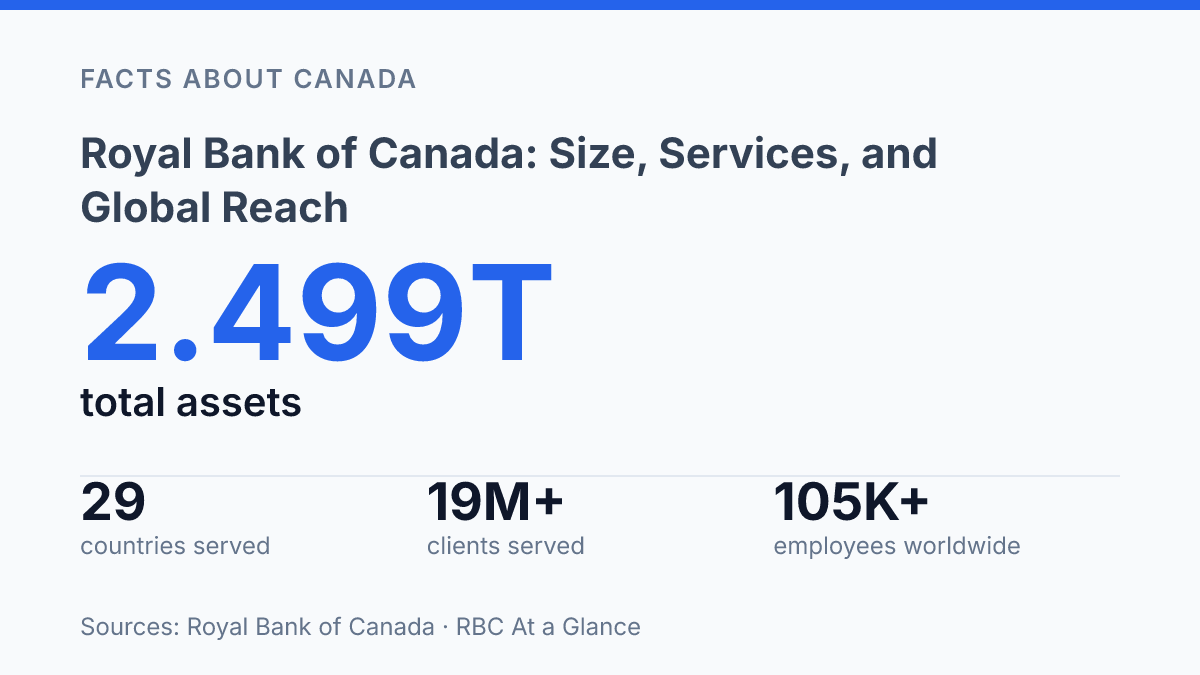
Royal Bank of Canada reported C$2.499 trillion in assets at July 31, 2026, a scale that places it well beyond a domestic retail bank and closer to a systemically significant financial institution with global reach. RBC operated in 29 countries, served more than 19 million clients, and employed over 105,000 people worldwide, while its TSX market capitalization reached C$406.2 billion. Those figures explain why the bank is often used as a reference point for the strength, concentration, and international profile of Canadian finance.
The institution’s size is not built on one activity alone: recent earnings came from personal banking, commercial banking, wealth management, and capital markets. Understanding RBC therefore requires looking at both its customer-facing network and its role in investment, asset management, credit creation, and public finance.
What the bank is and where it operates
A bank founded in 1864 now reports operations in 29 countries, showing how far its identity has expanded beyond its Canadian base. Royal Bank of Canada, commonly known as RBC, is a Canadian multinational financial services company headquartered in Toronto. Its long operating history places it among the enduring institutions in Canadian banking, while its present structure reflects a business built across domestic, cross-border, and international markets.
Canada remains the institution’s anchor market, both in brand identity and in its role within the national financial system. The bank’s headquarters in Toronto situate it in Canada’s largest financial centre, and its domestic presence supports relationships with households, businesses, investors, and public-sector clients. That Canadian base, however, does not fully describe the scale of the organization.
RBC’s geographic footprint extends into the United States and selected markets outside North America. According to RBC At a Glance – Q3/2026, the bank served more than 19 million clients and employed more than 105,000 people worldwide as of July 31, 2026. Those figures indicate that the institution’s workforce and client relationships are distributed across a much broader platform than a purely domestic bank would require.
The result is a Canadian-headquartered bank with an international operating profile. Its identity is still closely tied to Canada, but its reach is shaped by cross-border activity, overseas offices, and global client relationships. That combination helps explain why RBC is often discussed not only as a leading Canadian bank, but also as a large multinational financial institution with a presence well beyond its home market.
Key business lines and customer base
In one recent quarter, RBC earned more from personal banking than from capital markets, but neither division dominated its profit profile. In Q3 2026, its reported segment net income included C$1.923 billion from Personal Banking, C$1.544 billion from Capital Markets, C$1.442 billion from Wealth Management, and C$936 million from Commercial Banking, according to its Third Quarter 2026 Report to Shareholders. The spread matters because the bank’s earnings are not tied to a single customer group or revenue source.
Personal banking is the clearest link between the institution and everyday consumers. Chequing and savings accounts, mortgages, credit cards, payments, and personal lending generate interest income and fees while also creating long-term customer relationships. Serving over 19 million clients gives the bank a large base for deposits and household credit, which can support lending capacity across the wider business.
Commercial banking extends that role from households to operating businesses. It provides credit, cash management, trade finance, and advisory support to small firms, mid-sized companies, and larger enterprises. This business line connects the deposit and lending functions of a traditional bank with the working-capital needs of employers, suppliers, property owners, and exporters.
Wealth management and insurance broaden the model beyond deposits and loans. Wealth management earns fees from investment advice, asset management, custody, and administration; at July 31, 2026, RBC reported C$1.706 trillion in assets under management and C$6.188 trillion in assets under administration. Insurance adds protection products that help clients manage mortality, health, travel, property, and other risks, while giving the bank another source of non-interest revenue.
Capital markets serves a different customer base: corporations, governments, institutional investors, and financial sponsors. Its activities include underwriting, trading, advisory work, financing, and risk management. This broad product mix creates reach and resilience, but it also means performance depends on varied conditions, from consumer credit quality and business loan demand to investment markets, insurance claims, and corporate deal activity.
Why it leads Canadian banking by market value
A TSX market capitalization of C$406.2 billion at July 31, 2026, placed RBC at the top of Canadian banking by investor-assigned equity value. The bank’s quarterly shareholder materials reported that figure alongside a common share price of C$293.41, compared with C$249.8 billion in market value and C$177.79 per share one year earlier. That scale supports its position as the largest bank in Canada by market capitalization, a ranking based on the stock market’s valuation of the company rather than on assets, loans, deposits, or branch numbers.
The comparison matters because Canada’s banking sector is unusually concentrated around a small group of large national institutions. TD, Scotiabank, BMO, and CIBC are also major domestic banks with broad retail, commercial, wealth, and capital-markets operations, but RBC’s market value has stood above this peer group. In practical terms, that leadership indicates that investors have assigned a higher aggregate value to its expected earnings capacity, business mix, capital strength, and growth prospects than to those of other Canadian banking competitors.
Operational scale helps explain why the valuation is plausible, though it is not the same measure. As of July 31, 2026, RBC operated in 29 countries, served more than 19 million clients, and had 105,000+ staff worldwide, comfortably more than 101,000 employees, according to RBC At a Glance – Q3/2026. A workforce of that size signals the infrastructure required to run a universal bank across consumer banking, institutional finance, technology, risk management, compliance, and client support.
Market-cap leadership should still be read with precision. It reflects what public-market investors are willing to pay for the bank’s equity at a point in time; it does not by itself prove higher service quality, greater lending volume, or stronger profitability than every peer in every period. Its usefulness is comparative: within the Canadian banking sector, the measure shows how capital markets rank RBC’s overall franchise value relative to TD, Scotiabank, BMO, and CIBC.
What the size of the institution means for Canada
A balance sheet with C$2.499 trillion in assets gives RBC an economic role that extends well beyond ordinary customer service. According to its Third Quarter 2026 Report to Shareholders, the bank held C$1.645 trillion in deposits and C$1.109 trillion in loans net of allowances as of July 31, 2026. Those figures show why the institution matters for the movement of savings into credit: deposits from households, businesses, and institutions become funding for mortgages, credit lines, commercial borrowing, and investment activity across the economy.
Employment is another channel through which scale becomes economically visible. The same quarterly business-information table reported 101,269 full-time-equivalent employees, a measure that captures a large workforce spread across branch banking, technology, operations, risk management, client service, and market-facing roles. Because that workforce supports both domestic and international activity, the bank functions as a Canadian employer and as a platform for Canadian financial services expertise abroad.
For households, a bank of this size affects access, pricing, and service delivery through its capacity to maintain physical and digital channels at national scale. RBC reported 1,249 bank branches and 4,097 ATMs in the same quarterly filing, indicating that branch networks still sit alongside online and mobile banking rather than being replaced entirely. For companies, the institution’s lending capacity can support working capital, expansion plans, trade activity, and larger financing needs that smaller lenders may be less able to absorb.
Scale also shapes capital allocation. A large bank influences which sectors and borrowers receive credit, how risk is priced, and how savings are channelled into loans, securities, and managed assets. That does not mean every allocation decision carries the same public significance, but the aggregate effect is material because many individual credit decisions can influence investment patterns across regions and industries.
Canada’s banking system is concentrated around a small number of large federally regulated institutions, so size naturally attracts closer scrutiny. Regulators such as the Office of the Superintendent of Financial Institutions focus on capital, liquidity, governance, and risk controls because large banks are deeply connected to payment systems, credit markets, and household finance. The same scale that can support efficient credit distribution and nationwide service therefore also creates a continuing need for supervision, transparency, and policy attention.
Why RBC’s scale reaches beyond banking
RBC’s scale creates a practical consequence for Canada: the bank is not only a competitor in financial services but also part of the country’s economic infrastructure. Its C$5.0 billion in Canadian federal and provincial taxes for the year ended Oct. 31, 2025, shows why its performance matters beyond shareholders and clients. A bank of this size affects household credit access, business financing, employment, capital markets, and government revenue.
That does not make every expansion risk-free or every metric equally meaningful. It does mean that assessing RBC requires more than comparing branch counts or quarterly profit. The more relevant question is how a concentrated financial institution balances growth, resilience, customer service, and public trust as its reach continues to widen.
Frequently Asked Questions
Q: What does Royal Bank of Canada do?
A: Royal Bank of Canada is a Canadian multinational financial services company. It provides personal and commercial banking, wealth management, insurance, capital markets, and other financial services to clients in Canada and abroad.
Q: How big is Royal Bank of Canada?
A: Royal Bank of Canada is the largest bank in Canada by market capitalization. It serves over 19 million clients and has more than 101,000 employees worldwide, which indicates a very large operating scale across multiple business lines.
Q: Does Royal Bank of Canada operate outside Canada?
A: Yes. Royal Bank of Canada is a multinational financial services company with operations and clients beyond Canada. Its global presence supports both cross-border banking and international wealth and capital markets activity.
Q: How many customers does Royal Bank of Canada have?
A: Royal Bank of Canada serves over 19 million clients. That figure reflects its broad retail, commercial, and institutional reach across several markets.
Q: How many employees work at Royal Bank of Canada?
A: Royal Bank of Canada has more than 101,000 employees worldwide. That workforce size supports its large branch, advisory, and corporate services network across its banking and financial services operations.