
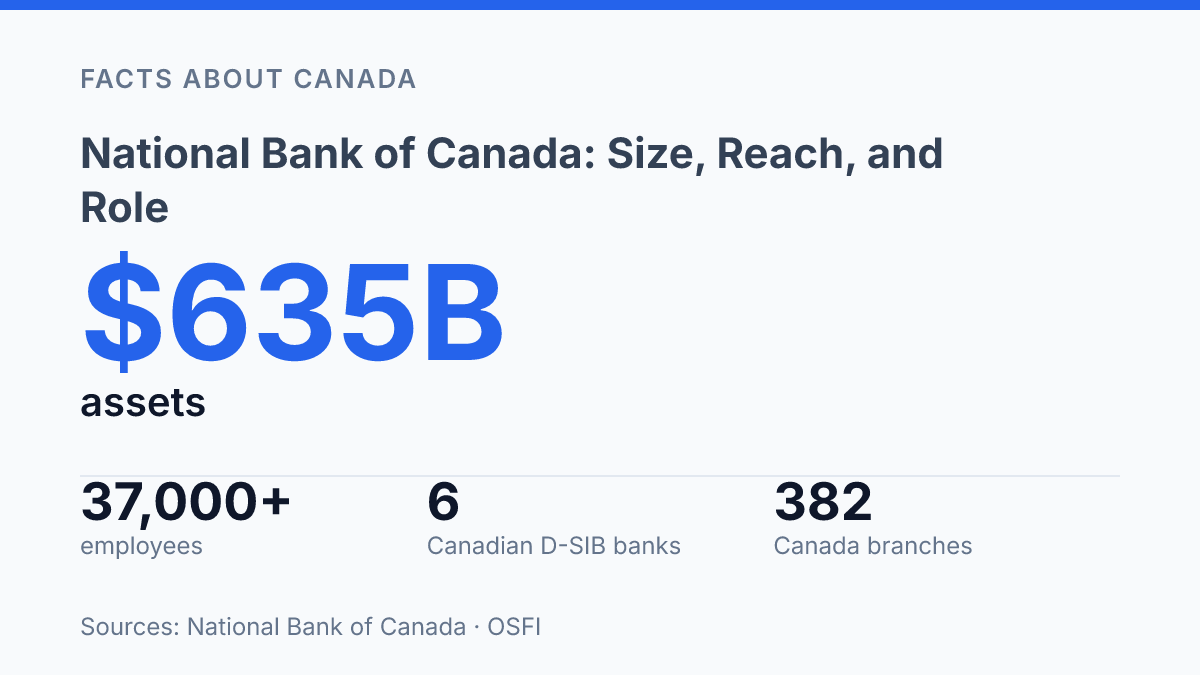
National Bank of Canada sits inside Canada’s top regulatory tier: OSFI classifies it as one of six domestic systemically important banks, a group that holds more than 90% of the country’s banking assets. That designation changes how the bank should be read: not simply as a Quebec lender with a familiar Montreal base, but as a systemically significant institution with national consequences. Recent disclosures reinforce the point.
By July 31, 2026, the bank reported $635 billion in assets and more than 37,000 employees, while its 2025 revenue split still showed a clear Quebec anchor: 45% from Quebec, 36% from the rest of Canada, and 19% from outside Canada. Its profile is therefore built on a contrast between concentrated strength and broader expansion. The bank’s headquarters, branch network, customer base, and competitive position all show how that balance works in practice.
Where the bank fits in Canada’s financial system
A bank can rank sixth in Canada and still sit inside the country’s highest regulatory tier for financial importance. National Bank of Canada is the sixth largest commercial bank in Canada, behind Royal Bank of Canada, TD Bank Group, Scotiabank, Bank of Montreal and CIBC by broad market position. That ranking places it below the Big Five, but not outside the core group that shapes Canadian banking competition, pricing, credit availability and payment infrastructure.
The clearest evidence of that status is regulatory rather than promotional: the Office of the Superintendent of Financial Institutions classifies it as one of only six Canadian domestic systemically important banks, alongside BMO, Scotiabank, CIBC, RBC and TD, as of 2026. OSFI’s designation matters because it reflects relative importance to the financial system, not simply brand recognition. These institutions are subject to heightened expectations because their distress could have wider effects on credit markets, depositors and financial stability.
Scale also shows up in operating figures. By July 31, 2026, the bank reported $635 billion in assets and more than 37,000 employees, according to its Q3 2026 results.
Those numbers are smaller than the largest Canadian banks, but they are well beyond the profile of a niche lender. They indicate an institution with substantial lending, wealth, capital markets and commercial banking capacity.
Its client base reinforces the same point. Serving 3.1 million clients gives the bank a sizeable retail and business relationship base, even though its national ranking remains one tier below the Big Five. In practical terms, that position makes it a scaled competitor rather than a marginal challenger: smaller than Canada’s largest lenders, yet large enough to influence customer choice, business financing and sector concentration within a banking system dominated by a small number of institutions.
Montreal headquarters and Quebec dominance
Quebec accounted for 45% of National Bank’s adjusted revenue in 2025, a concentration that explains why its Montreal headquarters is more than a corporate address, according to the bank’s annual report. The city anchors the institution’s executive base, brand identity, and strongest commercial relationships, giving the bank a provincial centre of gravity that is unusually clear for a major Canadian financial institution.
National Bank is the largest bank in Quebec, which makes the province central to both its market position and its public profile. That status does not make it the largest financial institution in the province overall: Desjardins, a cooperative financial group, remains larger in Quebec. The comparison matters because it shows that the bank’s local strength is substantial, but it operates in a province where a major non-bank competitor also has deep roots and broad reach.
The Quebec weighting is even clearer in the bank’s core domestic business. In 2025, its Personal and Commercial segment generated 64% of revenue from Quebec and 36% from other Canadian provinces, according to a National Bank investor fact sheet. This split indicates that the bank’s strongest competitive advantage is not simply national scale, but density in its home market, where long-standing customer relationships and local recognition support its position.
That regional dominance also defines the bank’s limits. A strong Quebec base gives National Bank a distinct identity and a defensible market position, yet it means its influence is less evenly distributed across Canada than that of larger rivals with broader coast-to-coast concentration. Quebec is therefore both the foundation of the bank’s strength and the clearest explanation for why its profile differs from Canada’s largest banking groups.
Branch network and provincial footprint
A Canadian physical network of 382 branches gives the bank a broader retail presence than its Quebec reputation alone suggests, while still leaving clear differences in strength from province to province. According to the bank’s 2025 annual report, that Canadian network also included 80 branches with commercial banking capabilities and 939 banking machines, making physical access a meaningful part of its distribution model rather than a symbolic presence.
The bank has branches in most Canadian provinces, but public reporting does not support the stronger claim that its branch coverage is uniform across the country. Its disclosures continue to identify Quebec as the clearest area of concentration, while the rest of Canada is generally reported as a combined market rather than through detailed provincial branch totals. That distinction matters because a broad provincial footprint can create national visibility without implying equal market share, equal branch density, or the same competitive position in each province.
For individuals, the branch and banking-machine network supports routine access to deposits, withdrawals, account maintenance, lending discussions, and advice-led services that are still often handled in person. For business clients, the 80 locations with commercial banking capabilities connect the physical network to credit, cash-management, deposit, and relationship-banking needs. The bank’s Personal and Commercial segment reported serving close to 3 million individuals and more than 173,000 businesses across Canada in 2025, which shows how branch distribution and client reach reinforce each other even where digital banking carries much of the day-to-day transaction volume.
What the bank’s scale means for customers and competitors
A bank can be nationally systemic and still exercise its greatest competitive force in one province. National Bank’s scale is best understood through that distinction: a client base of 3.1 million gives it a mass-market platform, while its Quebec leadership gives that platform unusual concentration and visibility in its home market. The result is neither a purely local lender nor a bank with the same even national profile as the largest Canadian competitors.
According to OSFI in 2026, Canada’s six largest banks hold more than 90% of total banking assets, which places National Bank inside the dominant tier of Canadian banking even though it is smaller than the largest national institutions. For customers, that scale supports a broad product set, established business-banking capacity, and access beyond its historical base. For competitors, it means the bank cannot be treated as a marginal regional player, especially in markets where its brand and client relationships are deeply established.
The Quebec comparison is different from the national comparison. Beside Desjardins, National Bank operates in a province where a major cooperative financial group remains a defining competitor, so provincial influence is shared rather than absolute. Against the larger national banks, its position is more selective: it has meaningful reach across provinces, but its strongest competitive weight comes from combining national banking status with a dense Quebec franchise.
This mix shapes its practical role in Canadian banking. Customers encounter a major federally regulated institution with particular strength in one province and service capacity across several others. Competitors face a bank whose influence is strongest where it is historically rooted, showing why national scale and provincial dominance are related measures of power but not identical ones.
What scale changes for a Quebec-rooted bank
The next question is less about whether the bank is regional or national, and more about how its scale will be managed as its footprint widens. A Quebec-heavy customer base gives the institution depth in a market it understands well, while systemic-bank status brings expectations that reach far beyond provincial boundaries. For customers, that can mean access to a larger balance sheet and a wider service platform.
For competitors, it means a Montreal-based bank with enough capital, regulatory standing, and distribution to matter outside its home market. The clearest signal to watch is the revenue mix: any sustained shift away from Quebec would mark not just growth, but a change in the bank’s centre of gravity.
Frequently Asked Questions
Q: How big is National Bank of Canada compared with other Canadian banks?
A: National Bank of Canada is the sixth largest commercial bank in Canada. That ranking places it below the country’s largest national lenders, but it still gives the bank significant scale across retail, commercial, and wealth services.
Q: Where is National Bank of Canada headquartered?
A: National Bank of Canada is headquartered in Montreal. The location matters because Quebec is its strongest market, and the bank has built a major presence there over time.
Q: How many clients does National Bank of Canada have?
A: National Bank of Canada serves about 3.1 million clients. That customer base reflects a broad mix of individual and business relationships across its operating regions.
Q: Does National Bank of Canada operate across Canada?
A: National Bank has branches in most Canadian provinces, so its network extends beyond Quebec. Its reach is broader than a regional bank, although its strongest position remains in its home province.
Q: What is National Bank of Canada’s role in Quebec’s financial sector?
A: National Bank is the largest bank in Quebec and the second largest financial institution in the province after Desjardins. That position makes it a central part of Quebec’s banking market, especially for customers seeking a major institution with a strong local base.