
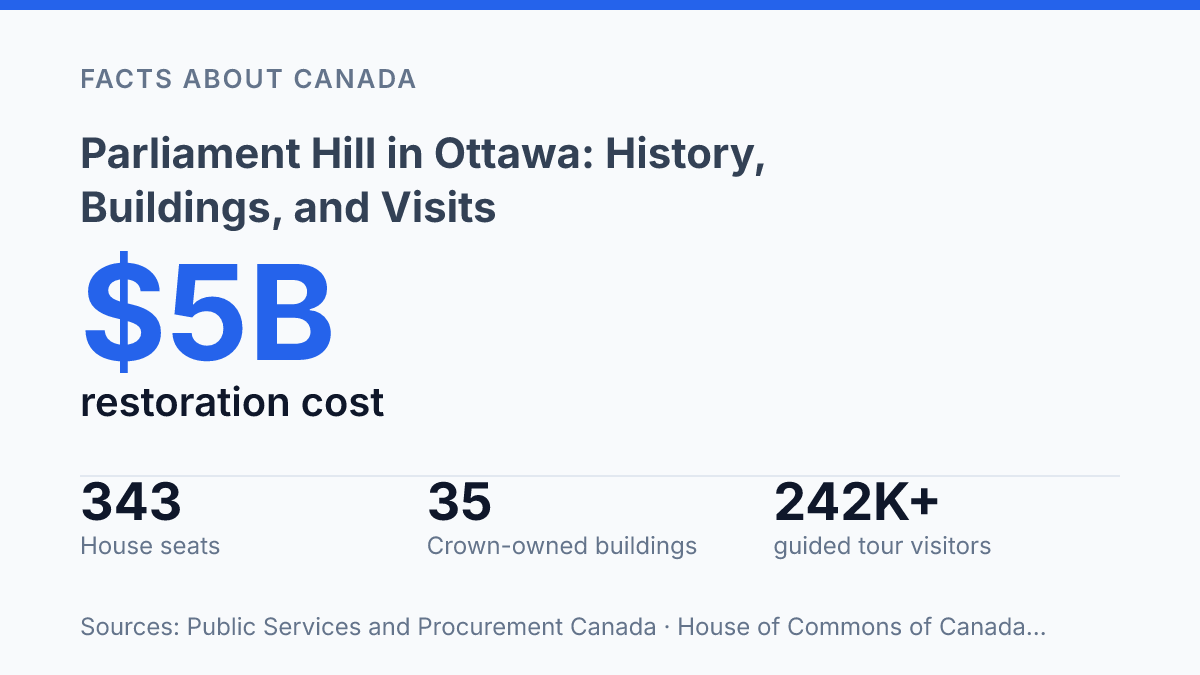
Parliament Hill is not just the lawn and three famous stone buildings above the Ottawa River; it is the legally defined core of a federal precinct that now includes 35 Crown-owned buildings, 28 of them designated heritage properties. Bounded by Wellington Street, the Rideau Canal, the Ottawa River, and Kent Street, the Hill occupies a 9-hectare public site where architecture, ceremony, and federal decision-making are unusually concentrated.
Its original Gothic Revival complex was built between 1859 and 1876, yet the place is still being remade: the Centre Block rehabilitation and Parliament Welcome Centre are estimated at $4.5 billion to $5 billion. This guide explains how the site is organized, why its architecture is so recognizable, how it functions within Canadian parliamentary life, and what visitors need to know while major construction continues.
What Parliament Hill includes and where it is located
Parliament Hill is not a single building but a defined federal precinct on Crown land, set on the southern bank of the Ottawa River in Ottawa, Ontario. Its civic address is Wellington St, Ottawa, ON K1A 0A9, placing it in Ontario directly across the river from Gatineau, Quebec. The location gives the site both a formal governmental role and a prominent position in the capital’s urban geography.
The precinct houses the Parliament of Canada and serves as the country’s principal federal political site. It is the public-facing setting most closely associated with national parliamentary work, even when legislative activity, offices, and visitor services extend across a wider federal campus. This distinction matters because the Hill is often described casually as if it were one structure, when it is better understood as a group of institutional buildings, ceremonial spaces, landscaped grounds, and related federal facilities.
According to the House of Commons of Canada, the Hill is bounded by Wellington Street, the Rideau Canal, the Ottawa River, and Kent Street, and the original Gothic Revival complex was constructed between 1859 and 1876. Those boundaries help separate the core site from the broader Parliamentary Precinct, which Public Services and Procurement Canada identifies as including 35 Crown-owned buildings, 28 of them designated heritage properties.
The open grounds are also part of the site’s identity, not merely space between buildings. Parks Canada records describe the public grounds as a 9-hectare Picturesque-style landscape rising from Wellington Street and falling sharply behind the Library toward the Ottawa River. That topography helps explain why the precinct reads as both a working seat of government and a prominent civic landmark within central Ottawa.
How the Gothic Revival design shapes the precinct
The Library of Parliament makes the precinct’s symbolism visible in stone: according to the Library of Parliament, its exterior has 16 flying buttresses, while the reading room rises to a 40-metre domed ceiling. Those details are not incidental ornament. Within the Hill’s Gothic Revival composition, pointed arches, steep roofs, carved stone, towers, tracery, and buttresses connect the working institutions of government to older parliamentary traditions associated with continuity, deliberation, and constitutional restraint.
The core architectural grouping is formed by Centre Block, East Block, and West Block, which together establish the precinct’s most recognizable formal identity. The use of the Gothic Revival style gives the complex a deliberately institutional character rather than the appearance of a palace, courthouse, or commercial district. Its vertical lines and medieval references were chosen to evoke the long history of representative government while adapting that language to a Canadian federal setting.
Symbolism, however, does not explain the precinct on its own. The same historic vocabulary has had to absorb fire, reconstruction, changing parliamentary needs, and modern conservation standards. The destruction of Centre Block in 1916 led to rebuilding rather than replacement with an entirely different architectural language, which helped preserve the visual continuity of the site even as its structure and functions changed.
Current rehabilitation work continues that pattern of continuity through adaptation. Public Services and Procurement Canada reported in 2025 that restoring Centre Block and building the Parliament Welcome Centre is estimated at $4.5 billion to $5 billion, a scale that reflects both the complexity of conserving heritage fabric and the need to support contemporary parliamentary operations. The result is a precinct where Gothic Revival is not merely a historical style applied to facades, but a governing visual framework that shapes how the buildings are read as symbols of parliamentary democracy.
Why the site matters in Canadian federal politics
Canada’s federal legislature represents 343 elected constituencies and 105 Senate seats from this Ottawa hilltop, making the site more than a landmark: it is where national political authority is visibly concentrated. The Parliament of Canada meets here, and the proceedings associated with legislation, debate, confidence votes, and federal accountability give the precinct its central role in decision-making. Its location in Ottawa, the capital city, links the physical setting to the formal seat of federal government rather than to a purely ceremonial monument.
The Hill also functions as one of the country’s most recognizable stages for civic ritual. Canada Day gatherings on July 1 have made the grounds a focal point for national celebration, while major state occasions can bring official ceremonies, commemorations, visiting dignitaries, and public observances into the same space used for ordinary parliamentary work. This dual use matters because political institutions gain public visibility not only through broadcasts and records, but through repeated national events that associate the site with collective moments of government, citizenship, and remembrance.
That symbolic role sits beside practical constraints. A working parliamentary campus must support elected officials, senators, staff, media, security operations, and visitors, often at the same time.
During large public events or high-profile state occasions, access can be adjusted, screening can intensify, and movement around the precinct may be restricted. The result is a site that is deliberately public-facing but not always freely open in the same way as a park or civic square; its importance depends on balancing visibility with the operational needs of federal government.
Visiting information and practical details
More than 242,000 people joined guided tours of Parliament in 2024–2025, while 69,000 visited Parliament: The Immersive Experience, according to the Library of Parliament Annual Report. Those figures show that public visitation remains substantial even while parts of the central complex are affected by long-term rehabilitation work.
For official visitor or parliamentary information, the appropriate phone contact is (613) 992-4793. The location should be entered as Wellington St, Ottawa, ON K1A 0A9 when checking maps, transit routes, or official visitor information, since nearby streets, construction zones, and security perimeters may affect how visitors approach the site.
Access is not a fixed year-round entitlement because the precinct remains an active government workplace. Tour options, public entry points, and visitor programming can change with parliamentary business, security screening requirements, construction activity, and seasonal programming. Official sources should be checked close to the intended visit date rather than relying on older travel listings or informal schedules.
Practical planning should allow time for screening and route changes, especially when major public events or official proceedings are taking place. The main point for visitors is that the Hill is both a public heritage destination and a functioning parliamentary setting, so availability may be broad at some times and restricted at others without that reflecting a permanent change in access policy.
What the restoration will change about the Hill
The next version of the Hill will not be a simple return to the pre-renovation experience. The Centre Block project is large enough to change how visitors enter, how security is organized, and how heritage spaces are interpreted for decades. That makes the current period unusually revealing: public tours, temporary chambers, and construction updates show a national institution operating while its symbolic centre is under repair.
The practical result is that a visit now offers two views at once: the working Parliament of the present and the architecture being prepared for future use. By the time Centre Block reopens after the targeted 2030–2031 main construction window, the visitor experience will likely be as much about access and interpretation as stonework and ceremony.
Frequently Asked Questions
Q: What is Parliament Hill in Ottawa?
A: Parliament Hill is a federally owned area of Crown land on the southern bank of the Ottawa River in Ottawa, Ontario. It is the home of the Parliament of Canada and the cluster of Gothic revival buildings associated with it.
Q: Where is Parliament Hill located?
A: The site is on Wellington St, Ottawa, ON K1A 0A9, in Ontario. Its position on the riverbank places it at the centre of Canada’s federal government precinct in Ottawa.
Q: What buildings are on Parliament Hill?
A: Parliament Hill contains a suite of Gothic revival buildings used by the Parliament of Canada. Their architectural details were selected to reflect the history and symbolism of parliamentary democracy.
Q: Why is Parliament Hill architecturally significant?
A: Its buildings are among the best-known examples of Gothic revival architecture in Canada. The style was chosen deliberately to connect the federal capital with traditions of parliamentary government.
Q: How can visitors get more information before going to Parliament Hill?
A: General visitor inquiries can be directed to (613) 992-4793. The site is in Ontario, so local travel planning can also be coordinated with Ottawa-area transit and tourism information.