
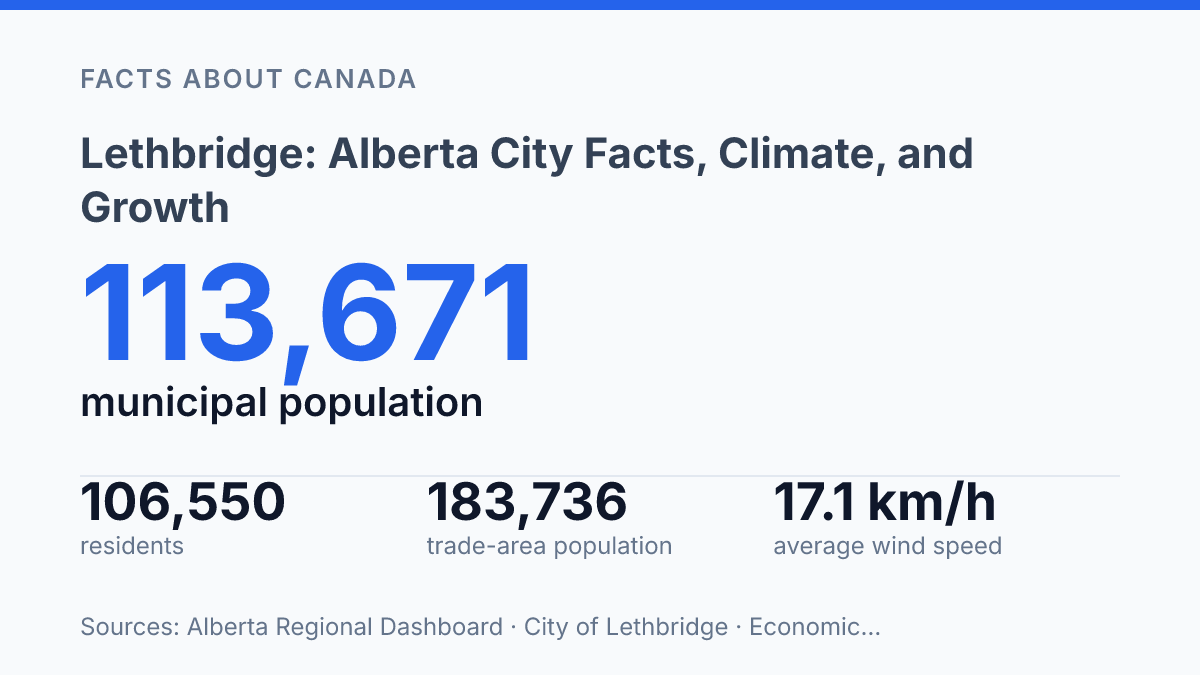
Lethbridge reached 106,550 residents in the 2023 municipal census, a gain of 5,068 people since 2019, while Alberta’s 2025 dashboard places it fourth among municipal populations in the province. That scale is only part of the story. The city sits 210 km from Calgary, 120 km from Waterton, and about 85 km from the U.S. border at Del Bonita, giving it a role that is regional, cross-border, and closely tied to the Rockies.
Its recent growth is also uneven, with the west side expanding faster than the north or south between 2019 and 2023. Climate adds another defining layer: warm summer highs around 26.3°C contrast with winter daytime averages near freezing, while wind remains a measurable feature rather than a local cliché. Together, location, population change, weather, and regional reach explain why the city stands out in southern Alberta.
Where Lethbridge is located in Alberta
Only 85 km from the U.S. border, Lethbridge functions as both a southern Alberta service centre and a gateway toward mountain and cross-border travel. The city is in southern Alberta, Canada, where it anchors services, commerce, education, and transportation for surrounding rural communities and smaller centres. Travel distances reinforce that position: the city is 210 km, or about two hours, from Calgary, 120 km from Waterton, and 85 km from the U.S. border at Del Bonita, according to Tourism Lethbridge, accessed in 2026.
Within Alberta, this location places the city southeast of Calgary and west of Medicine Hat, giving it a distinct role in the province’s southern corridor rather than tying it solely to one larger metropolitan area. Its setting also connects prairie agriculture, highway movement, and access to the Rocky Mountain foothills, which helps explain why it operates as a regional centre rather than only as a local municipality. The nearby Waterton area and the border crossing at Del Bonita strengthen that geographic identity by linking the city to both mountain recreation routes and international travel routes.
The city’s inland prairie position supports a dry, open-climate profile, but the Canadian Rocky Mountains still exert a visible influence on local conditions. Air moving off the mountains can shape wind and temperature patterns, helping produce the warmer breaks and windy conditions often associated with this part of Alberta. That combination of prairie exposure and mountain influence is central to understanding the city’s physical setting: it is not a mountain community, but its climate and regional connections are strongly affected by proximity to the Rockies.
Population growth and the 2023 census milestone
A municipal count above 100,000 changed the city’s statistical category as much as its headline population figure. According to the City of Lethbridge, the 2023 municipal census recorded 106,550 residents, an increase of 5,068 people from the 2019 count. That represented 4.99% growth over the four-year period, or about 1.25% per year, which shows measured expansion rather than a single-year surge.
That result made Lethbridge the fourth Alberta city to surpass 100,000 residents. The threshold is meaningful because municipalities of this size tend to face more complex planning requirements across transportation, recreation, utilities, emergency services, land use, and community facilities. A six-figure population also changes how a city is perceived in provincial comparisons: it signals a larger urban service base, a deeper labour and consumer market, and a broader administrative scale than smaller centres.
The number should be read carefully, however. Passing 100,000 confirms urban growth and helps anchor service planning, but it does not by itself explain what is driving local housing demand, business investment, or long-term economic change.
Those questions require separate evidence, such as building activity, employment data, migration patterns, and household composition. The census milestone is therefore best understood as a reliable population benchmark: it establishes current municipal scale, while leaving the causes and consequences of growth to more detailed indicators.
Weather patterns shaped by the Rocky Mountains
Daily highs near freezing in the coldest part of winter are a clue that the city’s weather does not behave like much of the Alberta interior. Environment and Climate Change Canada’s 1991–2020 normals show average daily maximums of 26.3°C in both July and August, while January and December daily maximums sit close to freezing. That pattern supports the common description that Lethbridge is known for warm summers, mild winters, and a windy climate, rather than the colder and more consistently wintry profile associated with many inland Prairie locations.
The mountain barrier to the west helps explain the difference. When air descends the eastern slopes, it can compress, dry, and warm, producing chinook-style conditions that raise temperatures quickly and interrupt winter cold. The same setup can also make local weather variable over short periods, because shifts in wind direction and air movement can change conditions faster than in places less exposed to downslope flows.
Wind is the clearest everyday expression of that geography. A 2026 summary citing Environment and Climate Change Canada normals reports an average annual wind speed of 17.1 km/h, with about 61 days per year reaching winds of 52 km/h or more and roughly 6.5 days per year with gusts of 90 km/h or more. These figures give scale to the city’s wind reputation: the same regional setting that can soften winter cold also helps produce strong winds and rapid weather shifts.
Why the city stands out in southern Alberta
Few Alberta cities combine a large urban scale with the practical exposure of an open, wind-prone prairie setting. Lethbridge stands out because its identity is not based on size alone; it is also shaped by a climate that is familiar in local life and visible in how outsiders describe the city. Growth has reinforced its status as a major centre in the south, while the weather gives it a distinct physical character within the province.
That combination helps explain why the city is commonly understood as more than a smaller regional municipality. Its population base supports a wider range of services, institutions, and civic functions than many surrounding communities can sustain on their own. At the same time, its setting keeps daily conditions tied closely to wind, rapid temperature changes, and seasonal variability, making climate part of the city’s practical identity rather than a background detail.
The same features that give the city its prominence also create pressures. Continued growth increases demand on infrastructure, housing, transportation, and municipal services, while exposure to strong winds and changeable weather affects building, maintenance, and everyday movement around the city. In that sense, its appeal and its challenges come from the same source: it is large enough to play a meaningful provincial role, yet still strongly defined by the southern prairie environment around it.
Why the regional count matters next
The next measure of the city’s importance will not come only from its resident count. Economic Development Lethbridge’s 2025 trade-area study estimated a household population of 183,736 across the wider market, including 81,469 people outside city limits. That distinction matters because infrastructure, retail demand, health services, education, and transportation planning are shaped by the number of people who rely on a city, not only by the number who sleep there.
Growth on the west side, continued regional pull, and climate pressures linked to wind and water supply will keep influencing how the city develops. The practical consequence is clear: southern Alberta’s urban geography cannot be read accurately from municipal population alone.
Frequently Asked Questions
Q: Where is Lethbridge located in Alberta?
A: Lethbridge is a city in southern Alberta, Canada. It is part of the province’s urban network and sits relatively close to the Canadian Rocky Mountains, which influence local weather patterns.
Q: How many people live in Lethbridge?
A: According to the 2023 municipal census, Lethbridge had a population of 106,550. That size places it among Alberta’s larger cities and reflects its steady urban growth.
Q: Is Lethbridge considered a large city in Alberta?
A: Yes. In 2023, Lethbridge became the fourth Alberta city to surpass 100,000 residents. That threshold is often used to identify cities with a more established regional role.
Q: What is the climate like in Lethbridge?
A: Lethbridge is known for warm summers, mild winters, and windy conditions. The nearby Canadian Rocky Mountains help shape these patterns by affecting temperature and airflow across the region.
Q: Why is Lethbridge often mentioned in growth discussions?
A: Lethbridge is frequently cited because its population has crossed a major urban milestone while remaining a mid-sized Alberta city. The combination of growth, regional position, and distinctive climate makes it a notable example of urban development in southern Alberta.