
Oshawa added 1,477 paid jobs in 2025 even as General Motors Canada prepared to move its assembly plant back to two shifts in February 2026, a contrast that captures the city’s current direction. The auto sector still matters: GM paired the staffing change with a $280 million investment tied to next-generation gas-powered full-size pickups. Yet the broader local economy, heritage sector, arts programming, and waterfront ecology now carry more of the city’s public identity than a single industry can explain.
The result is a place where an automotive museum, a 55-room National Historic Site, a growing music and art festival, and a provincially significant wetland all help define civic life. This article examines how industrial continuity, cultural activity, historic landmarks, and outdoor spaces combine to shape a city that is neither frozen in its manufacturing past nor detached from it.
From auto plants to today’s local economy
On January 29, 2026, General Motors Canada said Oshawa Assembly would return to a two-shift operation on February 2, putting about 500 employees on layoff while backing the plant with a $280 million investment for next-generation gas-powered full-size pickups. That combination of layoffs and reinvestment captures the city’s economic tension: auto manufacturing remains a defining sector, but it operates under changing product cycles, labour needs, and market conditions.
The Motor City identity grew from General Motors Canada and the wider supplier base that formed around vehicle production. Assembly work did more than provide jobs; it shaped household incomes, skilled trades, union activity, and the rhythm of daily life in surrounding neighbourhoods. As industrial employment expanded, residential growth followed, linking the city more tightly to Durham Region through commuter patterns, retail strips, schools, and subdivisions built around a working population tied to manufacturing.
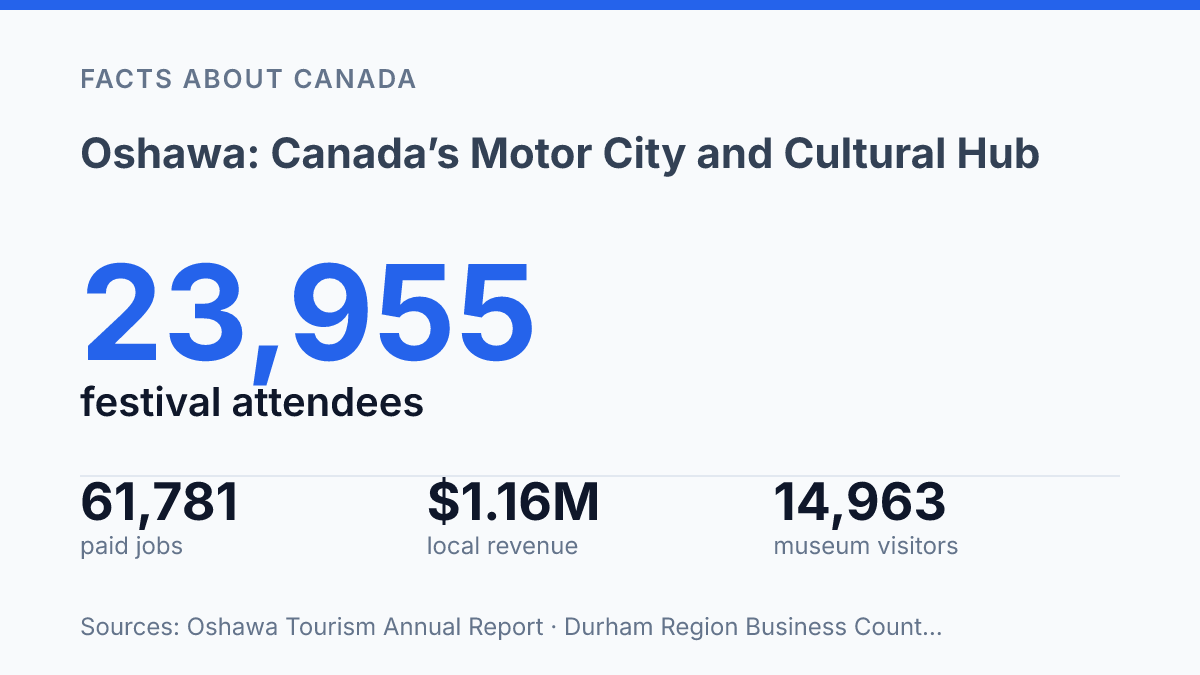
Durham Region’s 2025 Business Count Highlights reported 61,781 paid jobs in the municipality, up 1,477 from 2024, a 2.45% increase. The same count placed the city at 28% of Durham Region’s municipal job share, which indicates that its role is not limited to legacy industry. Manufacturing still matters, but the employment base now includes public institutions, service-sector work, construction, professional services, and goods movement.
Several large non-automotive anchors explain that broader profile. Ontario Tech University and Durham College support education, research, student employment, and procurement activity, while Lakeridge Health is a major health-care employer and service hub.
The city government, regional public services, warehousing, transportation, and distribution operations also contribute to the local job mix, helped by access to Highway 401, Highway 407, rail connections, and the eastern Greater Toronto Area market. This diversification does not erase the auto legacy; it shows how an industrial city has adapted by adding institutional and logistics strength around its manufacturing core.
Historic sites that anchor the city
A 55-room estate built for an automotive magnate remains one of the clearest physical links between the city’s early industrial wealth and its present-day heritage identity. Parkwood Estate was the home of Samuel McLaughlin, the influential industrialist associated with the McLaughlin Motor Car Company and General Motors of Canada, and its scale reflects the prosperity that shaped the community in the first half of the 20th century. According to Canada’s Historic Places, the main residence and 4.8 hectares of grounds were developed between 1915 and 1940, and the property was formally recognized as a National Historic Site on February 24, 1989.
The Canadian Automotive Museum gives that legacy a more public, object-based form. Housed in a former downtown auto dealership, the museum preserves vehicles, archives, and interpretive material connected to Canadian motoring history rather than treating the city’s automotive past as a closed chapter.
Its continued visitor draw is measurable: the Canadian Automotive Museum Annual Report recorded 14,963 visitors in 2024, including paid admissions, free visits, and special-event guests. That figure points to heritage tourism as a practical cultural asset, not only a commemorative exercise.
Other heritage places show that early growth was not confined to factories or executive estates. The Regent Theatre, opened in the early 20th century as an entertainment venue, illustrates the rise of downtown leisure and civic gathering spaces.
The Genosha Hotel reflects the ambitions of a growing urban centre that served business travellers, visitors, and residents during a period of commercial expansion. Older churches, civic buildings, and residential properties listed or designated through the municipal heritage system add a street-level record of how central neighbourhoods developed around work, worship, commerce, and public life.
These sites create a layered account of local history because they connect industrial leadership, transportation culture, architecture, and everyday urban development. Their value, however, depends on more than recognition plaques.
Large estates, museums, theatres, and historic commercial buildings require maintenance, adaptive use, and public support to remain accessible. Preservation therefore functions as both cultural stewardship and an ongoing civic cost.
Music, festivals, and arts that shape civic life
A single 2024 downtown arts festival drew 23,955 attendees, showing that the city’s cultural draw is measurable as well as symbolic. The Convergence Music and Art Festival recorded an 85% year-over-year increase in attendance, with 33.2% of visitors travelling more than 40 kilometres, according to the Oshawa Tourism 2024 Annual Report. The same report estimated $1.16 million in local business revenue and a 391% increase in foot traffic, evidence that arts programming can support restaurants, shops, and public spaces as well as performers.
Fiesta Week gives that civic culture a different form by centring multicultural associations, food, dance, and community-hosted pavilions. The Oshawa Folk Arts Council lists the 2026 Fiesta Pavilion Week for June 22–27, 2026, with 14 pavilions scheduled, a scale that reflects how cultural identity is organized through local volunteers and associations rather than only through formal institutions. Its importance lies partly in visibility: communities that may be dispersed across neighbourhoods become publicly recognizable through shared programming.
Seasonal traditions also help define local identity beyond downtown stages. The Peony Festival turns a flowering period into a recurring public gathering, linking horticulture, photography, vendors, and civic pride to a recognizable annual marker. Because its appeal depends on both natural timing and public programming, it functions as a community event rather than a conventional performance festival.
Year-round venues give these festivals a stronger base. The Biltmore Theatre and The Music Hall support touring acts and local live music, while the Robert McLaughlin Gallery anchors visual-arts programming through exhibitions, education, and community-facing events. Larger concerts and public entertainment also use Tribute Communities Centre, and smaller arts activity is supported through municipal cultural programming, including summer events in parks noted in the city’s 2024 culture update.
Festival-driven visibility can strengthen local pride and bring people into commercial areas, but it is not self-sustaining by default. Attendance, volunteer capacity, sponsorship, grants, and municipal support can shift from one year to the next. That variability makes the city’s mix of formal venues, recurring festivals, and community groups especially important: cultural life is more resilient when it is spread across several organizers and spaces rather than dependent on a single annual event.
Lakefront trails, dining, and places to spend time outdoors
A provincially significant wetland sits only a short distance from the shoreline trail system: Second Marsh is a 137-hectare urban ecological area in south Oshawa that supports habitat for 106 species of nesting birds, amphibians, and reptiles, according to the Greenbelt Indigenous Botanical Survey. Its presence changes the waterfront from a simple recreational edge into a mixed-use public zone where walking, cycling, birdwatching, and environmental protection overlap within the same part of the city.
Lake Ontario access is most visible around Lakeview Park, Ed Broadbent Waterfront Park, and the Waterfront Trail, which connects the city’s shoreline to a broader regional route along the lake. These spaces provide beach areas, open lawns, picnic sites, playgrounds, lookouts, and paved paths, making the south end one of the clearest links between residential neighbourhoods and the water. The trail network also extends inland through routes such as the Joseph Kolodzie Oshawa Creek Bike Path, which helps connect the urban core with parks, creek valleys, and the lakefront without relying only on road travel.
Food and outdoor activity reinforce each other most strongly around the downtown-to-waterfront axis. Independent cafés, casual restaurants, bakeries, and small takeout spots along King Street, Bond Street, and Simcoe Street give the central area a local dining character that differs from highway-oriented chain clusters. This matters because trail use and waterfront visits rarely exist in isolation; coffee stops, lunch places, and evening dining options help turn a walk, ride, or park visit into a longer stay within the city rather than a single-purpose trip.
Seasonal conditions shape how consistently these assets are used. Summer brings the fullest range of waterfront activity, while colder months favour walking, cycling where paths are clear, wildlife observation, and short visits rather than extended lakeside recreation.
Infrastructure also matters: parking, transit access, lighting, washrooms, and path maintenance affect whether the shoreline feels reachable from central neighbourhoods throughout the year. The result is a waterfront that broadens the city’s appeal, but its everyday value depends on practical connections as much as scenic access.
Why the motor-city identity still has room to grow
The city’s next phase will depend on how well it treats heritage, industry, ecology, and public culture as connected assets rather than separate files. A plant investment can protect specialized employment, but festivals, museums, trails, and waterfront sites broaden the reasons people visit, settle, and spend time there. That mix also creates planning pressure: growth has to support jobs and tourism without weakening the places that give the city its distinct character.
The practical consequence is clear. The strongest version of the city is not one that replaces its motor-city identity, but one that gives that identity more ways to remain useful.
Frequently Asked Questions
Q: Why is Oshawa called Canada’s Motor City?
A: Oshawa earned that nickname through its long association with automotive manufacturing, which shaped the city’s economy and identity for decades. That industrial legacy still influences how the city is perceived today, even as its cultural profile has expanded.
Q: What cultural events are Oshawa known for?
A: Oshawa is known for festivals such as Fiesta Week and the Peony Festival, both of which highlight the city’s multicultural character and seasonal traditions. Live music and arts programming also play a major role in the local cultural calendar.
Q: What are some popular things to do in Oshawa?
A: Popular activities include visiting historic sites like Parkwood Estate, exploring live music and arts venues, and trying indie eateries. Lakefront trails also draw visitors who want outdoor recreation close to the city core.
Q: Is Oshawa worth visiting for history as well as culture?
A: Yes. Oshawa combines preserved heritage sites with active cultural spaces, so it offers both historical context and contemporary experiences in one place. That mix helps explain why the city appeals to a wide range of visitors.
Q: What makes Oshawa different from other cities near Toronto?
A: Oshawa stands out for combining a strong industrial heritage with a visible cultural and festival scene. The result is a city identity that is shaped by both working history and ongoing community life.