
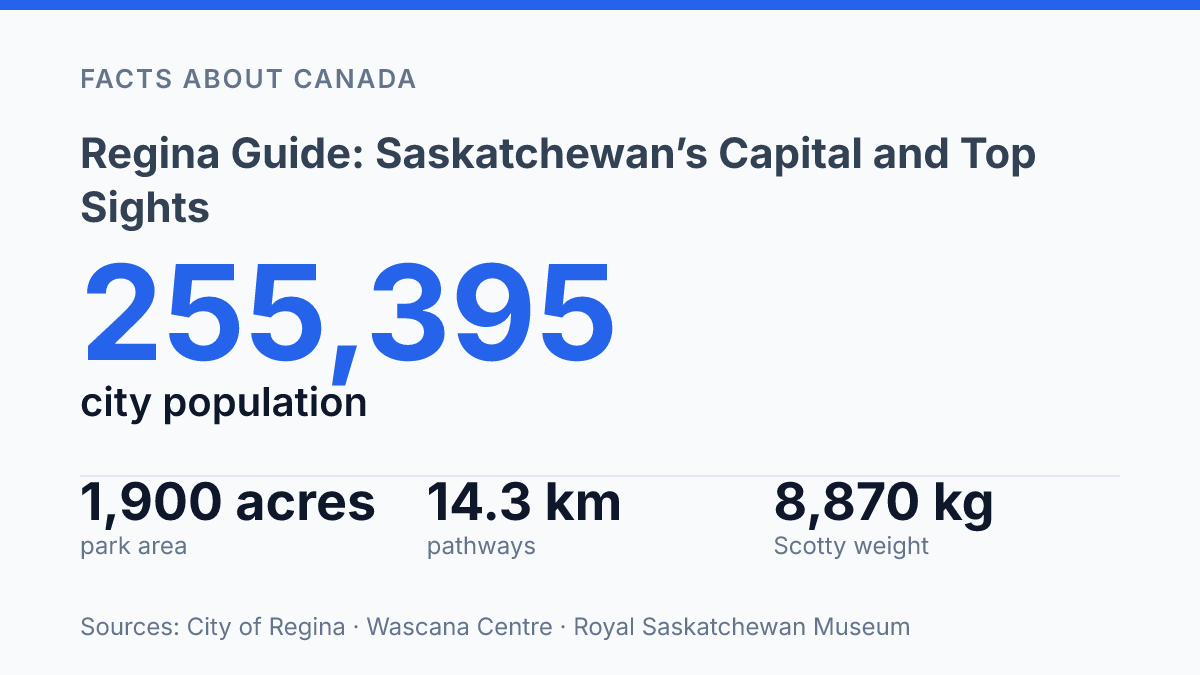
Regina entered 2024 with an estimated 255,395 residents, and the city’s own growth work projects 369,600 residents by 2051. That shift matters because the capital is not only adding population; it is carrying more of Saskatchewan’s government, cultural, education, and tourism functions. The city’s strongest visitor sites help explain that role.
Wascana Centre spans more than 1,900 acres around a 300-acre lake, placing major museums, public paths, and civic landmarks within a single urban setting. Nearby institutions add depth, from the Royal Saskatchewan Museum’s record-setting T. rex specimen to the MacKenzie Art Gallery’s province-wide reach. The science centre and RCMP Heritage Centre extend the picture further, showing how family learning, national policing history, and public education connect in one capital city.
Why Regina matters in Saskatchewan
Saskatchewan’s capital is more than an administrative address; its civic identity is strongly associated with parkland, public institutions, and planned urban growth. Located in south-central Saskatchewan, the city serves as the province’s seat of government while also functioning as a cultural and educational hub for residents across the surrounding region. That dual role helps explain why its public profile extends beyond legislature buildings and official offices.
Recent growth figures add practical weight to that role. The municipal population was estimated at 255,395 on July 1, 2024, and the city’s Growth Study projects 369,600 residents by 2051, along with 68,200 additional jobs and 56,900 additional housing units compared with the 2021 Census baseline, according to the City of Regina / Be Heard Regina, 2024–2026 page. These projections frame the capital not as a static government centre, but as a growing urban area facing long-term decisions about housing, employment land, transportation, and services.
Wascana Centre is central to how the city is understood on the ground. Rather than sitting apart from civic life, this major park-and-lake district helps connect government, recreation, and cultural institutions within a recognizable urban setting. The result is a capital whose identity is shaped as much by shared public space as by its formal provincial functions.
Wascana Centre and the city’s main museums
A single circuit around Wascana Lake can take in natural history, Indigenous cultural interpretation, and major art collections without leaving one urban park. Wascana Centre is the park surrounding the lake, and its scale helps explain why several major cultural stops sit within the same broad area rather than feeling like isolated attractions. According to Wascana Centre’s 2023 figures, the park covers more than 1,900 acres, includes a 300-acre lake, and offers 14.3 km of paved and unpaved pathways, making it both a recreational space and a practical cultural district.
The Royal Saskatchewan Museum gives the area its strongest natural and cultural history anchor. Its exhibits include material on Canada’s Aboriginal peoples and native animals, linking human history, ecology, and place in a way that reflects the province rather than presenting the museum as a generic collection. One of its most distinctive draws is Scotty, the Tyrannosaurus rex described by the museum on March 21, 2019, as the largest and oldest T. rex in the world, estimated at 8,870 kg, 13 m long, 4 m high at the hips, and more than 28 years old.
Visual art serves a different purpose nearby at the MacKenzie Art Gallery, which focuses on artwork from Saskatchewan as well as national and international collections. That contrast matters because the Wascana Lake area is not simply a cluster of similar institutions; it combines museums with different interpretive roles. The MacKenzie’s 2024–25 Annual Report says its exhibitions and programs impacted 669,265 individuals, welcomed 3,305 youth through school tours, and sent MacKenzie-organized exhibitions to six institutions across five provinces, showing how a gallery based in the park also circulates work well beyond its own walls.
Family-friendly science and hands-on learning
Roughly 70,000 annual visitors to the Saskatchewan Science Centre and Kramer IMAX Theatre come from outside the local region, a figure that helps explain why this stop functions as more than a neighbourhood attraction. A Saskatchewan Science Centre submission in 2025 delegation materials reported that the combined venue hosts close to 200,000 visitors annually, with about 35% arriving from outside the area and an estimated $4.6 million in yearly GDP impact. Those numbers point to a practical family and education draw that complements the city’s better-known heritage and arts institutions without serving the same purpose.
Hands-on displays are the centre’s main distinction. Rather than asking visitors only to read labels or move quietly through galleries, the exhibits are designed for touching, testing, observing, and repeating.
That activity-based format is especially useful for families with children of different ages because it allows shorter attention spans, shared problem-solving, and informal learning to coexist in the same visit. For school groups, the same structure can turn abstract classroom subjects into visible cause-and-effect demonstrations, making science easier to connect with everyday experience.
Its lakeside setting near Wascana Lake also matters because it places a science-focused visit within an easy-to-understand civic and recreational area. Families and teachers can pair indoor learning with time outdoors, which can make the stop more flexible than a single-purpose attraction.
The experience is best suited to visitors who respond well to participation and movement; those looking for a quiet, gallery-style visit may find the format less central to their interests. That distinction is precisely what broadens the city’s appeal: the science centre adds an interactive learning option rather than duplicating the role of nearby cultural sites.
RCMP history and the city’s national connections
A visitor centre beside Canada’s national police training base gives Saskatchewan’s capital a federal connection that most provincial capitals cannot match. The RCMP Heritage Centre focuses on the Royal Canadian Mounted Police, presenting the force through exhibits, education programs, and commemorative interpretation rather than as a general civic museum. Its location near RCMP Academy, Depot Division, makes the site more than a collection of displays; it is tied to a working national institution associated with police training and public service across Canada.
Education is one of the clearest measures of that national reach. According to the centre’s 2025–26 Annual Report, its On Patrol virtual program reached 9,968 students in that reporting year and has surpassed 60,000 participants since launch. The same report says 1,200 cadets took part in its Truth and Reconciliation Learning Journey cadet program, showing that the centre’s role extends beyond visitor interpretation into structured learning for both schools and future members of the force.
This connection strengthens the city’s visitor profile by adding a distinctly Canadian heritage site to the capital-city itinerary. The appeal is most direct for travellers interested in policing history, national symbols, public institutions, or Canadian identity, rather than for those seeking a broad art, science, or natural-history stop. That narrower focus is also its value: the centre gives the city a specialized attraction linked to a federal institution, making national history part of the local travel experience without turning the visit into a full survey of RCMP history.
Why growth will test the city’s cultural capacity
The city’s next chapter will depend on whether growth strengthens its public institutions rather than simply increasing demand around them. Projections for tens of thousands of new residents, jobs, and housing units by 2051 make Wascana Centre, museums, science learning, and national heritage sites more than visitor amenities. They are part of the civic infrastructure that helps a capital absorb growth without losing its public identity.
Funding decisions, school access, exhibit renewal, and transportation links will shape how widely those benefits are shared. The practical measure will be simple: whether a larger city still gives residents and visitors direct access to the places that explain Saskatchewan’s past, science, art, and national connections.
Frequently Asked Questions
Q: What is Regina known for as a city in Saskatchewan?
A: Regina is Saskatchewan’s capital and a major cultural centre in the province. It is known for civic institutions, large green spaces, and several museums and galleries clustered around Wascana Centre. Those features make it a common starting point for visitors interested in both history and public art.
Q: What can be seen at the Royal Saskatchewan Museum?
A: The Royal Saskatchewan Museum focuses on Canada’s Aboriginal peoples and native animals. Its exhibits combine cultural and natural history, which gives the museum a broad educational scope. It is also set within Wascana Centre, which makes it easy to combine with other nearby attractions.
Q: Is Wascana Centre worth visiting on its own?
A: Wascana Centre is a large park surrounding Wascana Lake, so it functions as both a recreation area and an attraction cluster. The park contains the Royal Saskatchewan Museum and the MacKenzie Art Gallery, which adds museum visits to the outdoor setting. That mix makes it especially useful for a short itinerary with varied activities.
Q: What kind of art is on display at the MacKenzie Art Gallery?
A: The MacKenzie Art Gallery shows both local and global artwork. That range means the collection can present Saskatchewan artists alongside wider Canadian and international works. For visitors, it offers a broader view of art than a strictly regional gallery would provide.
Q: What does the Saskatchewan Science Centre offer for visitors?
A: The Saskatchewan Science Centre features hands-on displays by the lakeside. Its interactive format is designed to make science approachable through direct participation rather than passive viewing. That makes it a practical stop for visitors looking for an experience that is more interactive than a traditional museum visit.