
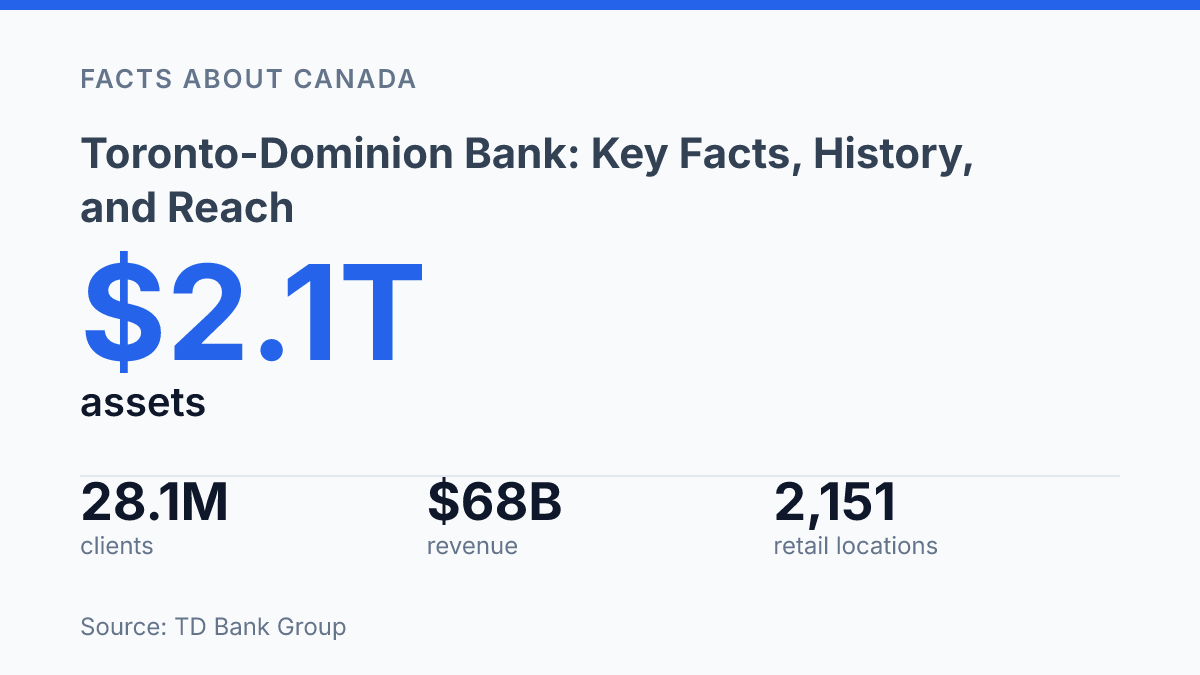
Toronto-Dominion Bank reported $2.1 trillion in assets and more than 28.1 million clients as of October 31, 2025, making it one of the largest financial institutions in North America. Its scale is not only Canadian: TD reported fiscal 2025 revenue split evenly between Canada and the U.S., including international operations, a balance shaped by acquisitions such as Banknorth in 2005 and Commerce Bancorp in 2008. That cross-border profile makes the bank more complex than a branch network or a household brand.
Its structure spans retail banking, commercial banking, wealth, insurance, and wholesale markets, while its role in Canada is reinforced by its designation as a domestic systemically important bank. The key facts behind TD show how a 1955 merger grew into a North American institution whose expansion, regulation, and market reach now have consequences beyond ordinary banking competition.
How TD Bank Group is structured
“TD” is a useful shorthand, but it compresses several corporate meanings into two letters. The legal name of the parent institution is Toronto-Dominion Bank, while the company does business under the operating brand name TD Bank Group and is commonly referred to simply as TD. That distinction matters because the brand describes the broader financial group presented to customers, investors, and regulators, while the legal name identifies the chartered bank behind the group’s corporate filings and obligations.
TD Bank Group is headquartered in Toronto, Ontario, placing its corporate centre in Canada’s largest financial hub. In public materials, the group describes itself as a North American financial institution organized around four core businesses: Canadian Personal and Commercial Banking, U.S. Retail, Wealth Management and Insurance, and Wholesale Banking. According to TD Bank Group’s 2025 Annual Information Form, these businesses served more than 28.1 million clients, a scale that explains why the company is usually discussed as a diversified financial group rather than only as a domestic bank.
The group label also helps separate corporate identity from individual market-facing names. “TD” may appear in casual references, investor materials, and customer communications, but the precise meaning depends on context: it can refer to the parent bank, the wider branded group, or a specific part of the organization. For a basic profile, the safest framing is that TD Bank Group is the operating brand of the legally named bank, with its head office in Toronto, Ontario.
How the bank was formed and expanded
A single 1955 charter joined two banks whose roots reached back nearly a century, creating an institution with scale that neither predecessor had built alone. According to TD Bank Group Historical Fast Facts, the bank was chartered on February 1, 1955, through the merger of The Bank of Toronto and The Dominion Bank. The Bank of Toronto had been founded in 1855, while The Dominion Bank dated to 1869, so the modern institution inherited two separate corporate lineages rather than one uninterrupted origin story.
The merger reflected a practical growth strategy: combining balance sheets, branch networks, customer bases, and management capacity into a larger national banking institution. In mid-20th-century Canada, this kind of consolidation could expand lending capacity and geographic reach more quickly than organic branch-by-branch growth alone. The result was not simply a new name, but a broader platform from which the combined bank could compete with other large Canadian financial institutions.
That layered origin matters because the bank’s later expansion followed a similar pattern of building scale through combinations and acquisitions. Its move into U.S. retail banking began with the Banknorth acquisition in 2005, followed by full privatization of TD Banknorth in 2007 and the purchase of Commerce Bancorp in 2008, according to TD’s historical acquisition information. Those transactions show continuity between the original merger logic and later cross-border growth: scale was repeatedly assembled by joining established franchises rather than relying only on internal expansion.
The consequence is a brand whose history is cumulative. The present institution carries the institutional memory of its two founding banks, the strategic implications of their 1955 combination, and later acquisition-led growth outside Canada. That structure helps explain why its history is better understood as layered institutional development than as a single founding followed by linear expansion.
Where TD operates in Canada and the United States
By revenue, TD is now as much a cross-border North American bank as a Canadian one: in fiscal 2025, it reported 50% of total reported revenue from Canada and 50% from the U.S., including international operations, according to its annual report. That balance helps explain why the bank’s competitive position is measured across both countries rather than only within its domestic market. A broader earnings base can reduce dependence on a single economy, while still leaving performance exposed to different interest-rate cycles, credit conditions, and supervisory expectations on each side of the border.
The physical network remains one of the clearest measures of that reach. At fiscal year-end 2025, TD reported 2,151 retail locations in North America, made up of 1,051 Canadian branches and 1,100 U.S. retail stores, according to its Q4 2025 investor presentation.
The U.S. count slightly exceeded the Canadian count at that point, which is notable for a bank rooted in Canada and shows how substantial the American platform has become. By Q3 2026, the reported totals had moved lower, with 1,037 Canadian branches and 1,048 U.S. stores, indicating some adjustment in the physical footprint while the bank retained large-scale coverage in both markets.
TD’s operating presence serves both personal and commercial customers rather than functioning only as a consumer branch network. In Canada, Canadian Personal and Commercial Banking is the main domestic retail and business-banking platform, while the U.S. retail operation gives the group a parallel customer base south of the border. This structure gives the bank access to household deposits, lending relationships, and business clients in two large banking markets, supporting scale across recurring customer relationships rather than relying on one national franchise alone.
The strategic value of this footprint lies in the combination of density and diversification. Large branch and store networks can support customer acquisition and local business relationships, while cross-border operations create more than one source of regional earnings. The tradeoff is that management must allocate capital, technology spending, and risk controls across two distinct banking systems, making operational consistency more complex than for a bank concentrated in a single country.
Why the bank matters in Canadian finance
A Canadian bank can be large without being formally systemically important; TD is both a major commercial institution and a bank whose distress would matter to the wider financial system. The Office of the Superintendent of Financial Institutions lists Toronto-Dominion Bank among Canada’s Domestic Systemically Important Banks, a category used for institutions whose size, complexity, interconnectedness, and substitutability make them significant to financial stability. That designation places the bank within the core group of large Canadian lenders rather than merely among many deposit-taking institutions.
Scale is one reason for that status. According to the TD Bank Group, 2025 Annual Information Form, TD serves over 28.1 million clients through Canadian Personal and Commercial Banking; U.S. Retail; Wealth Management and Insurance; and Wholesale Banking, and reported $2.1 trillion in assets as of October 31, 2025, with 102,218 average full-time-equivalent employees in fiscal 2025. Assets indicate the volume of loans, securities, cash, and other financial resources on the balance sheet, while the employee count points to the operating scale needed to support retail, commercial, investment, insurance, and advisory activities.
The bank’s importance in Canadian finance also comes from the breadth of services it provides across customer groups. In consumer banking, it handles everyday products such as deposit accounts, cards, mortgages, and other personal lending.
In business banking, it supports companies with credit, cash management, and commercial financial services. Its wealth and insurance operations extend the institution’s role beyond deposits and loans into advice, investment management, retirement planning, and risk protection.
These indicators explain institutional significance, but they should not be read as direct measures of service quality or financial performance. A large asset base and broad client reach show that the bank is deeply embedded in Canadian and North American finance; they do not, by themselves, show whether customers receive better service, whether returns are stronger, or whether risks are lower. For that reason, TD’s importance is best understood as a combination of systemic designation, balance-sheet scale, workforce size, and participation in several core financial markets.
Where TD’s scale meets regulatory limits
TD’s next phase is likely to be shaped as much by constraint as by scale. The US$434 billion asset cap placed on its U.S. banking subsidiaries after the 2024 anti-money-laundering resolution limits one of the main engines that built its cross-border reach. At the same time, the bank’s Canadian systemic status means its stability remains a matter of public financial interest, not just shareholder performance.
That combination makes TD a useful case study in modern banking: size can create resilience, but it also raises the cost of regulatory failure. The practical measure to watch is whether TD can keep its North American earnings balance while operating with a smaller margin for U.S. expansion.
Frequently Asked Questions
Q: What is Toronto-Dominion Bank known for?
A: Toronto-Dominion Bank is known as a major Canadian banking and financial services company operating as TD Bank Group. It serves retail, commercial, and wealth management customers across Canada and in other markets. Its scale makes it one of the best-known financial brands in the country.
Q: Where is TD Bank headquartered?
A: Toronto-Dominion Bank is headquartered in Toronto, Ontario. That location reflects its Canadian roots and central role in the country’s financial sector. The bank operates internationally, but its corporate base remains in Toronto.
Q: Is TD Bank the same as Toronto-Dominion Bank?
A: Yes, TD Bank is the common brand name for Toronto-Dominion Bank. The company also does business as TD Bank Group. In everyday use, the shorter TD name is often used in place of the full corporate name.
Q: What type of company is Toronto-Dominion Bank?
A: Toronto-Dominion Bank is a Canadian multinational banking and financial services corporation. Its business covers core banking services and related financial products. The multinational structure means it operates beyond Canada as well as within it.
Q: How does TD Bank compare with other Canadian banks?
A: TD Bank is one of Canada’s major financial institutions and has a broad presence in banking and financial services. Its national and international reach places it among the largest Canadian banking groups. That scale supports a wide customer base and diversified operations.