
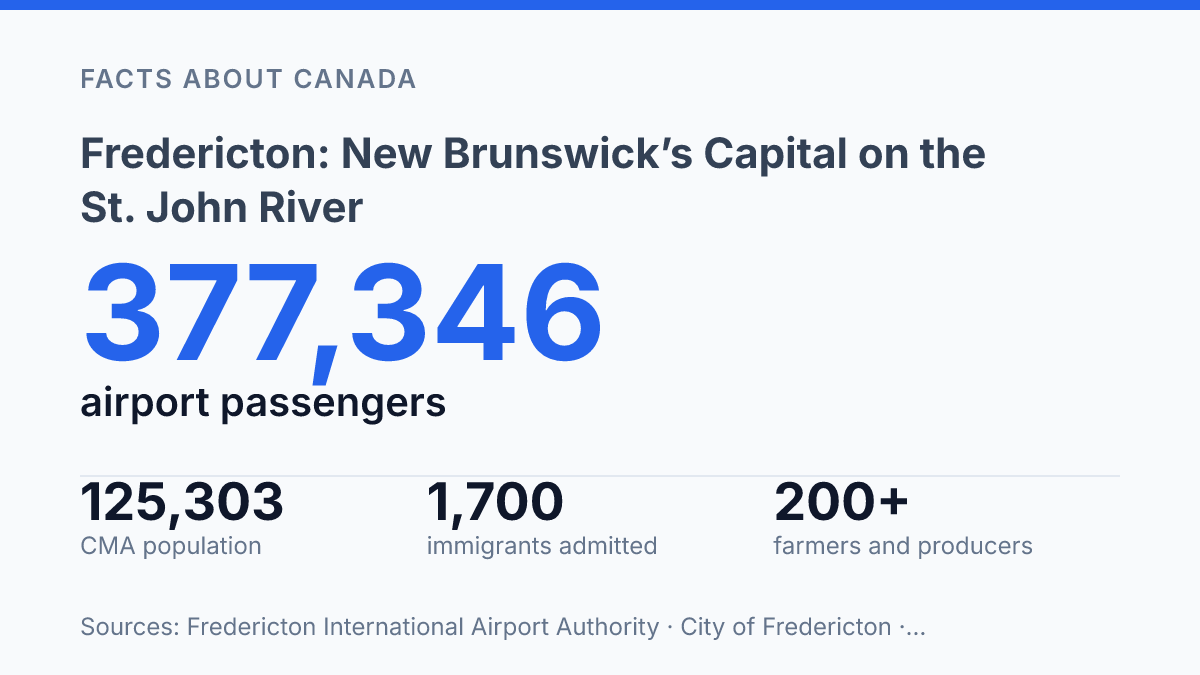
Fredericton reached an estimated 79,000 residents after annexation, while its census metropolitan area climbed to 125,303 in 2025, a scale of growth that complicates the image of a quiet small capital. Its position on the St. John River still explains much of its role, but the city’s present appeal also depends on access: the airport is 14 kilometres from downtown, and road links place Halifax, Bangor, Montreal and Boston within a practical regional travel frame.
The same pattern appears in its cultural geography. A rare British garrison legacy, a major public art collection that began with Lord Beaverbrook’s 1959 gift of 300 works, and a market with more than 200 producers all point to a capital whose identity is built through institutions as much as scenery.
Where Fredericton sits and why it matters
New Brunswick’s capital sits far enough inland to feel sheltered from the Bay of Fundy, yet the St. John River keeps it tied to older movement routes across eastern Canada. That capital is Fredericton, positioned on the river in the central-western part of the province, where water access helped guide settlement patterns before modern highways made overland travel dominant. The river still gives the city a legible shape: civic, residential, and institutional areas sit close to a natural corridor that has long supported movement, orientation, and urban growth.
Its scale also matters: according to the City of Fredericton, the pre-annexation population reached 74,655 on July 1, 2025; including annexed areas, the city estimates about 79,000; and the census metropolitan area reached 125,303, up 2,803 from 2024. Those figures place the city between two identities: it is small enough for the riverfront and core districts to remain closely connected, but large enough to function as the main public-sector hub for provincial administration.
As an administrative centre, the city concentrates government offices, legislative activity, and provincial services that affect communities well beyond its municipal boundaries. That role gives it the practical weight of a capital, even when its built form feels more compact than many seats of government. The contrast is central to understanding its civic character: political functions are present, but they are set within a riverside city where geography softens the impression of bureaucracy and makes the capital feel closely tied to its setting.
Historic Garrison District and the Changing of the Guard
Only four remaining structures survive from the British garrison era that shaped the Historic Garrison District, according to the City of Fredericton Economic Vitality Committee. The district began as an 18th-century British army base, with the garrison period running from 1784 to 1869; the 11 Carleton Street Militia Arms Store, built in 1832, is one of the clearest physical links to that military past. Its national historic designation in 1960 reflects not only the age of the site, but also the rarity of intact garrison-era fabric in the city centre.
The best-known public ritual associated with the area is the Changing of the Guard, a seasonal ceremony that translates the district’s military origins into a visitor-facing performance. Rather than asking visitors to interpret the former base only through plaques and surviving buildings, the ceremony gives the heritage setting movement, sound and a clear link to regimental tradition. Current programming should still be checked before planning around it: the official 2026 Historic Garrison District page promotes free summer events from June 11 to September 10, including concerts, films and the Garrison Night Market, but does not list the ceremony in that schedule.
What keeps the district from feeling like a preserved relic is its everyday cultural use. Artists’ studios bring working craft and visual production into the former military precinct, while an outdoor theatre turns the open heritage space into a performance venue during the warmer months. This combination explains why the Historic Garrison District is the city’s most recognizable heritage area: its military past remains legible, but the site now functions as a civic stage for seasonal events, creative work and public gathering rather than as a static historic enclosure.
Art museums and market culture
A gallery that began with a 300-work gift now holds over 7,000 objects, giving the city an art institution with a reach larger than its scale might suggest. According to the Beaverbrook Art Gallery, its permanent collection began in 1959 with Lord Beaverbrook’s donation, and it has since grown into holdings that include Canadian and international works. The Beaverbrook Art Gallery therefore functions as more than a visitor stop: it places regional identity in conversation with national and global art histories through a collection broad enough to support changing exhibitions and sustained public programming.
Just to the south, Fredericton Boyce Farmers Market gives cultural life a more everyday form. The market features more than 200 farmers, purveyors and producers, according to the market’s own 2026 profile, and its mix of seasonal produce, prepared food and crafts makes it a practical commercial space as well as a social one. Unlike a museum collection, its character changes with the growing season and with the makers present on a given market day, which keeps local food culture visible rather than abstract.
Taken together, these two stops show that the city’s appeal is not held in a single landmark or limited to official heritage. The gallery represents formal cultural preservation and interpretation, while the market reflects daily exchange, regional agriculture and craft production. That split gives the capital a cultural layer beyond government functions and historic tourism, with art and food culture operating as parallel ways of understanding local identity.
How to read the city’s appeal today
The capital region admitted 1,700 immigrants in 2025, according to the City’s 2026 population reporting, so the city’s modest scale should not be read as cultural stillness. That contemporary growth sits within a core whose public identity remains unusually concentrated. The St. John River gives the centre a clear physical orientation, while the nearby heritage district, gallery, market activity and civic spaces keep much of the visitor-facing city within a walkable frame.
Capital status gives the city a weekday rhythm shaped by administration, public service and institutional routines. Tourism and local cultural life operate differently: they draw attention to preserved military heritage, formal art collections, food and craft exchange, and public programming that changes with the season. The contrast is not a split personality so much as a layering of uses, with government work providing civic purpose and cultural activity giving the central area a broader public role.
The city is often associated with history, arts and seasonal events because those themes reinforce one another in the same compact setting. Heritage supplies the spatial memory, art institutions provide curated cultural depth, the market anchors local production and social exchange, and summer programming turns historic spaces into recurring public venues.
Read this way, the city’s appeal is not based on size or spectacle. It rests on the balance between administrative function, river-oriented urban form and a modest but distinct cultural profile.
What growth changes about the capital’s appeal
The more useful way to read the city is as a small capital absorbing larger-capital pressures without losing the scale that makes its institutions visible. Population growth, international migration and recovering air traffic raise practical questions about housing, transport, public space and cultural capacity. They also make the historic core more than a visitor zone; it becomes a shared reference point for residents arriving from different places.
That balance is not automatic. If growth continues, the city’s advantage will depend on whether its riverfront, public programming, galleries and markets remain accessible parts of daily life rather than isolated amenities for select audiences.
Frequently Asked Questions
Q: What is Fredericton best known for?
A: Fredericton is known for its role as New Brunswick’s capital and for its setting on the St. John River. It is also associated with the Historic Garrison District, where an 18th-century British army base now hosts the Changing of the Guard ceremony, artists’ studios, and an outdoor theatre.
Q: Is Fredericton worth visiting for history and culture?
A: Yes. The city concentrates several cultural sites in a compact area, including the Historic Garrison District and the Beaverbrook Art Gallery. That mix makes it useful for visitors interested in military history, public art, and local performance spaces.
Q: What can visitors do in the Historic Garrison District?
A: The district offers a mix of heritage and cultural activities. Visitors can watch the Changing of the Guard ceremony, explore artists’ studios, and attend events at the outdoor theatre. Its 18th-century military origins give the area a clear historical frame.
Q: Where is the Beaverbrook Art Gallery in relation to Fredericton’s main sights?
A: The Beaverbrook Art Gallery is nearby the Historic Garrison District, making it an easy addition to a short visit. Its collections include Canadian and international works, which broadens the city’s cultural offering beyond local heritage sites.
Q: What can be found at the Fredericton Boyce Farmers Market?
A: The Fredericton Boyce Farmers Market sells seasonal produce and crafts. Located just south of the main historic area, it adds a local food and artisan stop to the city’s visitor circuit.