
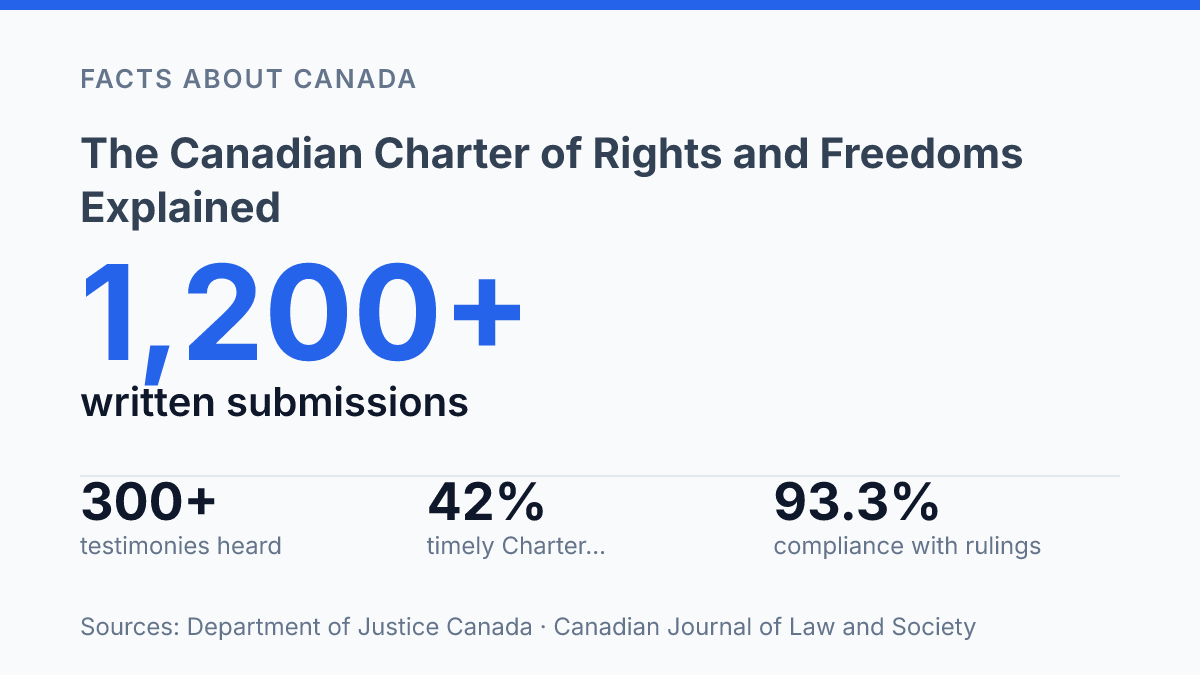
The Canadian Charter of Rights and Freedoms emerged from an unusually public constitutional process: before the Canada Act was signed in Ottawa on April 17, 1982, a parliamentary committee reviewed more than 1,200 written submissions and heard over 300 witnesses. That origin matters because the Charter is not a free-standing rights declaration; it is part of Canada’s Constitution and binds governments in specific ways. Its protections are often grouped into seven categories, from fundamental freedoms and legal rights to equality and language education rights, yet those guarantees do not operate as absolute commands.
Courts must decide when state action infringes a right, whether a limit can be justified under section 1, and how section 33 can temporarily shield legislation from some Charter challenges. The result is a rights framework built on both protection and structured restraint.
What the Charter is and where it fits in the Constitution
Before it became enforceable constitutional law, a parliamentary committee reviewed more than 1,200 written submissions and heard over 300 testimonies, according to the Department of Justice Canada. That process preceded the enactment of the constitutional text that now gives the Charter its legal authority.
The Canadian Charter of Rights and Freedoms is a constitutional bill of rights and forms the first part of the Constitution Act, 1982. Its placement is legally significant because it is not an ordinary statute that Parliament or a legislature can amend or override in the usual way. It is entrenched in the Constitution of Canada, which means it sits above ordinary legislation within Canada’s legal hierarchy.
Queen Elizabeth II signed it into law on April 17, 1982, as part of the constitutional changes that brought the Constitution Act, 1982 into force. From that point, the Charter became part of the supreme law that courts use to assess whether government action and legislation comply with constitutionally protected rights and freedoms.
This superior legal status gives the Charter strong force, but it does not enforce itself automatically. Its practical effect usually depends on constitutional interpretation, legal challenges, and judicial remedies. Courts decide whether a government law or action is inconsistent with the Charter and, when necessary, determine the appropriate constitutional consequence.
Which governments must follow it
A federal immigration rule, a provincial health law, and a territorial education policy can all be measured against the Charter, while a purely private contract normally cannot. The key application rule is section 32(1), which says the Charter applies to the Parliament and Government of Canada and to each provincial legislature and government; Justice Canada’s 2026 Charterpedia describes its reach as extending broadly across federal, provincial, and territorial governments. In practical terms, public authority at each level must act within Charter constraints when making laws, administering programs, enforcing rules, or exercising official powers.
This means the Charter does not apply only to statutes passed by legislatures. It can also constrain regulations, government policies, administrative decisions, policing, public-service delivery, and other state action when a public body is exercising legal authority. The legal question is usually not just whether a government actor is involved, but how the challenged rule or conduct affects a protected right in its specific context.
Private disputes are treated differently because the Charter is primarily a limit on government power rather than a general code for all relationships between individuals, companies, or organizations. A disagreement between private parties does not become a Charter case merely because one party claims unfairness or discrimination. Private conduct may still be regulated by ordinary legislation, human rights codes, contract law, employment law, or other legal rules, but those frameworks operate differently from direct constitutional review.
The boundary is broad but not mechanical. Courts examine the source of the authority being used, the nature of the decision-maker, and the connection between the challenged action and government responsibility. That case-by-case approach explains why Charter application can be clear in some settings, such as legislation or official enforcement, and more complex where public and private functions overlap.
Core rights protected under the Charter
A single Charter dispute can turn on very different protections, from a person’s right to speak or worship freely to the rules police must follow before searching a home or making an arrest. Federal justice materials commonly organize these protections into 7 categories: fundamental freedoms, democratic rights, mobility rights, legal rights, equality rights, official language rights, and minority language education rights. That grouping is useful because the Charter does not protect only courtroom rights; it also shapes political participation, movement within Canada, public institutions, and access to services in English or French.
Fundamental freedoms cover conscience, religion, thought, belief, opinion, expression, peaceful assembly, and association. These guarantees have wide reach because expression can include political speech, artistic activity, protest, advertising, and other forms of communication. Their breadth is deliberate, but it also means disputes often turn on boundaries, such as when expressive activity conflicts with another public objective or when religious freedom is raised in an institutional setting.
Legal rights focus on the relationship between individuals and the justice system. They include protection against unreasonable search and seizure, safeguards on arrest or detention, the right to be informed of reasons for detention, access to counsel, trial within a reasonable time, and protections connected to fair hearings and punishment. These rights are especially significant because they regulate state power at moments when liberty, privacy, and physical security may be most exposed.
Equality and language protections operate in a different but equally structural way. Equality rights address discriminatory treatment before and under the law, including unequal benefit or protection of the law based on listed or analogous grounds.
Language rights support the use of English and French in key federal institutions and, in specific contexts, provincial institutions, while minority language education rights protect access to schooling for eligible communities. Together, these guarantees show that the Charter is not limited to preventing government overreach; it also sets baseline conditions for fair legal treatment and participation in public life.
How courts balance rights with limits
Section 1 makes the Charter unusually strong but not absolute: a government can lose on a rights claim and still preserve a law if the limit is justified with evidence and proportional reasoning. The clause permits only “reasonable limits prescribed by law” that can be demonstrably justified in a free and democratic society, according to Justice Canada’s Charterpedia. In practice, this means the analysis does not end when a court finds that official action restricts a protected interest; the government then carries the burden of explaining why the restriction is lawful, important, carefully designed, and not excessive in its effects.
The Supreme Court of Canada has been central to turning that text into a working legal test. In R. v.
Oakes, the Court developed the proportionality framework that still structures most section 1 analysis: the objective must be pressing and substantial, the law must be rationally connected to that objective, the impairment of the right must be as limited as reasonably possible, and the benefits must outweigh the harm to the protected interest. This approach gives courts a disciplined method for reviewing legislation without treating every rights infringement as automatically fatal.
That framework matters most when governments defend laws affecting expression, personal security, or equal treatment, because the constitutional question becomes more precise than whether the law has a worthy purpose. Courts examine the quality of the evidence, the fit between the measure and the objective, the existence of less impairing alternatives, and the real-world impact on affected people. A law aimed at public safety, administrative fairness, or social policy may still fail if its reach is broader than its justification can support.
Remedies are part of the same constitutional structure. Courts may declare legislation invalid, suspend a declaration to give lawmakers time to respond, read provisions narrowly, or grant individual relief where appropriate.
A 2026 empirical study in the Canadian Journal of Law and Society found that, in Supreme Court Charter invalidation cases from 2010 to 2023, legislatures complied with the Court’s rulings in 93.3% of cases. That figure suggests that judicial review often prompts legislative revision rather than simple institutional deadlock, while section 1 remains the main mechanism through which rights protection and justified public regulation are assessed together.
Where Charter scrutiny is becoming more visible
Charter law is becoming more visible as a public governance process, not only as courtroom doctrine. Justice Canada’s Charter Statements website received more than 1 million visits between December 2020 and August 2023, while a 2024 evaluation found that only 42% of federal statements were tabled before or on the day second reading began. That gap matters because rights review is most useful when it informs debate before legislative positions harden.
At the same time, recent scholarship counting 12 notwithstanding clause invocations between 2018 and 2026 shows that constitutional limits are now part of active political strategy. The practical question ahead is not whether the Charter matters, but how early and openly governments account for it.
Frequently Asked Questions
Q: What does the Canadian Charter of Rights and Freedoms protect?
A: It protects core rights and freedoms in Canada, including fundamental freedoms, democratic rights, mobility rights, legal rights, equality rights, and language rights. As part of the Constitution, it sets binding limits on government action at the federal, provincial, and territorial levels.
Q: When did the Canadian Charter of Rights and Freedoms come into effect?
A: It was signed into law on April 17, 1982. That date marks its formal entry as part of the Constitution Act, 1982.
Q: Is the Charter part of Canada’s Constitution?
A: Yes. The Charter is the first part of the Constitution Act, 1982, which entrenches it within the Constitution of Canada. That constitutional status gives it higher authority than ordinary legislation.
Q: Does the Charter apply to provincial governments?
A: Yes. It applies to all federal, provincial, and territorial governments, which means public bodies across Canada must act consistently with its guarantees. This broad reach is one reason it shapes both national and local government decisions.
Q: Who signed the Canadian Charter of Rights and Freedoms into law?
A: Queen Elizabeth II signed it into law. Her signature on April 17, 1982 formalised the Charter as part of Canada’s constitutional framework.