
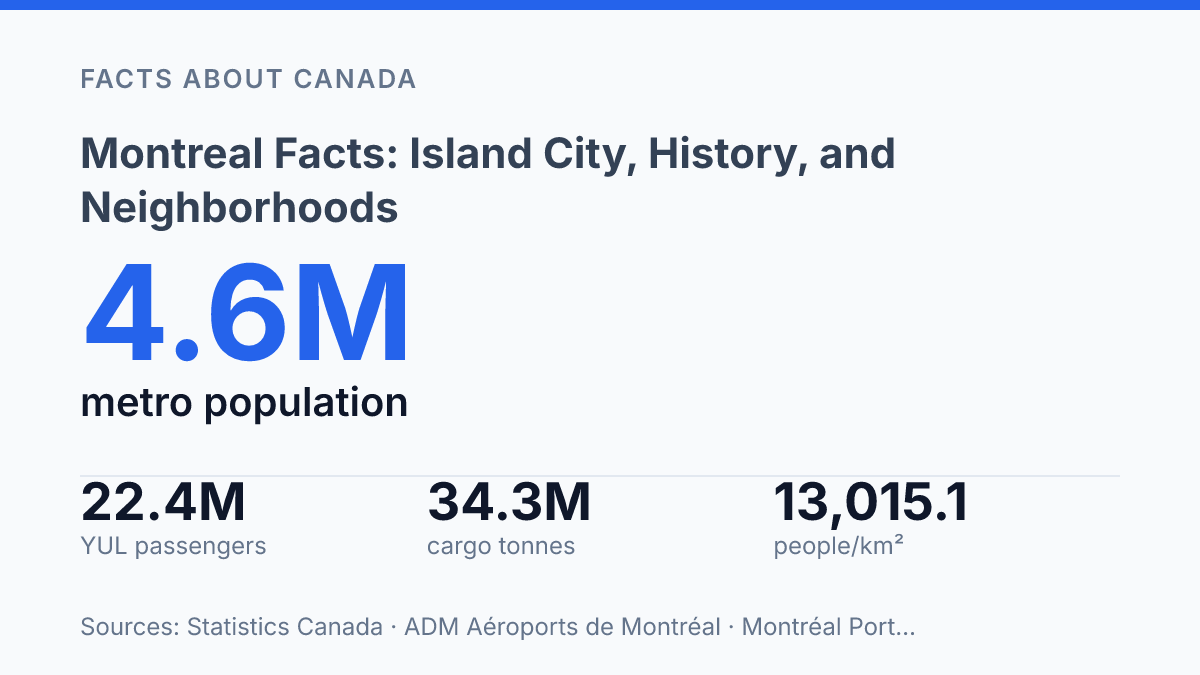
Montreal’s CMA reached 4,597,837 people on July 1, 2025. The real story is the slowdown: 0.5% growth after 2.4% the year before.
That contrast fits the city better than any postcard. It’s an island built on movement, yet its identity keeps coming from borders: river channels, parish lines, former towns, language, and borough maps.
Cargo still proves the point. The port handled 34.3 million tonnes in 2025, and YUL moved a record 22.4 million passengers in 2024.
The older layers are just as precise. Paul de Chomedey de Maisonneuve reached the island on May 17, 1642, then Ville-Marie began the next day. In my honest opinion, that origin matters less as a founding myth than as a clue. To understand the city, you need to see why Old Montréal and the Plateau feel like different urban arguments on the same island.
Where Montreal sits and why the location matters
A city can sit on an island and still command a region of more than 4,597,837 people. That tension defines Montréal better than any postcard view. The urban core feels enclosed by water, bridges, slopes, and old street patterns, but its influence reaches far beyond the shoreline.
The city stands on Île de Montréal, set in the Saint Lawrence River. That position shaped how people moved, traded, and built. Roads and rail lines had to answer to the island’s edges.
Bridges became strategic, not decorative. Expansion could not simply spread in every direction at once, so density, port access, and cross-river connections mattered from the start.
This is why the city doesn’t behave like a generic provincial capital. It’s Québec’s largest city. That scale gives it cultural weight, business pull, and regional authority.
As of July 1, 2025, the Montréal census metropolitan area had 4,597,837 people, up 0.5% from the previous year after 2.4% growth the year before, according to Statistics Canada. Growth cooled. The metro area still shows why the island city matters far outside its municipal limits.
At the center rises Mount Royal, the triple-peaked hill that gave the city its name. It does more than mark the skyline. It interrupts the grid, anchors orientation, and makes the city feel physically layered rather than flat.
You don’t just move through streets here. You move around a hill, toward the river, or across a bridge.
In my view, the most useful way to understand Montréal is as a compact island city with metropolitan reach. The island form keeps the center legible and bounded.
The daily city spills across suburbs, commuter routes, industrial corridors, and river crossings. That contrast gives the place its character: contained at first glance, expansive the moment you follow where people actually live and move.
From French colonial roots to a modern metropolis
Ville-Marie began with about 40 people from France in 1642, but its street pattern still does more than decorate postcards. The settlement founded by Paul de Chomedey de Maisonneuve became the old core now known as Vieux-Montréal, where the scale feels older than the skyline around it.
You see it in the tight blocks, the stone façades. The way civic and religious buildings still command the best sightlines.
Walk through Vieux-Montréal and the colonial character is right underfoot. Cobblestone streets slow people down, which changes how the district feels. It isn’t only pretty.
It forces you to notice shopfronts, courtyards, church towers. The narrow rhythm of streets laid out for a different age.
Notre-Dame Basilica gives the old district its most dramatic focal point. Built from 1824 to 1829, the Gothic Revival landmark was designed to hold 8,000 worshippers and now welcomes over 1 million visitors a year, according to Basilique Notre-Dame de Montréal. That number explains the crowds.
It doesn’t explain the building’s grip on the area. Its scale turns the surrounding streets into a kind of approach.
Heritage sells the district, but Vieux-Montréal isn’t a preserved stage set. People still live above restaurants, work in offices behind old stone walls, rush to appointments, and cross the same streets tourists stop to photograph. In my honest opinion, that tension is what keeps the old quarter from feeling fake.
The French imprint also reaches beyond architecture. Montréal helps anchor Québec’s French-speaking identity through everyday public life: street names, storefront language, parish traces, and civic spaces that grew from colonial-era planning.
The past isn’t frozen there. It keeps shaping what you read, where you walk, and how the city presents itself at street level.
How boroughs changed after independent cities merged
The strangest thing about the 2002 merger is how little it erased on the ground. Former cities and towns didn’t simply lose their habits when they joined the larger municipality. Their street grids, local services, school ties, shopping streets, and civic loyalties kept shaping daily routines.
That’s why the borough system matters. It gives local districts a formal way to manage parks, libraries, permits, waste collection, zoning details, and cultural programming without pretending every area works the same way. One council table can govern the whole city, but people still experience it through much smaller territories.
The structure also changed quickly. According to the Site officiel du Mont-Royal, the island-wide city began with 27 boroughs, then shifted by 2006 into the city of Montréal with 19 boroughs and 15 separate municipalities around it.
That sounds technical. It changed who answered for local decisions and who felt represented.
Density makes the differences obvious. Le Plateau-Mont-Royal had 105,813 residents in the 2021 census and a density of 13,015.1 people per square kilometre, according to Ville de Montréal and Statistics Canada. Ville-Marie had a similar population count, but its density was roughly half as high, and its 2016–2021 growth reached 17.7%.
Same urban system. Very different pressure.
Older central areas carry government offices, tourism, nightlife, and heritage streets in tight quarters. Newer residential or mixed-use districts tend to feel more practical: schools, duplexes, shopping plazas, transit stops, and local parks do more of the daily work.
The contrast isn’t better versus worse. It’s rhythm versus rhythm.
One city exists on paper, but its neighborhoods still feel stubbornly separate in practice… and that’s part of the appeal. In my humble opinion, the borough model works best when it protects that friction instead of smoothing it away.
Vieux-Montréal vs the Plateau: two very different faces
Only a short ride separates ceremonial stone from balcony chatter. That small distance explains why the city can feel like two places at once.
Vieux-Montréal earns the attention it gets. Its cobblestoned streets, preserved facades, and Notre-Dame Basilica give the old core a formal weight that photographs well. The mood is polished, historic, and slightly staged in the best possible way.
The postcard pull is real: Tourisme Montréal reported in its 2024 annual report that visits to the metropolis rose nearly 7% compared with 2023. Heritage districts benefit from that demand.
They can also feel curated for visitors. You don’t need to dislike that to notice the tradeoff.
The Plateau works differently. It feels denser, looser, and more lived-in, with exterior staircases, packed blocks, murals, corner shops, and people using the street as a social room.
Its bohemian reputation isn’t just an aesthetic. It comes from local culture that still shows up at sidewalk level.
That contrast matters more than any checklist of attractions. The old core gives you the old-world version of Montréal, with grand interiors and stone streets. The Plateau gives you the modern city in motion, less polished but more immediate.
The polished heritage of Vieux-Montréal gets the postcard treatment. The Plateau often feels more like where the city actually lives. In my view, that second feeling is what keeps the trip from becoming a museum walk.
What the Island Still Explains Better Than Any Postcard
The next smart way to read Montreal is through friction, not charm.
A port that moved 34.3 million tonnes of cargo can sit a short walk from stone streets built for horses. Notre-Dame Basilica can draw more than 1 million visitors a year. The Plateau still explains daily life better than a landmark ever will. Municipal borders add another twist.
The island-wide merger of 2002 tried to make one city legible. The later split proved local identity doesn’t obey a neat map.
Use the facts as coordinates, then watch how people move between them. In my humble opinion, the city makes the most sense when you stop asking what it is and start asking which version you’re standing in.
Frequently Asked Questions
Q: Why is Montreal built on an island?
A: Montreal sits on an island in the Saint Lawrence River. That geography shaped how the city grew. The river made it a natural hub for trade and travel. It also limited how the city could expand. That pressure helped shape the dense urban core people know today.
Q: What does the name Montreal mean?
A: The city is named after Mount Royal, the triple-peaked hill at its center. That link is easy to miss if you only know the downtown skyline. The name points straight back to the land itself. Mount Royal still gives the city its identity. Saint Lawrence River frames the island setting. Québec is the province where Montreal stands.
Q: Is Montreal the biggest city in Quebec?
A: Yes. Montreal is the largest city in Canada’s Québec province. That matters because it acts as the province’s biggest urban center for culture, work, and transport. Montreal is the largest city in Québec. 1 city carries the strongest pull in the province.
Q: What are the main neighborhoods in Montreal?
A: Montreal’s boroughs include neighborhoods with very different personalities, from Old Montreal’s cobblestones to the Plateau’s bohemian feel. What’s often missed is that many boroughs were once independent cities. The city still feels layered rather than uniform. In my view, that’s what makes Montreal more interesting than a city with one obvious center.
Q: What is Old Montreal known for?
A: Old Montreal is known for its cobblestone streets and French colonial character. The Notre-Dame Basilica sits at the center of that area. It gives the district a strong visual anchor. Notre-Dame Basilica is the standout landmark. Vieux-Montréal keeps the old street pattern alive. French colonial history still shows in the layout.