
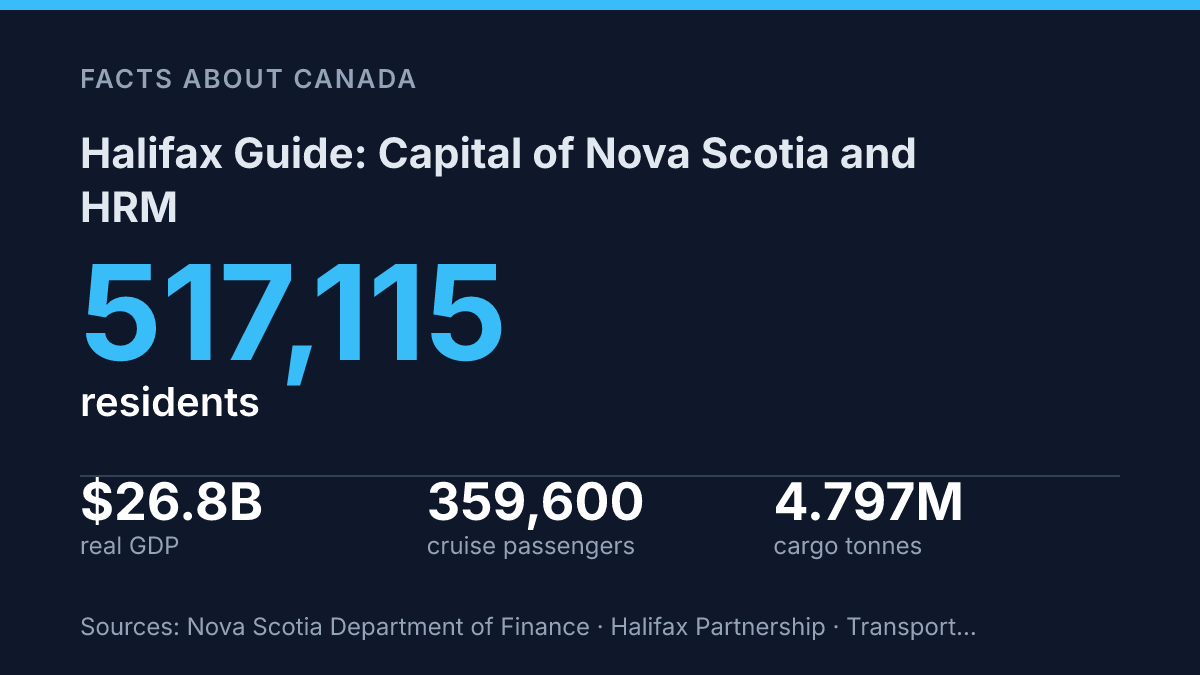
Halifax held 47.3% of Nova Scotia’s population on July 1, 2025, making it less a conventional provincial capital than the place where nearly half the province’s demographic weight is concentrated. The municipality’s 517,115 residents accounted for 7,835 of Nova Scotia’s 10,476 net new residents over the prior year, while real GDP reached $26.8 billion in 2017 dollars, already above a 2027 target reported by the local economic development agency. Those figures explain why a guide to the capital has to look beyond landmarks or civic labels.
The useful questions are structural: how regional government works across urban, suburban, and rural communities; why the labour market and municipal budget carry provincial significance; and how the port, cruise traffic, and Atlantic location connect the municipality to wider Canadian geography. The result is a city best understood as both a capital and a regional operating system.
Why Halifax Matters in Nova Scotia
Almost half of Nova Scotia’s residents live in one municipality, which makes the province’s capital much more than a seat of government. Halifax is the capital of Nova Scotia, but its civic importance is also demographic: as of July 1, 2025, HRM had a population of 517,115, equal to 47.3% of Nova Scotia’s 1,093,245 residents, and accounted for 7,835 of the province’s 10,476 net new residents over the prior year, according to the Nova Scotia Department of Finance. Those figures show why provincial administration, labour markets, public services, and regional planning are so strongly centred in the capital municipality.
The full official municipal name is Halifax Regional Municipality, usually shortened to HRM in government and planning contexts. The shorter city name remains common in everyday use, but the official structure matters because it defines the municipal government responsible for local services, taxation, land-use decisions, transportation planning, emergency services, and community infrastructure across the municipality. This distinction also affects population comparisons: HRM is not just the historic urban core, but the legal municipality whose boundaries are used in provincial and municipal statistics.
As the most populous municipality in Nova Scotia, HRM functions as the province’s primary administrative and population centre. That status does not mean every provincial institution or economic activity is located there, but it does mean decisions made in and for HRM often have province-wide implications. When nearly one in two Nova Scotians lives under the same municipal government, local service capacity, housing supply, transportation networks, and planning choices become central to understanding how the province operates as a whole.
How Halifax Regional Municipality Is Organized
The 1996 amalgamation made one local council responsible for an area that had previously been split among separate urban, suburban, and county-level administrations. That change created HRM by combining the former cities of Halifax and Dartmouth, the Town of Bedford, and the Municipality of the County of Halifax. The result was not simply a renamed city, but a regional municipality with a much wider jurisdiction than the older city-only boundary suggested.
This structure means HRM includes the urban core as well as surrounding communities, suburban districts, coastal settlements, and rural areas under the same municipal government. The practical effect is that local services, land-use planning, taxation, policing arrangements, transit decisions, and infrastructure priorities are managed across a broad regional area rather than through several neighbouring municipal governments. Administrative boundaries therefore describe a regional service area, not just the downtown or historic peninsula.
Political representation reflects that regional scale. Since 2012, according to Halifax Regional Municipality, the municipality has had 16 electoral districts, each represented by one councillor, with a mayor elected at large. Council has also established four community councils covering groups of districts, which allows some local planning and development matters to be considered closer to the communities affected while still operating within the wider municipal framework. Regional Council remains the central decision-making body for municipality-wide policy and budgets.
The amalgamated model simplifies administration because one municipality can coordinate services across a connected urban region and its surrounding areas. It also complicates comparisons with older population figures, maps, and historical references.
A number from before amalgamation may describe the former city only, while a modern HRM figure describes a much larger municipality. For demographic, economic, or planning analysis, that distinction is essential: the same place-name can refer either to a historic urban core or to the broader regional government created in the 1990s.
Population, Economy, and Public Role
Statistics Canada’s 2021 Census recorded 439,819 people in HRM, a figure that helps separate the official census count from later annual population estimates. The census number matters because it is the baseline used for many demographic comparisons, service-planning models, and federal statistical products, while annual estimates track more recent movement between census years.
Public administration gives the municipality an economic role beyond its local tax base. The Nova Scotia Legislature sits at Province House, and major provincial departments, agencies, and administrative offices are concentrated in the urban core. That concentration supports employment in policy, finance, justice, health administration, and public services, while also increasing demand for office space, professional services, transit, and civic infrastructure.
The labour market reflects that institutional weight but is not limited to government. According to the Partnership’s 2026 economic update, HRM’s real GDP reached $26.8 billion in 2025, measured in 2017 dollars, after 2.3% real growth over the previous year. The same update reported a 2025 labour force of 297,400, employment growth of 3,200 positions, and an unemployment rate of 5.6%, indicating a large service-based labour market with continued expansion but not unlimited spare capacity.
Education and health care are especially visible anchors within that mix. Dalhousie University, Saint Mary’s University, and the Nova Scotia Community College system support teaching, research, student spending, and specialized employment. Health care is centred on institutions such as the QEII Health Sciences Centre and IWK Health, which draw patients, clinicians, researchers, and administrative staff from well beyond the municipality.
Port-related activity adds a different kind of economic function, tied to trade, logistics, and visitor movement rather than office-based public service. The port authority’s 2024 statistics summary reported 4.797 million metric tonnes of cargo at its facilities, including 509,000 TEUs of containerized cargo.
Transport Canada recorded 359,600 cruise passengers in 2024, showing how marine infrastructure supports both freight movement and seasonal tourism. Taken together, these sectors show a diversified urban economy built from public functions, services, education, health care, and maritime activity rather than one dominant industry.
What Halifax Means in Canadian Geography
A North Atlantic location gives the municipality a rare Canadian geography: it is closer by sea to major European routes than inland capitals whose connections depend mainly on continental corridors. Located on Nova Scotia’s Atlantic coast, the city sits on a deep, ice-free harbour opening to the Atlantic Ocean. That position makes maritime access not just local infrastructure, but a national-facing connection point where ocean shipping links with rail and highway systems serving the rest of eastern Canada.
The port’s geography helps explain why it functions as one of the region’s major marine gateways rather than only a provincial facility. According to the port authority’s 2025 statistics summary, containerized trade handled at its facilities was distributed across Asia at 41%, Europe at 34%, and Latin America and the Caribbean at 14%. The spread shows that the port is not oriented to a single nearby market; it connects Atlantic Canada to several transoceanic trading regions.
Within Atlantic Canada, this role differs from Saint John, Moncton, and Fredericton. Saint John is also a port city, with an industrial harbour on the Bay of Fundy, while Moncton’s regional significance is tied more to its inland position and road and rail distribution. Fredericton, although a provincial capital, functions primarily as an administrative and university centre rather than a marine gateway.
The same coastal geography also creates distance-based planning pressures. Separation from the Quebec–Windsor corridor, the Greater Toronto Area, and other central Canadian markets means growth depends on strong long-distance transport links and sustained port, rail, airport, and highway capacity. Coastal access supports trade and international connectivity, but infrastructure planning must account for a city that is both outward-facing across the ocean and relatively far from the country’s largest population and consumer markets.
Where provincial growth becomes municipal capacity
The next test is not whether the capital keeps growing, but whether public systems can absorb growth that is slower than 2024 yet still concentrated. A municipality managing a $1.33 billion operating budget, a $0.31 billion capital plan, and port activity measured in hundreds of thousands of containers has to make local choices with provincial effects.
Housing approvals, transit capacity, tax policy, harbour infrastructure, and district representation will shape more than municipal service levels; they will influence where Nova Scotia’s next residents and employers can realistically settle. If the province keeps adding people unevenly, the capital region will remain the place where demographic arithmetic turns into roads, council votes, tax bills, and berth space.
Frequently Asked Questions
Q: Is Halifax the capital of Nova Scotia?
A: Yes. Halifax is the capital of Nova Scotia and serves as the province’s main administrative centre. It is also the largest municipality in the province by population.
Q: What does HRM stand for in Halifax?
A: HRM stands for Halifax Regional Municipality. It is the official municipal name used for the city and surrounding communities governed together under one local government.
Q: Is Halifax a city or a municipality?
A: Halifax is officially a regional municipality rather than a single incorporated city. The municipality includes Halifax and other communities that were amalgamated into one governing unit.
Q: Why is Halifax important in Nova Scotia?
A: Halifax is important because it combines provincial government functions with the province’s largest population centre. That makes it a key location for public administration, services, and regional economic activity.
Q: What is the difference between Halifax and Halifax Regional Municipality?
A: Halifax usually refers to the urban centre, while Halifax Regional Municipality refers to the full municipal government area. In official usage, HRM is the broader legal entity that includes the city core and surrounding communities.