
The question “What is the best city to live in Canada?” has no single answer in 2026 because the leading candidates win on different measures: Ottawa scored 177.8 in Numbeo’s 2025 Quality of Life Index, while Québec City’s average purpose-built two-bedroom rent was $1,277, according to CMHC. Those two numbers frame the problem better than any national top-ten list. A city can be safe, relatively affordable, career-rich, or internationally admired, but rarely all at once.
Vancouver ranks 10th globally in the EIU liveability table, Toronto remains Canada’s strongest career market, and Calgary and Edmonton are drawing some of the country’s fastest population growth. This comparison looks at Canadian cities through the measures that change daily life most: housing costs, wages, safety, employment depth, and the kind of resident each place is most likely to serve well.
How to compare Canadian cities fairly
A city that looks affordable on rent can become expensive once commuting, taxes, and income prospects are counted together. Fair comparisons therefore need to separate livability from affordability and then reconnect them through household circumstances: income level, job sector, housing needs, tolerance for winter or rain, and reliance on transit or a car. This is why no single urban centre can win for every resident; the same housing market can suit a high-earning renter, strain a family seeking a detached home, and be irrelevant to someone whose career is tied to a different region.
Composite rankings are useful starting points because they measure more than reputation. The Numbeo Quality of Life Index, for example, combines indicators such as purchasing power, safety, health care, cost of living, property price-to-income ratios, traffic commute time, pollution, and climate.
In 2025, Numbeo reported Ottawa at 177.8, ahead of Vancouver at 177.0, Halifax at 170.6, and Quebec City at 170.4, with Ottawa’s pollution index at 24.6. The value of this kind of index is not that it settles the question, but that it shows which factors are being rewarded and which may be absent from a personal decision.
Affordability also changes when local details are included. Provincial income taxes, sales taxes, utility costs, insurance costs, and public-service funding can alter take-home pay and recurring expenses even when salaries look similar. Transit access has a similar effect: a lower rent far from frequent service may require car ownership, while a higher rent near reliable transit can reduce transport costs and commute stress.
Housing supply is another reason averages need careful handling. A citywide rent or ownership measure can hide sharp differences between central apartments, suburban townhomes, older purpose-built rentals, and newly built units.
High livability scores may reflect strong overall conditions while still masking pressure in specific neighbourhoods or for households entering the market for the first time. A fair comparison should therefore treat rankings as a filter, not a verdict, and weigh them against wages, housing availability, climate preferences, and access to suitable work.
Cities that score well for livability and value
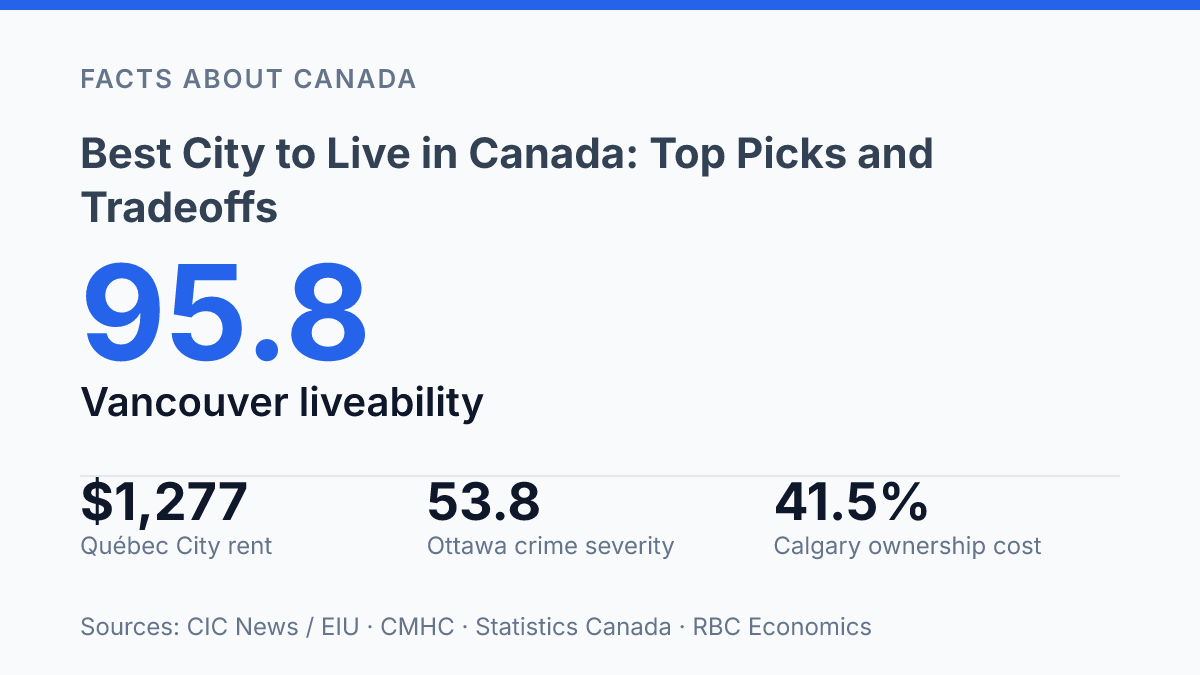
Québec City’s average purpose-built two-bedroom rent was $1,277 in 2025, according to CMHC, making its rental market one of the clearest value cases among major Canadian urban areas. The city pairs that housing advantage with a low Crime Severity Index of 55.3 in Statistics Canada’s 2024 data, well below the national index of 77.9. The constraint is practical rather than cosmetic: French is central to work, public services, schooling, and everyday transactions, so the affordability advantage is easier to access for residents who can function in French.
Ottawa offers a more balanced version of the same value argument, especially for households that want stable employment options without Toronto-level housing pressure. Federal government work anchors the labour market, while the technology sector gives the capital a private-sector base as well; CBRE ranked Ottawa No. 14 in North America for tech talent in its 2026 scoring report.
Safety also supports the case, with Statistics Canada reporting a 2024 Crime Severity Index of 53.8 for Ottawa, lower than Toronto’s 59.4 and below the national figure. Its cleaner environment and lower housing strain help explain why it is often treated as a high-livability alternative to Canada’s largest city: RBC Economics put Ottawa’s aggregate ownership-cost measure at 43.2% of typical pre-tax household income in Q1 2026, while single-detached ownership costs in Toronto consumed more than 80%.
Halifax is less of a bargain than it once was, but it still appeals as a lower-cost Atlantic option with a broader employment base than many smaller coastal cities. CMHC listed average purpose-built two-bedroom rent at $1,826 in 2025, below Toronto and Vancouver, and reported that Halifax turnover rent eased from $2,116 to $2,058 between 2024 and 2025. Health care, education, and a growing technology sector give the city more economic depth than a purely lifestyle-driven choice would suggest.
Edmonton is the value pick with the clearest growth signal, though it carries a different risk profile. Statistics Canada’s 2025 subprovincial estimates found the Edmonton CMA grew 3.0% from July 1, 2024, to July 1, 2025, the fastest rate among Canadian CMAs, and gained 11,742 people from interprovincial migration.
Strong wages, comparatively attainable family housing, and jobs linked to health care, public services, education, and energy-related activity support that momentum. The tradeoff is sharper than in Ottawa or Québec City: winters are severe, and the city’s 2024 Crime Severity Index of 101.1 was above the Canadian index.
Where wages and career paths matter most
Toronto, Calgary, and Vancouver dominate many high-income career searches precisely because they are not low-cost compromises. Toronto is Canada’s largest city and its main corporate centre, with deep labour markets in banking, insurance, consulting, law, accounting, advertising, media, and technology. That concentration matters because career progression often depends not only on the first job available, but on the number of competing employers within the same field, which can improve mobility for experienced workers and specialists.
The technology market reinforces that advantage. CBRE’s 2026 Scoring Tech Talent report ranked Toronto No. 3 in North America and reported that the city added 75,000 tech jobs from 2022 to 2025.
Vancouver ranked No. 9 in the same report, reflecting its strength in software, digital media, visual effects, gaming, and film-related production. For workers in these sectors, Vancouver’s appeal is not limited to scenery or climate; it also offers access to employers and project-based work that smaller markets may not match.
Calgary is the clearest example of a city where earnings potential and tax structure can alter the calculation. The city is closely tied to energy, but its employment base also includes finance, engineering, corporate services, and a growing technology sector; CBRE placed it No. 15 in North America for tech talent. Alberta’s lack of a provincial sales tax can also improve day-to-day purchasing power compared with provinces that apply one, although that advantage depends on income level, household size, and housing costs.
The tradeoff is that stronger labour markets do not automatically produce a higher standard of living. CMHC’s Fall 2025 Rental Market Report listed average purpose-built two-bedroom rents at $2,363 in Vancouver, $2,034 in Toronto, and $1,914 in Calgary, keeping all three outside the category of low-cost choices.
These cities are most compelling when the job market provides a clear income premium, faster advancement, or industry access that offsets higher shelter costs. Without that career benefit, their headline opportunity can be diluted by the price of participating in the market.
What kind of resident each city suits best
Ottawa, Vancouver, Calgary, and Edmonton point to four different answers: stable public employment, climate access, household space, and wage-sensitive affordability. Ottawa is the clearest fit for public-sector workers, policy professionals, and households that want a relatively balanced cost-to-income relationship without moving away from a large urban job base. It also suits residents who value institutional stability, bilingual employment options, and a capital-city environment that is less dominated by the private-sector cycles found in larger corporate centres.
Vancouver is best matched to residents who place climate and setting near the top of the decision. Its appeal is strongest for people willing to accept high housing costs in exchange for mild winters, coastal access, and proximity to mountains.
That profile often includes outdoor-oriented professionals, retirees with established equity, and workers in fields where Vancouver’s labour market is deep enough to justify the premium. The tradeoff is clear: the city works best when lifestyle value is not treated as separate from the housing budget.
Calgary and Edmonton suit families and young professionals who want more living space, stronger after-tax purchasing power, and access to wages that can support home ownership earlier than in the most expensive coastal or Greater Toronto markets. Calgary is the better fit for residents who want a larger corporate economy and quicker access to the Rockies, while Edmonton is often a stronger match for people prioritising detached housing options, public institutions, and a lower-cost entry point into a major metropolitan area. In both cases, the Alberta choice is strongest for households that can accept colder winters in return for space and a lighter tax burden.
Toronto remains the best fit for residents whose careers depend on the largest possible labour market, especially where promotions, clients, or specialised roles matter more than housing efficiency. Québec City suits people who prioritise affordability and safety and can work comfortably in French.
Halifax fits residents seeking a smaller metropolitan base with an Atlantic setting and a slower pace than Canada’s largest cities. The practical answer is therefore constraint-led: choose Ottawa for balance and public-sector stability, Vancouver for climate and geography, Calgary or Edmonton for space and earnings, Toronto for career scale, Québec City for low-cost stability, and Halifax for a compact coastal alternative.
The constraint that matters more than the ranking
The next useful move is to treat rankings as filters rather than verdicts. A household choosing between Toronto and Calgary is not only comparing amenities; it is deciding whether a deeper labour market justifies a much higher ownership burden. A renter weighing Vancouver against Québec City is making a different calculation, because the CMHC two-bedroom gap was more than $1,000 a month.
These differences will matter more if population growth keeps concentrating in Alberta and high-skill jobs remain clustered in Toronto, Vancouver, and Ottawa. The strongest choice is the city where the least flexible constraint, whether rent, safety, language, family support, or career access, is not under constant strain.
Frequently Asked Questions
Q: What is the best city to live in Canada for most people?
A: There is no single best city for everyone, because priorities such as income, housing costs, climate, and career field change the answer. Ottawa often scores well for quality of life, Calgary stands out for stronger wages and tax advantages, and Vancouver appeals more to people who value milder weather and access to nature. The best choice depends on which tradeoffs matter most.
Q: Which Canadian city has the best balance of jobs and affordability?
A: Calgary is often seen as one of the strongest middle-ground options because it combines high average incomes with no provincial sales tax. Ottawa is also competitive, with stable government and technology employment and costs that are generally lower than Toronto. Edmonton can also fit this profile for buyers who want more affordable detached housing.
Q: Is Vancouver worth the high cost of living?
A: Vancouver can be worth the premium for people who prioritize a mild coastal climate, outdoor access, and employment in sectors such as tech and film. The main limitation is housing and overall living costs, which are among the highest in the country. That means the city tends to suit higher earners or households with flexible budgets.
Q: Which Canadian city is safest and most affordable?
A: Quebec City is often cited as one of the safest and most budget-friendly provincial capitals, with low crime rates and comparatively affordable housing. Ottawa also ranks well on safety and livability, though its housing market is usually more expensive than Quebec City’s. Language is an important factor in Quebec City because functional French is essential for daily life and work.
Q: What city in Canada is best for families?
A: Calgary and Ottawa are both strong family choices because they combine employment stability, livability, and access to services. Calgary is especially attractive for households that want higher incomes and mountain access, while Ottawa is often favored for safety and a more measured cost structure than Toronto. Edmonton can also be a practical option for families seeking space and lower housing costs.