
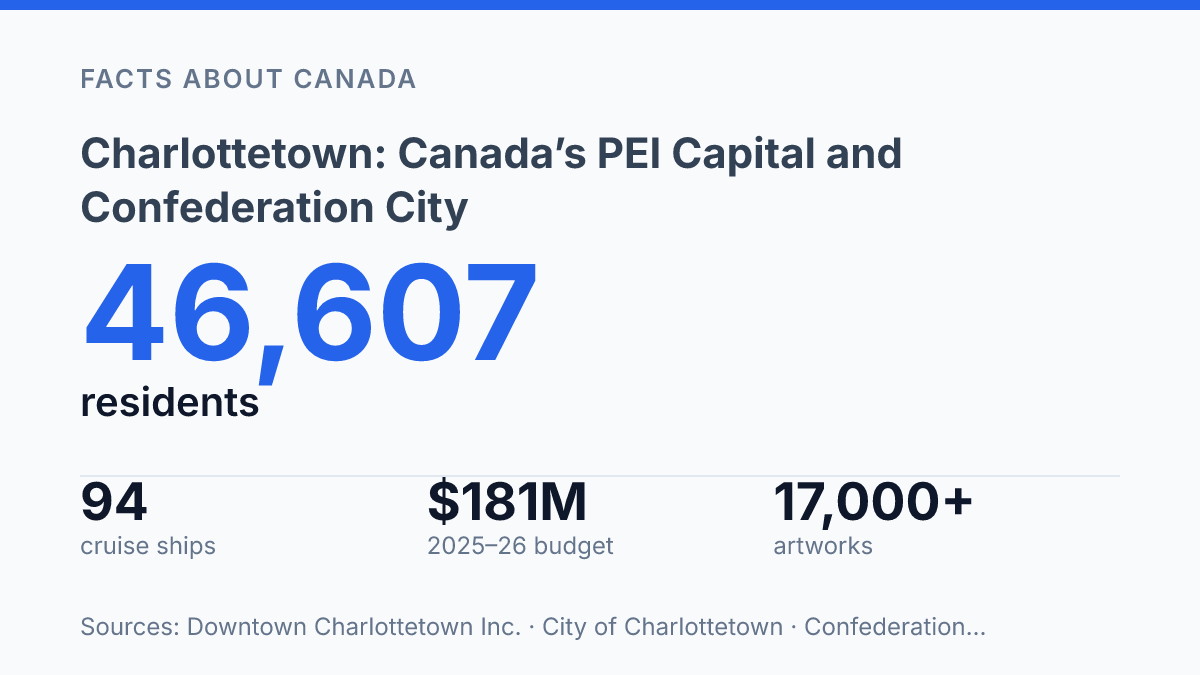
Charlottetown had 46,607 residents in 2024, a 4.3% annual increase that outpaced Prince Edward Island’s 2.8% growth, but its influence is larger than its population suggests. The capital concentrates government, local commerce, tourism, and national memory in a compact downtown where 83% of 532 business members were locally owned in 2024. That scale matters because the city is not only PEI’s administrative centre; it is also the place where the 1864 conference first redirected a planned Maritime Union discussion toward the idea of a wider Canadian federation.
Recent evidence adds another layer: Province House returned to the Legislative Assembly in October 2026 after 12 years of conservation. The sections ahead examine how the city’s political role, Confederation legacy, and downtown cultural landmarks fit together, from Victoria Row to the Confederation Centre of the Arts and St. Dunstan’s Basilica.
Why Charlottetown matters in Prince Edward Island
A city of fewer than 50,000 residents anchors the public administration of a province of nearly 180,000 people. Charlottetown is the capital of Prince Edward Island, and its importance is civic as much as geographic: it is the place where the province’s political and administrative functions are concentrated, despite the modest scale of both the city and the island.
Set on the southern coast of Prince Edward Island, the city occupies a practical position within the province rather than a dominant metropolitan one. That coastal setting helps explain its long-standing role as a centre for movement, government, and services on an island where distances are comparatively short and provincial institutions carry outsized local importance. The capital’s influence is therefore measured less by national population rank than by its function within PEI’s public life.
Recent population figures underline that balance between small-city scale and provincial weight. The city had 46,607 residents in 2024, a 4.3% increase over 2023, while Prince Edward Island reached 179,301 residents, up 2.8% year over year, according to the Downtown Charlottetown Inc., 2024 Annual Report. Those numbers show a growing capital, but not a large one by Canadian standards, which makes its administrative role especially central to its identity.
As the island’s administrative centre, the city links provincial governance with everyday urban services. Government offices, public-sector employment, municipal infrastructure, and downtown commercial activity are all shaped by the presence of the capital. This creates a compact civic core where provincial business and local life overlap more visibly than they would in a much larger capital city.
How the city became tied to Confederation
A meeting first called to discuss a Maritime Union became one of the political steps that made Canadian Confederation possible. The Charlottetown Conference ran from September 1–9, 1864, and its original purpose was to consider closer union among New Brunswick, Nova Scotia and Prince Edward Island, according to the Legislative Assembly of Prince Edward Island. That narrower agenda matters because it clarifies the city’s historical role: the gathering did not create Canada by itself, but it helped move intercolonial union from a regional proposal into a wider constitutional conversation.
The setting of that meeting gives Province House its particular national significance. Province House National Historic Site hosted the 1864 conference, which is why the building is closely associated with the origins of Confederation. Its designation as a National Historic Site reflects that role, preserving the place where a decisive phase of political negotiation began rather than simply commemorating an abstract idea.
Recent conservation work has reinforced the building’s status as a protected civic and historical landmark. The Legislative Assembly of Prince Edward Island announced that it received the keys to Province House on October 2, 2026, after 12 years of conservation, with the last sitting before restoration having taken place on November 27, 2014.
That long closure illustrates the practical demands of maintaining a site whose importance is both architectural and constitutional. The building’s association with the 1864 conference remains the core reason the city is remembered nationally as the place where Confederation was set in motion, even though the formal creation of Canada came later through further meetings, legislation and political agreement.
Victoria Row, the arts centre, and St. Dunstan’s Basilica
A short walk in the historic core links a fire-scarred pedestrian street, a national arts institution, and a Gothic Revival basilica. Victoria Row’s present role as a pedestrian dining and shopping strip rests on repeated reinvention: the street was destroyed by fire in 1866 and again in 1884, then converted in 1997 into a pedestrian row at a development cost of $250,000, according to the Area Development Corporation. Its shops and restaurants make it one of the most visible commercial spaces in the centre, but its significance is not only retail; the street also shows how older urban fabric has been adapted for public use rather than treated as a static heritage display.
The strongest cultural anchor beside this commercial activity is the Confederation Centre of the Arts, which opened in 1964 and cost $5.6 million to build, according to the centre’s own history. Its permanent collection contains more than 17,000 works, giving the institution a role beyond seasonal tourism or performance programming. The centre is also closely associated with the stage musical based on “Anne of Green Gables,” a work that connects Prince Edward Island’s best-known literary figure with live performance in the city’s core.
St. Dunstan’s Basilica adds a different kind of cultural weight nearby. Parks Canada records the St. Dunstan’s Roman Catholic Basilica at 65 Great George Street as a nationally designated historic site, with the present church built from 1896 to 1907 and recognized for its Gothic Revival architecture.
The proximity of the basilica, Victoria Row, and the arts centre means the main cultural stops are not widely spread out. That compactness makes the historic centre easy to experience on foot, while also showing how dining, performance, architecture, and heritage are closely layered in a small area rather than separated into distinct districts.
Why the capital’s scale still matters
Growth, tourism, and heritage conservation will test the city’s ability to remain both a working capital and a legible historic place. A $181-million 2025–26 municipal budget shows that the civic role carries costs beyond symbolic status, from utility needs to capital projects. At the same time, 1.71 million PEI visitors in 2024 and record cruise traffic through Port Charlottetown indicate that heritage streets and cultural institutions are operating under renewed demand.
The practical question is not whether the city should preserve its Confederation identity, but how that identity can support daily civic life rather than crowd it out. Province House’s return from conservation gives that question a fixed address on Great George Street.
Frequently Asked Questions
Q: Why is Charlottetown historically significant in Canada?
A: Charlottetown is known as the site of the Charlottetown Conference of 1864, which helped set the stage for Canadian Confederation. The meetings took place at Province House National Historic Site, linking the city directly to the country’s political origins. That history makes the city an important stop for understanding how Canada was formed.
Q: Is Charlottetown the capital of Prince Edward Island?
A: Yes. Charlottetown is the capital of Prince Edward Island and sits on the province’s southern coast. Its role as the provincial capital gives it administrative importance in addition to its national historic profile.
Q: What can visitors see on Victoria Row in Charlottetown?
A: Victoria Row is a compact area with shops, restaurants, and the Confederation Centre of the Arts. It is also associated with the musical based on Anne of Green Gables, which connects the district to one of Prince Edward Island’s best-known cultural references. The area is often used as a starting point for exploring the city’s downtown core.
Q: What is the Province House National Historic Site?
A: Province House National Historic Site is one of Charlottetown’s best-known heritage buildings. It hosted the Charlottetown Conference in 1864, making it a central location in the story of Confederation. The site remains important because it ties the city’s built heritage to a defining national event.
Q: What architectural landmark is near Charlottetown’s historic center?
A: St. Dunstan’s Basilica is a nearby Gothic Revival landmark. Its style and prominence make it one of the city’s most recognisable churches. Together with the historic district, it adds a strong architectural dimension to Charlottetown’s appeal.