
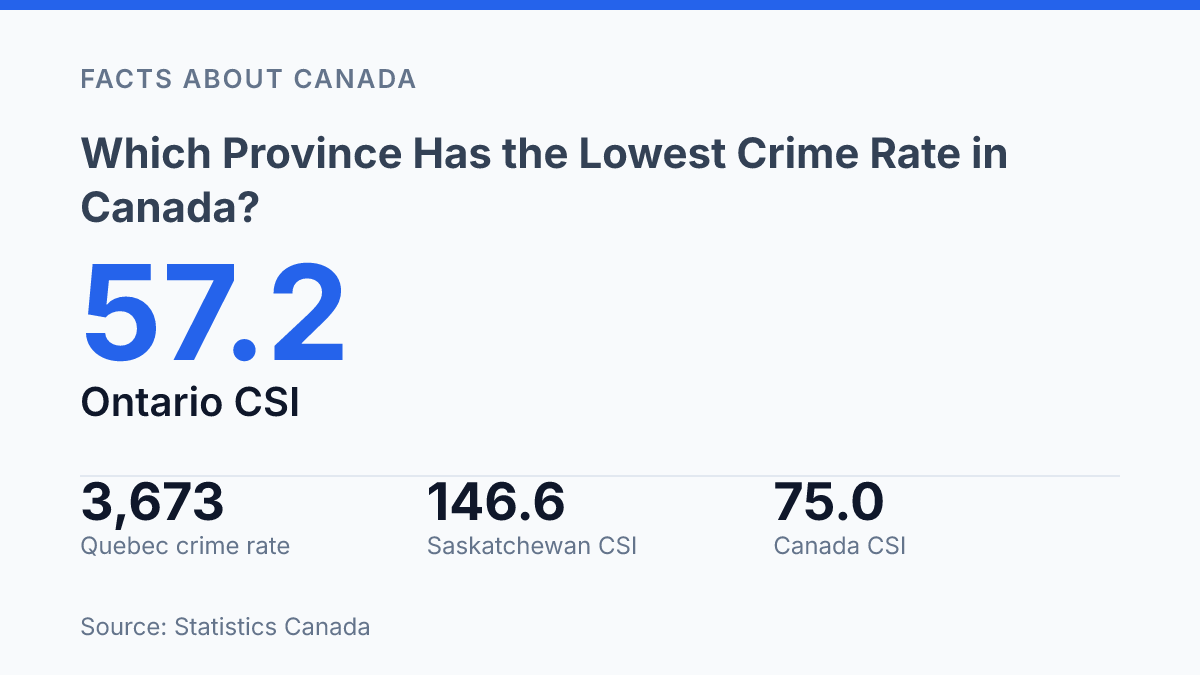
The answer to “Which province has the lowest crime rate in Canada?” changes with the metric: in 2025, Ontario ranked lowest by the Crime Severity Index at 57.2, while Quebec had the lower police-reported crime rate at 3,673 incidents per 100,000 people. That distinction matters because the Crime Severity Index does not simply count incidents; it weights offences by seriousness, using 2006 as a national base of 100. A province with fewer reported incidents is not always the same province with the lowest weighted severity.
Statistics Canada’s 2025 data places Ontario, Quebec, Prince Edward Island, and Nova Scotia below the national CSI of 75.0, while Saskatchewan’s CSI was more than 2.5 times Ontario’s. The comparison shows why provincial rankings need a clear metric before they can support any meaningful claim about relative safety.
Crime Severity Index rankings across provinces
The lowest provincial Crime Severity Index in the compiled ranking belongs to Ontario, with a CSI of 60.7, placing it just ahead of Quebec rather than far below every other province. Statistics Canada data compiled by Canada Home Security Systems ranks Ontario first among provinces on this measure, followed by Quebec at 63.0, Prince Edward Island at 72.6, and Nova Scotia at 75.5.
A lower CSI reflects a combination of less frequent and less serious police-reported crime, so the ranking is not simply a count of incidents. On that basis, Ontario sits at the top of the provincial list, with Quebec close behind. The difference between 60.7 and 63.0 is modest, which means the two provinces should be understood as occupying the same low-CSI tier rather than as sharply separated in everyday safety conditions.
The same pattern appears in newer federal data: in 2025, Statistics Canada’s police-reported Crime Severity Index and crime rate table ranked Ontario lowest among provinces at 57.2, down 6% from 2024, while Quebec ranked second at 61.6, down 5%. That later table reinforces the central finding that Ontario and Quebec lead the provincial rankings when the comparison is based on crime severity rather than a simple incident rate.
Prince Edward Island and Nova Scotia round out the next positions in the Canada Home Security Systems compilation, but their scores are noticeably higher than Ontario’s and Quebec’s. The ranking therefore identifies Ontario as the safest province by CSI, while also showing that Canada’s lowest provincial scores cluster mainly in Central Canada and the Atlantic region.
How the Crime Severity Index is measured
A single homicide changes the Crime Severity Index far more than a single minor theft, which is why the measure can tell a different story than a simple crime count. The CSI is designed to reflect both how often police-reported offences occur and how serious those offences are, rather than treating every incident as equal. According to Statistics Canada, offences are assigned weights based on seriousness, so a place with fewer but more severe crimes can score differently from a place with more low-severity offences.
The practical reading is straightforward: a lower CSI means crime is either less frequent, less severe, or some combination of both. The national average of 77.9 provides a reference point for interpreting provincial figures because it shows whether a province sits below or above the broader Canadian level in the same measurement system. That context matters because the index is comparative; the number is most meaningful when assessed against Canada as a whole, other provinces, or prior years.
The CSI is not the same as the conventional crime rate, which counts incidents relative to population. Statistics Canada says the index has a base value of 100 for Canada in 2006 and includes Criminal Code incidents, including traffic violations, as well as other federal statute violations. This broader and weighted structure helps explain why CSI-based rankings can differ from rankings based only on incidents per 100,000 people.
Its strength is consistency, but its limits are also relevant. A province-wide CSI can smooth over neighbourhood-level variation, seasonal population swings, tourism-driven changes, and differences between urban and rural communities. For that reason, the index is best read as a high-level comparison of police-reported crime severity, not a complete measure of everyday safety in every local area.
Why Ontario and Quebec rank so low
Ontario’s low score is notable because it comes from Canada’s most populous province, not from a small jurisdiction with fewer large urban areas. The provincial figure is shaped by major census metropolitan areas such as Toronto, Ottawa, and Hamilton, which Statistics Canada reported among the lower-CSI large urban markets in 2025. That matters because large cities contribute heavily to a province-wide result; when the largest population centres record comparatively low severity scores, the provincial average can remain low even if some communities face higher local levels of crime.
The structure of policing in Ontario also affects how the provincial number should be read. Police-reported data come from large municipal services as well as the Ontario Provincial Police, which provides policing for many smaller municipalities and rural areas, so the final measure is an aggregation across very different service areas. This does not mean the policing model alone explains the result, but it helps clarify why Ontario’s score is a broad provincial average rather than a direct proxy for conditions in any single city, suburb, or rural community.
Quebec’s position is similarly supported by more than one indicator. In Statistics Canada’s 2025 data, Quebec remained below the Canada-wide CSI level of 75.0, and it also had a lower conventional police-reported crime rate than Ontario, at 3,673 incidents per 100,000 population compared with 4,296. That distinction is useful because Quebec’s low ranking is not only a product of severity weighting; it also reflects a comparatively low volume of reported incidents on the standard rate measure.
The comparison with Atlantic provinces reinforces the pattern. In the same cited 2025 provincial ranking, Prince Edward Island recorded a CSI of 68.4 and Nova Scotia 73.0, placing both above Ontario and Quebec even though they are much smaller provinces.
At the same time, averages still mask local variation: in 2024, Statistics Canada reported that rural CSI across provinces was 100.6 versus 72.7 in urban areas, while Quebec’s rural score was higher than its urban score. The main conclusion is therefore structural rather than singular: large, diverse provinces can post low province-wide crime severity scores when their major population centres and overall incident mix remain comparatively low, but those scores should not be read as uniform conditions everywhere within the province.
What the numbers mean for comparing provinces
Ontario at 60.7 versus 77.9 for the national average shows a material gap, not a marginal lead. In the provincial table used here, that spread places Ontario well below the Canada-wide benchmark, which supports a broad comparison that Ontario records less severe police-reported crime than the country as a whole on this measure.
The practical takeaway is that provincial CSI rankings are best treated as a high-level comparison tool. They are useful for comparing provinces on a consistent scale because each jurisdiction is assessed through the same index, but they do not prove that one province is safer in every possible sense. A CSI score reflects reported offences across a large geographic area, so it is better suited to province-to-province comparison than to fine-grained conclusions about individual cities, towns, or neighbourhoods.
Local conditions can differ sharply within the same province. A provincial average may combine large metropolitan areas, smaller communities, remote regions, and places with different policing arrangements or reporting patterns. This means two communities inside a low-CSI province can still have very different crime profiles, just as a higher-scoring province can contain areas with comparatively low reported crime severity.
For a precise comparison, provincial CSI should be the starting point rather than the final answer. It identifies the broad pattern clearly, especially when one province sits notably below the national average, but local crime tables and municipal or regional data are needed when the question becomes more specific than a province-wide ranking can support.
Why the metric matters more than the label
A provincial ranking is most useful when it is treated as a measurement choice rather than a broad safety label. CSI is better for comparing the seriousness of police-reported crime across places; the standard crime rate is better for estimating how often incidents are reported relative to population. Neither measure captures unreported crime, local neighbourhood variation, or differences in reporting behaviour.
For policy analysis, housing decisions, or media interpretation, the next question should be narrower: violent or property crime, urban or rural setting, one year or a multi-year trend. A province can sit near the bottom of the national CSI table while still containing communities with very different local conditions.
Frequently Asked Questions
Q: Which province has the lowest crime rate in Canada?
A: Ontario has the lowest Crime Severity Index in the data provided, with a CSI of 60.7. Quebec follows closely at 63.0, which shows that both provinces rank below the national average of 77.9. Since a lower CSI means less severe and less frequent crime, Ontario is identified as the safest province in this ranking.
Q: What does the Crime Severity Index measure?
A: The Crime Severity Index measures both the volume and seriousness of police-reported crime. A lower score indicates less severe and less frequent crime, so it gives a more nuanced picture than a simple crime count. This is why it is often used to compare provinces more reliably than raw incident totals.
Q: Is Quebec also considered one of the safest provinces in Canada?
A: Yes. Quebec records a CSI of 63.0, which places it just behind Ontario and well below the national average of 77.9. That means it is also among the provinces with the lowest recorded crime severity in the available data.
Q: How does Prince Edward Island compare with Ontario and Quebec on crime rates?
A: Prince Edward Island has a CSI of 72.6, which is still below the national average but higher than Ontario and Quebec. That suggests crime severity is lower than average, but not at the same level as the two lowest-ranking provinces. The gap is meaningful because CSI is designed to show both frequency and seriousness.
Q: Why might crime rankings differ from one province to another?
A: Provincial rankings can differ because the Crime Severity Index reflects both how often crime occurs and how serious those offences are. Differences in population density, urban concentration, and local enforcement patterns can all affect the score. As a result, a province can have a lower CSI even if its population is larger, provided crime is less severe on average.