
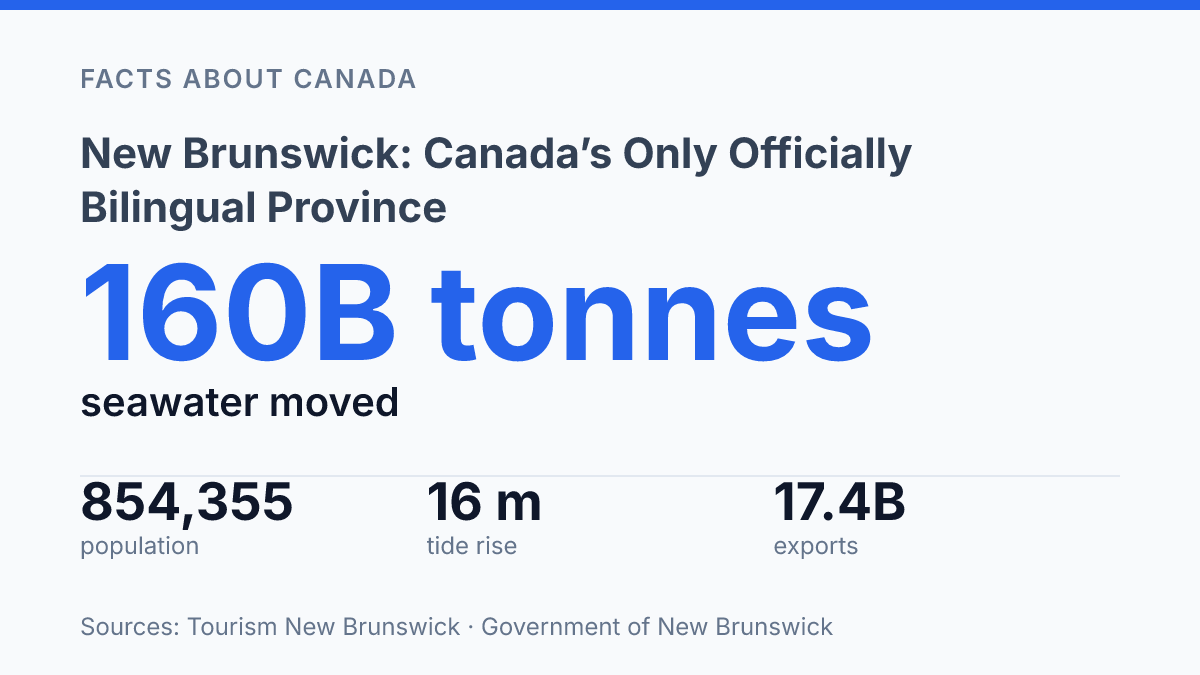
New Brunswick meets the Bay of Fundy at a scale that sounds invented: 160 billion tonnes of seawater moves in and out twice a day. That single fact explains more than a tourism brochure ever could.
It shapes routes, towns, jobs. The way outsiders remember the province.
But the water is only part of the story. This is Canada’s only officially bilingual province, with 34.0% of residents speaking both English and French in the 2021 Census.
That’s not a slogan. It changes schools, workplaces, hiring, customer service, and politics.
The province is also growing faster than its quiet reputation suggests. Its population reached 854,355 on July 1, 2024, after a third straight year above 2% growth. In my view, the real story is the contrast: a small Atlantic province with old border geography, huge tides, two public languages. An economy that now has to make room for more people.
Where New Brunswick Sits in Canada
No other Canadian province combines a U.S. land border with direct Atlantic access in quite the same way. New Brunswick sits in eastern Canada, pressed between Quebec to the northwest, Maine to the southwest, Nova Scotia to the east, the Bay of Fundy to the southeast. The Gulf of Saint Lawrence to the northeast.
That looks compact on a national map. The border mix gives it coastal routes and cross-border ties that larger provinces don’t share.
Its position also explains why movement matters here. The province is connected to Nova Scotia by the 24-kilometre-wide Isthmus of Chignecto, and its eastern boundary is entirely coastal along the Gulf of St. Lawrence and Northumberland Strait, according to Government of New Brunswick, 2026/accessed.
That narrow land link makes the province feel like both a gateway and a hinge. Freight, tourism, and daily travel all bend around that geography.
The province joined Confederation in 1867, but its present shape matters more here than its early political story. You can drive from interior forest communities toward Fundy ports, Acadian coastal towns, or the Maine border without crossing huge distances.
Yet distance can fool you. Short lines on a map don’t always mean easy connections, especially when settlement follows rivers, shorelines, and older road corridors.
The 2021 census counted 781,315 people, which makes space part of the province’s identity. Low density spreads services, schools, and labour markets across small cities, towns, and rural areas rather than one dominant urban centre. In my view, that scattered pattern is the key to understanding the province faster than any map legend.
It’s not empty space. It’s a province built around edges: inland, coastal, and international at once.
Why the Bay of Fundy Defines the Province
Every tide in the Bay of Fundy moves more seawater than most people can picture: 160 billion tonnes, twice a day, according to Tourism New Brunswick. At places like Hopewell Rocks, the tidal range can reach up to about 16 metres. That means the same shoreline can feel like two different places within a single day.
French and English Life Side by Side
A person can grow up in an Acadian household, work mostly in French, and still deal with public life through institutions that switch languages depending on the counter, the classroom, or the town line. That’s why the province’s language story can’t be reduced to a cheerful label.
The provincial Official Languages Act, adopted in 1969, gave French and English equal status in provincial government. In practical terms, residents have the right to receive provincial services in either language. Courts, legislation, agencies, and public offices are supposed to serve both communities, not treat one language as a courtesy translation of the other.
Numbers show how deep that arrangement runs. Canadian Heritage reports that the 2021 Census counted 231,850 French-speaking residents, or 30.3% of the population, and 260,120 people who were bilingual in English and French.
That means language policy isn’t aimed at a symbolic minority. It shapes daily administration, hiring, schooling, and workplace expectations.
But official bilingualism looks cleaner on paper than it feels in real life. Service delivery can vary by region.
School systems run as distinct Anglophone and Francophone sectors. Local identity can be Acadian, English-speaking, bilingual, or some mix that doesn’t fit neatly into a government form. In my honest opinion, that friction is exactly what makes the province’s bilingual character real rather than decorative.
You see the Acadian presence clearly in Caraquet, Bathurst, and communities across the Acadian Peninsula, where French isn’t a second layer on public life. It’s the main language of families, businesses, radio, festivals, and political memory.
Statistics Canada reported that 111,715 workers used French at least regularly at work in 2021. This is also a workplace reality.
The Acadian flag says a lot in one image: the French tricolour marked with a gold star. Each year, the Fête nationale de l’Acadie on August 15 turns that symbol into public celebration. It’s cultural pride, yes, but it’s also a reminder that language here carries history, rights, and community power.
What Drives the Economy Today
Services grew faster than goods in 2024. The money still smells faintly of spruce, diesel, saltwater, and refinery heat. According to The NB Economy 2024 in Review, real GDP rose 1.8% that year, with service-producing industries up 2.5% and goods-producing industries down 0.4%.
That split says a lot: the old economy hasn’t vanished. It no longer carries the province alone.
Forestry still gives the interior its industrial backbone. Around Edmundston, Miramichi. The western woodlands, pulp-and-paper plants, sawmills, trucking firms, and wood-product suppliers keep paycheques moving through smaller communities.
The tradeoff is exposure. Lumber prices, U.S. demand, energy costs, and fibre supply can turn a strong year into a hard one fast.
Coastal towns run on a different rhythm. Lobster, crab, freezing, packing, and export shipping support work in places such as Shediac and Grand Manan, where seafood is not just a menu item but a wage base.
Processing matters as much as catching. A crate that leaves the wharf with more handling, grading, and packaging behind it keeps more income close to home.
Energy gives the export economy much of its weight. Merchandise exports reached $17.4 billion in 2024. The U.S. took 90.4% of that total, according to The NB Economy 2024 in Review.
Energy products added $410.9 million in export growth, helped by Saint John’s port-and-refining role. That creates scale. It also ties the province closely to one foreign market.
Moncton, Saint John, and Fredericton now anchor the growth story as much as forests and fisheries do. Moncton’s metro area grew 5.3% in 2024, ranking second among Canadian CMAs, according to the same provincial review.
Saint John brings port, industrial, and energy jobs. Fredericton adds government, education, and professional services. In my humble opinion, that balance is the real story: the province still earns from traditional industries, but its future depends just as much on offices, warehouses, classrooms, hospitals, and transport routes.
Where growth will test the province first
New Brunswick’s next test won’t be whether it can explain itself to outsiders. It will be whether growth can improve daily life without flattening the things that make the province distinct.
The pressure points are already visible. Moncton is pulling in people fast, French still carried real workplace weight in 2021, and exports lean hard on the United States, with 90.4% of merchandise sales going there in 2024. That mix creates opportunity. It also leaves little room for lazy planning.
In my honest opinion, the smartest way to read the province is not as small or peripheral. Read it as exposed. To tides, trade, language politics, and population change.
Places like that reveal their future early. You just have to look closely enough.
Frequently Asked Questions
Q: Why is New Brunswick the only officially bilingual province in Canada?
A: New Brunswick is the only province with bilingual status because both English and French have equal standing there under provincial law. That matters in real life, not just on paper, since government services have to work in both languages. In my humble opinion, it’s the clearest example in Canada of bilingualism being built into everyday public life.
Q: What does it mean for a province to be officially bilingual?
A: It means people can expect government services, notices, and many public interactions in both English and French. That creates a real difference for residents. It also means the province has to keep two language systems running side by side. 1969 is the key year here. That’s when New Brunswick adopted its official bilingualism policy.
Q: Where is New Brunswick located in Canada?
A: It sits in Atlantic Canada and shares borders with Quebec to the northwest, Nova Scotia to the east. The U.S. state of Maine to the southwest. It also touches the Gulf of Saint Lawrence to the northeast and the Bay of Fundy to the southeast. New Brunswick has a location that ties it to both French-speaking and English-speaking regions.
Q: Do you need to speak both English and French to live in New Brunswick?
A: No, you don’t need both to live there. English is common, French is strong in many communities. You can get by with one language in a lot of daily situations. But if you work with government or public services, knowing both can give you a clear advantage.
Q: What makes New Brunswick different from Quebec and the other provinces?
A: Quebec is officially French-speaking, but New Brunswick is the only province where both English and French have equal official status. That difference shapes schools, public services, and even how people think about identity in the province. 2 official languages set it apart in a way no other province matches.