
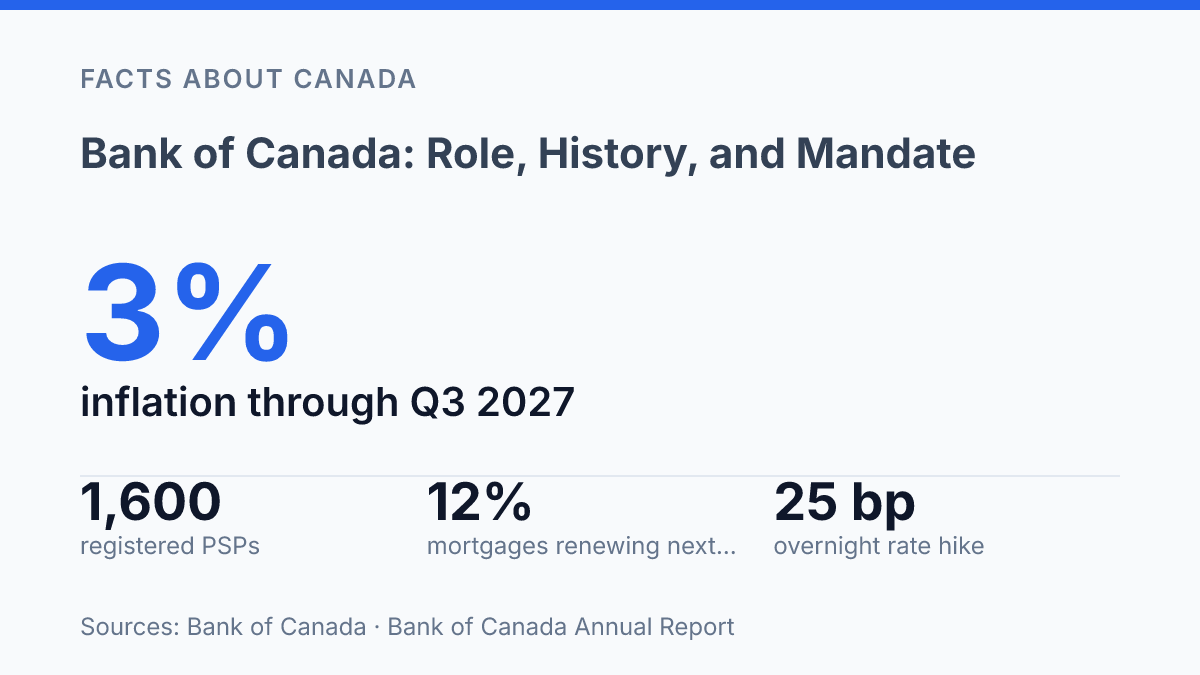
The Bank of Canada can change borrowing costs across the economy with a quarter-point rate move, as it did on October 28, 2026, when it raised the target overnight rate to 2.5%. That power sits inside an institution with an unusual path: created by law in 1934, opened in 1935 as a privately owned bank, and converted in 1938 into a special federal Crown corporation. Its legal capital remains $5 million, held through 100,000 shares issued to the Minister of Finance on behalf of the Crown.
The central bank’s role is therefore not limited to setting interest rates. Its mandate connects inflation control, financial stability, currency, payments oversight, and the transmission of policy into household budgets and business decisions. The structure behind those choices helps explain why a technical rate announcement can affect mortgages, investment plans, and payment systems months or even years later.
What the central bank does
A change in the policy rate can take six to eight quarters to have its full effect on inflation, which is why central banking is as much about expectations as immediate borrowing costs. The Bank of Canada conducts monetary policy mainly by setting the target for the overnight rate, the short-term interest rate that influences funding conditions across the financial system. Commercial lending rates, mortgage rates, bond yields, and the exchange rate do not move mechanically with every decision, but the overnight-rate target is the main signal around which many market prices adjust.
The inflation-control framework gives that rate setting a clear benchmark. Under the agreement with the federal government, the central bank aims to keep inflation at 2%, the midpoint of a 1% to 3% control range, according to the Bank’s inflation-control target materials.
The current agreement was renewed in December 2021 and runs to December 31, 2026. This framework matters because it gives households, firms, and financial markets a measurable anchor for price expectations; when inflation is expected to return to target, wage contracts, borrowing decisions, and investment plans can be made with less uncertainty.
Interest-rate policy also has direct economic side effects, which are part of the transmission mechanism rather than incidental consequences. Higher rates can reduce demand by making mortgages, consumer credit, and business loans more expensive, while lower rates can support spending and investment by easing financing conditions. The same mechanism that helps restrain inflation can also cool housing demand and delay capital spending, so policy decisions require judgment about how quickly inflation is moving relative to growth and financial conditions.
Beyond price stability, the central bank promotes a safe and sound financial system. Its responsibilities include monitoring vulnerabilities, supporting core financial-market functioning, overseeing designated payment and settlement systems, and acting as lender of last resort when solvent financial institutions need emergency liquidity. These functions are separate from ordinary monetary-policy decisions, but they are connected in practice: a financial system that can transmit payments, credit, and liquidity reliably is necessary for interest-rate policy to work through the economy.
How it was created and structured
Canada’s central bank began as a privately owned institution before it became part of the federal public sector. The Bank of Canada Act received royal assent on July 3, 1934, and the institution opened in March 1935 before later being nationalized; the Bank says it became a special federal Crown corporation in 1938, according to Bank of Canada, Our history / About us. That sequence matters because its modern legal identity combines public ownership with a governance model meant to separate day-to-day policy judgment from ordinary departmental control.
As a Crown corporation, the Bank is owned by the federal government rather than private shareholders. Under the current Act, its capital is $5 million, divided into 100,000 shares with a $50 par value, all issued to the Minister of Finance on behalf of the Crown. This structure places ownership clearly with the federal state, while the corporation’s statutory footing gives it institutional continuity beyond changes in government.
Governance is split between executive leadership and board oversight. The Board consists of the Governor, the Senior Deputy Governor and 12 independent directors, with the Deputy Minister of Finance serving as an ex officio non-voting member. The independent directors are appointed to renewable three-year terms, while the Governor and Senior Deputy Governor serve seven-year terms, a longer horizon that supports continuity in institutional management.
The Minister of Finance has a formal role in the appointments framework, especially through the appointment of independent directors with approval by the Governor in Council. The Governor and Senior Deputy Governor are appointed by the independent directors, also subject to Governor in Council approval. The result is a public institution with democratic accountability through legislation, ownership and appointments, but with operational independence designed to reduce the risk that technical decisions are driven by short-term political demands.
Why the bank matters for households and businesses
A quarter-point policy-rate change can affect a household credit line or a company’s floating-rate loan well before it appears in slower-moving economic data. When the Bank of Canada changes its policy rate, commercial lenders usually adjust prime rates and other benchmark lending rates in the same direction. That matters for variable-rate mortgages, home-equity lines of credit, unsecured lines of credit, and many business loans, because interest charges reset as borrowing benchmarks move.
Fixed-rate borrowers are not insulated indefinitely, since renewal brings past rate changes into current payments. In its 2026 Financial Stability Report, the Bank said the final group of pandemic-era five-year fixed-payment mortgages renewing over the next 12 months represented about 12% of outstanding Canadian mortgages, with average payment increases of about 15%. This illustrates why monetary policy can remain relevant to household cash flow even after a borrower initially chose a fixed rate.
For businesses, the same interest-rate channel affects investment, inventory financing, payroll flexibility, and expansion plans. A lower policy rate can make borrowing less costly and support spending and hiring, particularly in interest-sensitive sectors such as housing, construction, retail, and capital-intensive services. The qualification is material: if inflation is already elevated, easier credit conditions can prolong price pressure by sustaining demand faster than supply can respond.
Inflation control matters because purchasing power depends on the relationship between wages, income, and prices over time. The central bank does not set grocery, rent, fuel, or service prices directly, but its decisions influence the conditions under which firms raise prices and households decide whether to spend, borrow, or save. More stable inflation also helps businesses set contracts, wages, and price lists with less need to build in large precautionary increases.
Exchange rates add another channel for households and firms with cross-border exposure. Interest-rate differentials influence the Canadian dollar because investors compare expected returns on Canadian-dollar assets with returns available in other currencies. If markets expect Canadian rates to be relatively higher, the Canadian dollar may strengthen, which can reduce import costs but weigh on exporters’ foreign-currency revenues; expectations of relatively lower rates can have the opposite effect, sometimes before any formal decision is announced.
Key tools and recent policy signals
The October 28, 2026 rate package showed how a single announcement can carry several policy signals at once: the policy-rate level, the corridor around it, and the economic outlook used to justify the decision. In that release, the target rate was raised by 25 basis points to 2.5%, with the Bank Rate set above it and the deposit rate below it, according to the central bank’s press release. Those companion rates matter because they help anchor very short-term money-market pricing around the intended policy stance rather than leaving the headline rate as a standalone number.
The main operating tools are the policy interest rate and market operations that support it. The policy rate sets the reference point for overnight funding costs, while open market operations, including repo-style transactions and securities operations, help manage liquidity so market rates trade close to the intended setting. This combination allows policy to be expressed both through an announced rate and through day-to-day implementation in financial markets.
Regular communication is also a policy instrument because it reduces uncertainty about how decisions are being made. Scheduled rate announcements give markets fixed decision points, while the Monetary Policy Report provides the fuller assessment of inflation, growth, spare capacity, and risks behind selected decisions. The October 2026 report, for example, said the inflation outlook had been revised higher than in July and that growth projections had been adjusted, which explained why the policy message was not limited to the rate change itself.
Recent policy language has been shaped by the return from pandemic-era emergency conditions to the 2 per cent inflation target framework renewed in the 2020s. Forward guidance can be used when officials want to clarify how policy is likely to respond if conditions evolve as expected, and it can influence bond yields, exchange-rate expectations, and lending conditions before any later decision is taken. Its usefulness is conditional, however: when inflation, labour-market data, or growth indicators shift quickly, guidance may need to be revised, making current data and risk assessments more informative than earlier signalling.
Why the policy lag matters after each rate decision
The central bank’s influence is easiest to see on rate-announcement days, but its effects are measured over a longer interval. Policy actions typically take six to eight quarters to work fully through inflation, which means a 2026 decision can still be shaping borrowing conditions in 2028. That delay matters when inflation is projected to remain above 3% into 2027 and a share of mortgage holders faces payment resets.
It also explains why payment supervision and financial-stability monitoring are now part of the same institutional picture as interest rates. The practical consequence is clear: the most relevant signal is not only what the Bank decides, but how its projections, risks, and timing change from one report to the next.
Frequently Asked Questions
Q: What does the Bank of Canada do?
A: The Bank of Canada is Canada’s central bank and a Crown corporation. It formulates monetary policy and supports a safe and sound financial system. These functions give it a central role in managing inflation and maintaining confidence in the financial system.
Q: When was the Bank of Canada created?
A: The Bank of Canada was chartered in 1934 under the Bank of Canada Act. That date marks the institution’s formal creation as Canada’s central bank. Its founding established a national authority for monetary policy.
Q: Is the Bank of Canada part of the federal government?
A: The Bank of Canada is a Crown corporation, which means it operates with a distinct legal structure while serving a public function. It is not a commercial bank and does not compete for customers. Its mandate is set in law and tied to national economic stability.
Q: What is the Bank of Canada’s main mandate?
A: Its mandate is to formulate monetary policy and to promote a safe and sound financial system in Canada. In practice, that means it helps guide borrowing conditions and supports overall financial stability. These responsibilities shape how the central bank responds to economic change.
Q: Why is the Bank of Canada important to the economy?
A: The Bank of Canada matters because its decisions affect inflation, interest rates, and confidence in the financial system. By setting monetary policy, it influences how the economy responds to growth, downturns, and financial stress. Its stability role helps reduce risks that could spread through the banking system.