
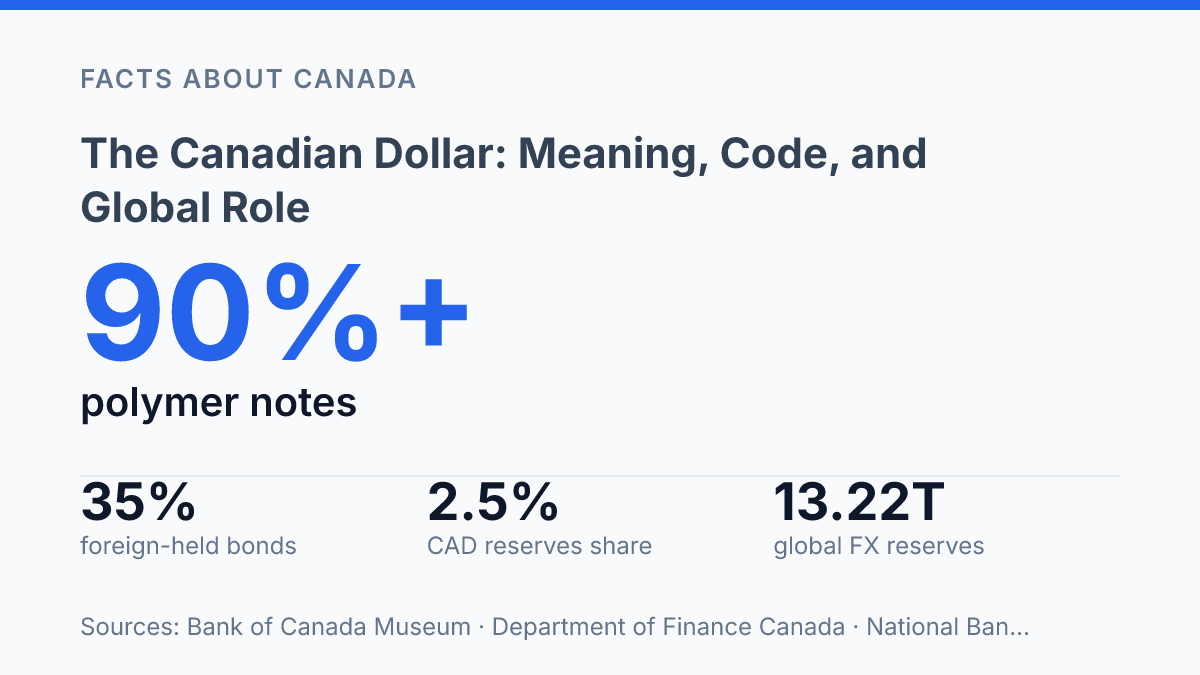
The Canadian dollar held roughly 2.5% of the world’s allocated foreign exchange reserves in 2026 Q1, a small share beside the U.S. dollar’s 56.70% but large enough to make CAD a regular reserve asset rather than only a domestic unit of account. That status rests on details that range from notation to sovereign credit quality: Can$ is the preferred English disambiguator in general writing, while CAD is the standard finance and exchange-rate code. The same currency also has a distinctive cash system, from 100-cent accounting and polymer notes to the 11-sided loonie introduced in 1987.
These everyday features connect to a larger monetary role. Central banks do not hold CAD because Canada is the largest economy; they hold it because Canadian public debt, legal institutions, liquidity, and credit ratings make it a credible diversification asset.
What the currency is called and how it is written
A Canadian price written simply as “$25” may be perfectly clear inside Canada but ambiguous in cross-border copy, which is why Can$, CA$, C$, and CAD all appear in different settings. The official English name is the Canadian dollar, its international currency code is CAD, and the French form is dollar canadien. In ordinary domestic writing, the dollar sign alone is often enough because the national context supplies the meaning.
The main complication is that there is no single universal form used to separate Canada’s currency from other dollars, especially the US dollar. The Government of Canada Translation Bureau / Language Portal of Canada identifies Can$ as the preferred English disambiguator, written with no space before the amount, while CAD is the usual finance and exchange-rate code and is formed from CA plus D for dollar. Other forms, including CA$ and C$, also appear in international writing, data tables, and market commentary, with choice shaped by audience, house style, and the need to avoid confusion with US-dollar amounts.
Informal labels add another layer to the written system. The nickname “loonie” comes from the common loon image on Canada’s one-dollar coin, and the term can refer to the coin itself or, in market language, to the currency more broadly.
Among French-speaking Canadians, huard, the French word for loon, serves a similar role. These labels are common enough to appear in everyday speech and financial commentary, but they do not replace CAD in exchange-rate contexts or the formal English and French currency names in official writing.
Denominations, cents, and the loonie
Canada no longer distributes one-cent coins for circulation, yet every dollar is still accounted for as 100 cents. The base unit is the dollar, and each dollar is divided into cents, written with the cent sign ¢ when amounts are expressed below one dollar. In cash terms, prices and accounts can still be calculated to the cent even though physical payment is handled through the denominations that remain in ordinary circulation.
According to the Government of Canada, everyday coins are 5¢, 10¢, 25¢, $1 and $2, while the most common bank notes are $5, $10, $20, $50 and $100. The Royal Canadian Mint says one-cent coins remain legal tender, but it stopped distributing pennies on February 4, 2013. That separation between accounting units and circulating coins explains why cent amounts continue to appear on receipts, invoices and electronic payments even when cash totals may be rounded at the point of sale.
The one-dollar coin is the denomination most closely tied to everyday Canadian speech. Its reverse shows a common loon, and that bird gave the coin its familiar English nickname, “loonie.”
In ordinary conversation, the word can refer narrowly to the $1 coin; in looser usage, especially around exchange rates or market commentary, it may also stand for the national currency. Formal financial, legal and international contexts avoid that ambiguity by relying on the official currency name and standard identifiers rather than the coin nickname.
Why the Canadian dollar matters in global reserves
A currency can be trusted enough for official reserves and still occupy only a narrow slice of the global total, which was Canada’s position as of January 2024. At that point, Canada’s currency was the fifth-most held reserve currency in the world and accounted for about 2% of all global reserves. That share gives it an established international role, but not one comparable in scale to the leading reserve currencies.
The ranking also shows the hierarchy of official reserve holdings. Canada’s currency stood behind the US dollar, the euro, the yen, and sterling, placing it ahead of many other national currencies but well below the dominant reserve units. In practical terms, this means it is recognized by reserve managers as a credible asset for diversification, while still functioning as a secondary reserve choice rather than a core anchor of the global monetary system.
Reserve status reflects more than a country’s size. Central banks generally require reserve assets that can be held with confidence, converted when needed, and supported by stable institutions.
Canada’s relative economic soundness, strong sovereign position, and durable legal and political systems help explain why its currency appears in official portfolios. The consequence is a role that is meaningful but measured: it signals international confidence and usable liquidity, yet its small share shows that global reserve demand remains concentrated in the top four currencies.
Why central banks hold it
Canada entered fiscal 2025 with top-tier federal ratings from three of four cited agencies, a credential that directly affects how reserve managers judge sovereign paper. As of March 31, 2025, the federal government was rated Aaa by Moody’s, AAA by S&P, AA+ by Fitch, and AAA by DBRS, all with stable outlooks, according to the Department of Finance Canada. For official reserve holders, those assessments matter because reserves are not held only for return; they must also remain credible, transferable assets in periods of market stress.
The Canadian government’s sovereign position supports demand for its debt instruments because it gives central banks a pool of assets issued by a borrower widely regarded as capable of meeting obligations in its own currency. This does not mean reserve managers treat Canadian assets as risk-free in every circumstance, but high sovereign credit quality narrows the range of concerns they must manage. Foreign participation also signals institutional acceptance: non-residents held 35% of Government of Canada securities in 2024–25, up from 28% the previous year, according to the same federal data.
Institutional stability is the other major reason the currency attracts official holders. Canada’s legal system, independent courts, predictable public administration, and continuity of democratic governance reduce the risk that reserve assets will be impaired by arbitrary controls, contract uncertainty, or sudden institutional disruption. In reserve management, those features are practical rather than abstract, because official institutions must be able to value, hold, sell, and account for assets under clear rules.
These strengths explain why Canada’s currency can serve as a diversification asset for central banks seeking exposure beyond the largest reserve units. Allocation decisions, however, are not determined by Canadian fundamentals alone. They also depend on portfolio mandates, transaction needs, market depth at the time of purchase, and wider global financial conditions, so strong institutions create eligibility and confidence rather than guaranteeing a fixed level of demand.
Why reserve status depends on trust, not size
Reserve status is not fixed by symbolism or coin design; it is earned through repeated evidence that a currency can be held, valued, and traded with confidence. CAD’s position may remain modest compared with the U.S. dollar and euro, yet modest does not mean marginal.
Canada’s Aaa/AAA federal ratings from major agencies as of March 31, 2025, and the rise in non-resident holdings of Government of Canada securities to 35% in 2024–25 show why the currency keeps a place in official portfolios. The practical implication is clear: changes in Canada’s fiscal credibility, debt market depth, or external demand for government securities would matter more for CAD’s reserve role than any change to its coins or notes.
Frequently Asked Questions
Q: What is the Canadian dollar and what is its currency code?
A: The Canadian dollar is the official currency of Canada. Its currency code is CAD, and the symbol is $; in French, it is called dollar canadien.
Q: Why is the Canadian dollar sometimes written as Can$, CA$, or C$?
A: Those forms are used to distinguish it from other currencies that also use the dollar sign, especially the US dollar. There is no single standard disambiguating form, so usage varies by context.
Q: How is the Canadian dollar divided?
A: The base unit is the dollar, and each dollar is divided into 100 cents. The cent is represented by the symbol ¢.
Q: Why is the Canadian dollar called the loonie?
A: The nickname comes from the common loon pictured on the reverse of the one-dollar coin. In English-speaking Canada, and among some foreign exchange traders and analysts, the coin and sometimes the currency itself are called the loonie; in French, huard is also used.
Q: How important is the Canadian dollar in global reserves?
A: As of January 2024, the Canadian dollar accounted for approximately 2% of global reserves and ranked fifth among reserve currencies. It is held by central banks because of Canada’s economic stability, strong sovereign position, and steady legal and political institutions.