
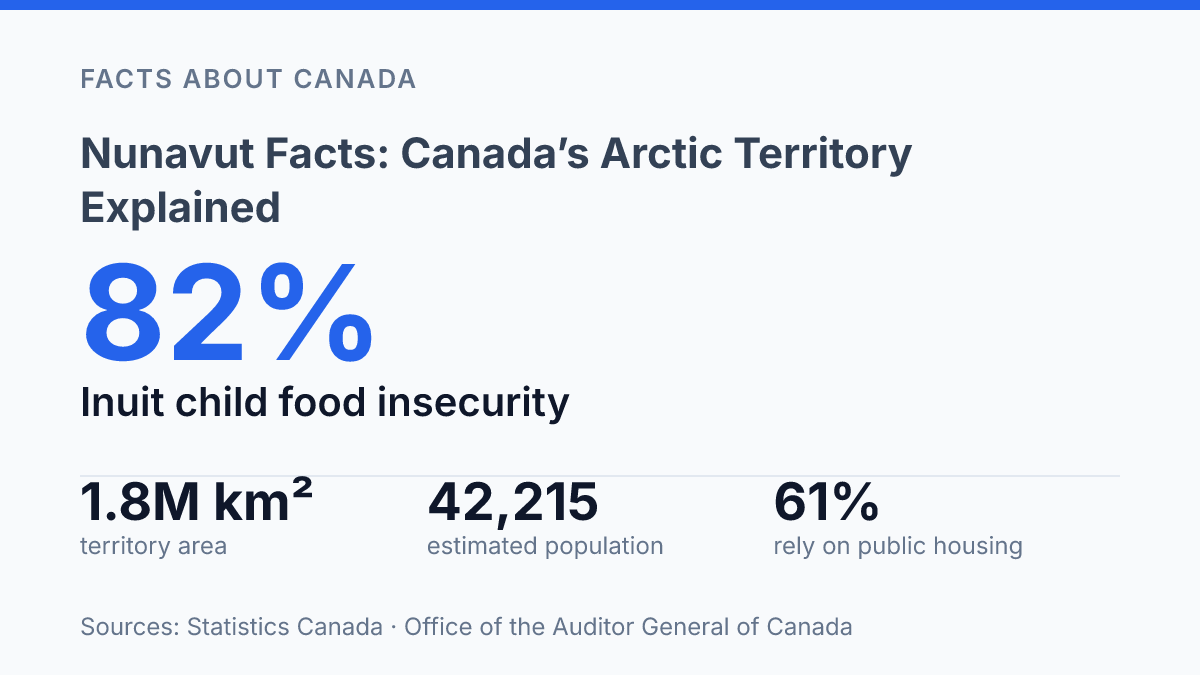
Nunavut covers over 1.8 million km², yet only 42,215 people were estimated to live there on April 1, 2026. That scale sounds empty on paper.
It isn’t empty. It’s expensive, planned, and intensely local.
Twenty-five communities sit without roads between them. A grocery order, a medical trip, or a visit to family can depend on weather, freight. An aircraft seat. In my honest opinion, these facts explain why distance is a daily force, not a map feature.
But scale doesn’t soften the harder numbers. In 2024, 82% of Inuit children aged 1 to 14 lived in households that had faced food insecurity. At the same time, Inuktut remains strong in homes, schools, and public life.
The Nunatta Sunakkutaangit Museum makes that contrast feel concrete. This guide looks at place, daily life, Inuit culture. The Arctic conditions that shape travel, identity, and almost every choice.
Where Nunavut sits in Canada’s far north
Nunavut is Canada’s largest territory, yet much of it is ocean-broken island country rather than one continuous northern slab. Its official area is 2,093,011 square kilometres, a scale that makes ordinary distance feel deceptive. For another measure of that size, Statistics Canada, 2024/ reports that it covers over 1.8 million km², or 20.9% of Canada’s land mass, with an estimated population of 42,215 on April 1, 2026.
When Nunavut became a separate territory on April 1, 1999, it was carved out of the eastern and northern parts of the Northwest Territories. Its capital, Iqaluit, sits on Baffin Island, not on the mainland.
That detail matters. The administrative centre is already deep inside the Arctic island system.
Most of the territory belongs to the Canadian Arctic Archipelago. Baffin Island dominates the eastern side, Ellesmere Island reaches toward Greenland. The territory also includes the eastern fringe of Victoria Island.
There is mainland too, along the coast west of Hudson Bay. The island geography defines how this far-north region fits together.
Borders give the map a cleaner shape than the place has in real life. The territory meets the Northwest Territories to the west and Manitoba to the south, then opens to Hudson Bay, the Arctic Ocean, and waters facing Greenland.
Those edges don’t make it feel more connected. They make it feel more exposed.
On a flat map, the place can look nearly empty. That reading is wrong. Empty-looking space becomes hard country when it is split by channels, sea ice, tundra, and long flights between small communities.
A straight line between two points tells you little here. Water and weather decide what is close. In my view, this is the geographic fact that matters most: size alone doesn’t explain the remoteness. Fragmentation does.
How people live in remote Arctic communities
A crate of milk may reach a home by aircraft or summer sealift, not by truck, because Nunavut has no road links to the rest of Canada. Most communities depend on planes year-round, then sealift or boat access when summer water conditions allow it. That changes the price, timing, and certainty of almost everything people buy.
Iqaluit is the biggest community, but many settlements are small, isolated, and spread far apart. The pattern is not suburban growth with highways between towns. It’s a network of places tied to airstrips, shorelines, weather windows, and local knowledge.
The 2021 Census counted about 36,858 residents across the territory, a number that underlines just how sparse life is across such a huge northern space. Small populations can make services harder to deliver. A delayed flight can affect groceries, medical appointments, school supplies, and mail in the same week.
That isolation is costly. It doesn’t only produce hardship.
It also keeps daily life closely tied to local routines, seasonal movement, and mutual support. People plan around weather, share rides and equipment, and rely on community networks in ways that don’t fit a southern Canadian model.
Housing shows the pressure clearly. In 2025, the Office of the Auditor General of Canada reported that 61% of residents relied on public housing, and 45% of public housing was overcrowded. In my honest opinion, this is the part outsiders miss: remoteness is not a romantic detail here. It shapes the basic mechanics of home, food, care, and connection.
Inuit culture, art, and the Nunatta Sunakkutaangit Museum
A carving small enough to fit in your hand can carry a hunting memory, a family joke. A political argument at once. Inuit are the Indigenous people whose culture shapes much of Nunavut’s identity and daily life.
That influence shows up in language, family knowledge, food traditions, land skills, stories, performance, clothing. The way objects are made to be used as well as admired.
Language gives that culture daily weight. Statistics Canada reported in 2024 that 73.1% of Inuit residents had an Inuktut mother tongue in 2021, a figure that says more than pride. It shows a living cultural system being passed through homes, schools, radio, public meetings, and ordinary conversation.
Stone carvings may be the best-known works outside the Arctic, but they’re only one part of a much wider practice. Artists also make prints, drawings, textiles, tools, jewelry, and handmade clothing such as sealskin garments. There isn’t one Inuit style, and treating it that way misses the point.
The Nunatta Sunakkutaangit Museum in Iqaluit gives visitors a close look at Inuit art and cultural objects without turning them into distant relics. Its collections help connect everyday materials with memory, skill, and place. Still, the museum is only one doorway into the culture, not the culture itself.
Tradition matters here. It isn’t frozen in the past.
The strongest works show how culture stays alive by adapting: old forms meet new materials, market demands, modern politics, grief, humour, and environmental change. In my humble opinion, that tension is what makes Inuit art so powerful. It doesn’t ask to be treated as fragile history.
Why the Arctic setting shapes everything from travel to identity
A grocery shelf can tell you more about Arctic geography than a map ever will. Across this Arctic territory, tundra, rocky highlands, and rugged islands turn distance into a daily cost. Milk, fruit, medicine, spare parts, school supplies: all of it has to arrive through a narrow chain of flights, seasonal marine shipments, and local handling that most southern shoppers never see.
Shipping is the part outsiders underestimate. A missed delivery window doesn’t just delay bulk goods. It can raise prices for months.
Environment and Climate Change Canada reported that in 2024, summer sea ice in Northern Canadian Waters fell to 0.74 million km², or 19.6% of the region’s total area. Less ice may sound like easier movement. It also brings unstable conditions, erosion risks, and planning headaches for communities that depend on predictable seasons.
Air travel carries the same pressure. On Baffin Island, fog, wind, equipment limits, and long routing can turn a routine appointment into a multi-day problem. If you need dental surgery, specialized medical care, legal services, or a training course, the trip can involve waiting, rebooking, and paying prices shaped by fuel and distance.
That’s not an abstract hardship. It changes whether people can attend appointments, bring family support, or return home on time.
Food costs show the human side of the terrain. Statistics Canada reported in 2024 that 82% of Inuit children aged 1 to 14 lived in a household that had experienced food insecurity.
That number doesn’t mean families lack knowledge or resilience. It means the supply system asks remote communities to absorb costs created by geography, weather, and thin infrastructure.
But isolation cuts both ways. The same distance that complicates travel also protects language, land-based knowledge, hunting practices, and local authority over identity. In my view, that tradeoff defines the territory better than any slogan.
The Arctic setting doesn’t sit in the background here. It shapes what arrives, what costs more, what takes longer… and what remains firmly rooted.
The Part a Map Can’t Explain
Start with the people, not the postcard. If 2024 taught outsiders anything, it was this: Arctic beauty can sit beside a housing waitlist, a delayed flight. A grocery bill that changes what a family eats.
Your next step is simple. Learn why Inuktut still carries daily life for most Inuit households, then ask what it takes to keep that true when 82% of Inuit children aged 1 to 14 lived in food-insecure homes. In my humble opinion, that contrast matters more than any scenic label.
Nunavut is easier to admire from far away than to understand up close. Treat every distance, price, word, artwork, and weather window as part of the same Arctic equation.
Frequently Asked Questions
Q: Where is Nunavut located in Canada?
A: Nunavut sits in northern Canada and makes up most of the Canadian Arctic Archipelago. It’s a huge territory. The population is spread very thin. That size matters… travel and services work very differently there than they do in southern Canada.
Q: Why is Nunavut so sparsely populated?
A: The territory has vast tundra, craggy mountains, and remote communities… not easy ground for big cities. Many places can only be reached by plane or boat, which keeps settlement small and scattered. In my view, that isolation is the defining feature people miss most when they picture life there.
Q: How do people get around in Nunavut?
A: In many places, you can’t just drive in and out. Plane and boat are the main ways to reach remote villages, especially outside the few larger centers. That’s a practical reality, not a travel quirk.
Q: What is Nunavut known for culturally?
A: Nunavut is known for Inuit art, carvings, and handmade clothing. Those traditions are a core part of daily life and identity, not just tourist items. You’ll see that clearly in local museums and community collections.
Q: What can you see at the Nunatta Sunakkutaangit Museum?
A: The Nunatta Sunakkutaangit Museum in Iqaluit shows Inuit art and related cultural pieces. It’s one of the best places to understand the territory beyond the geography. The capital is on Baffin Island. The museum also gives you a strong sense of place.