
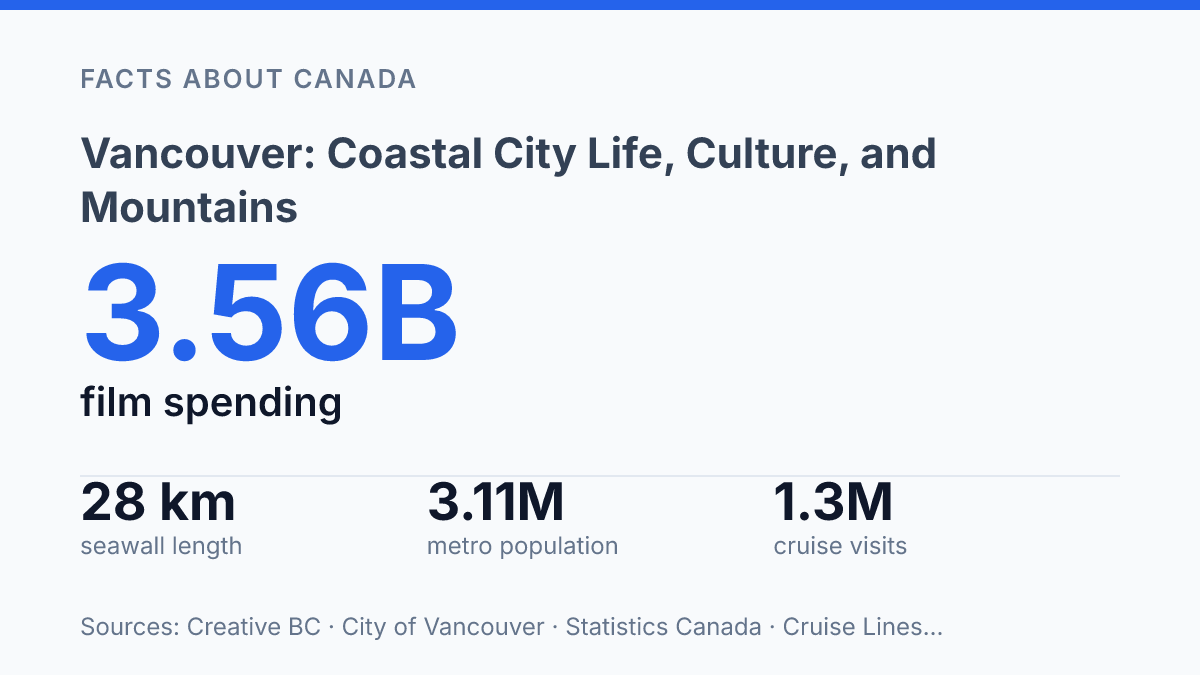
Vancouver added more than 127,000 people to its metropolitan area in the year to July 1, 2024, pushing the region above 3.1 million residents and making growth a central fact of coastal city life. That scale changes how the city is understood: not simply as a scenic stop between ocean and mountains, but as a dense, majority-racialized urban centre with global tourism, screen production, and housing pressures working at the same time.
Its public image rests on visible geography, including a 28 km waterfront seawall and the North Shore mountains, yet recent figures on filming days, cruise passengers, museum attendance, and rental vacancy show a city shaped as much by infrastructure and demand as by scenery. The following sections examine how place, culture, industry, and daily living conditions combine to define Canada’s most closely watched west-coast metropolis.
Why Vancouver stands out on Canada’s west coast
Few Canadian cities combine a Pacific seaport, a compact municipal footprint, and density above 5,749.9 people per sq km at the same scale. Vancouver sits on Canada’s Pacific coast in British Columbia, where its harbour connects western Canada to trans-Pacific trade routes and helps make the city a national gateway rather than only a regional centre. That port function supports freight, tourism, logistics, and professional services, giving the city an economic role that extends well beyond its municipal boundaries.
Recent population growth reinforces that gateway status. The census metropolitan area reached 3,108,941 people in 2024, after adding more than 127,000 people in the year to July 1, a 4.2% increase, according to Statistics Canada. This places the urban region among Canada’s major growth centres and helps explain why regional planning, transit capacity, and housing supply are central to its public policy debates.
At the municipal level, the 2021 Census recorded 662,248 residents living within 115.18 square kilometres, a concentration that makes the city one of the densest in Canada. Density supports walkable neighbourhoods, frequent transit corridors, and a strong market for local shops and services, but it also increases competition for land. The result is a city where waterfront access, apartment construction, street space, and public amenities carry unusually high civic importance.
Demographic diversity is another defining feature of the city’s present-day profile. In the 2021 Census, 354,615 residents were counted in Statistics Canada’s visible-minority category, representing 54.5% of the city population.
That majority-racialized population reflects long-standing and continuing immigration patterns, particularly from Asia and the Pacific region. For commerce and daily life, this diversity expands language networks, food cultures, business ties, and community institutions, while also making equity in housing, services, and public space a practical planning concern rather than an abstract value.
How mountains, water, and film production shape the city
Views toward the North Shore Mountains are not a decorative backdrop; they are one of the city’s most visible planning conditions, shaping sightlines, waterfront land values, outdoor culture, and the way the city is photographed. Burrard Inlet, English Bay, False Creek, and the mountain wall beyond them create a compact visual geography in which dense urban districts sit close to beaches, marinas, forested slopes, and ski terrain. That proximity helps explain why the city’s image is often built around contrasts: glass towers against snow-covered ridges, working waterfronts beside public paths, and residential neighbourhoods pressed close to recreational space.
The same setting also gives screen productions a unusually flexible canvas. According to a 2025 City of Vancouver update, the city recorded 1,031 filming days and 1,547 filming locations in 2024, increases of 90% and 87% from the previous year.
Creative BC estimated $3.56 billion in film and television production spending across British Columbia in 2024, with foreign production making up most of that total. Those figures show that filming is not a small image-building sideline; it is a major economic activity tied to labour, studios, location services, post-production, and the city’s capacity to stand in for other places on screen.
The nickname Hollywood North reflects that production identity as much as any single landmark does. Mountain views, rain-dark streets, modern downtown blocks, waterfront edges, and nearby forests allow the region to double for a wide range of North American settings, which reduces the need for companies to move between distant locations. Public familiarity with the city can therefore be indirect: many audiences have seen its streets, bridges, and skylines without necessarily recognizing them as local places.
This visibility brings practical tensions. Scenic waterfronts and mountain-facing districts attract visitors, production crews, residents, and developers to many of the same areas, increasing pressure on street space, parking, public access, and neighbourhood routines. The result is a city identity built partly on spectacle, but managed through permits, land-use decisions, and debates over who benefits from the places that make the city so recognizable.
Arts institutions and First Nations collections worth seeing
The Vancouver Art Gallery reported more than 186,000 visitors in 2024 and holds more than 13,000 works, according to its annual report, making it one of the city’s main repositories of modern and contemporary art. Its identity is strongly tied to regional art, including work associated with Emily Carr and artists connected to British Columbia, while its exhibitions also place local production beside national and international practices. That combination matters because the gallery does more than display a civic collection; it helps define which regional artists enter wider art-historical conversations.
At the Museum of Anthropology at the University of British Columbia, First Nations collections occupy a central position rather than a side gallery. The museum is especially known for Northwest Coast Indigenous works, including monumental carvings, house posts, masks, and related material culture, with displays that connect objects to specific communities and artistic lineages. Its setting within a university also gives the institution a research role, so the collections are interpreted through scholarship, conservation, and relationships with originating communities rather than only through aesthetic presentation.
The city’s cultural profile is not limited to museums. The Orpheum Theatre, opened in 1927 and operated through Vancouver Civic Theatres, remains closely associated with large-scale performance, including its role as the home of the Vancouver Symphony Orchestra. As a venue, it represents a different part of the arts ecosystem: live performance, touring programs, and civic cultural infrastructure rather than collecting institutions.
These anchors give the arts scene visibility, but they do not represent the full range of local creation. Smaller artist-run centres, Indigenous-led initiatives, neighbourhood stages, and independent producers often carry experimental and community-based work with fewer resources and less tourist attention. The result is a cultural profile shaped by major public institutions and by less-visible creators whose influence can exceed their funding or public profile.
What to know about daily life in a dense coastal city
The same compactness that makes daily errands possible without a car also turns curb space, rental homes, and access to parks into practical planning issues. Dense apartment corridors, mixed-use streets, and closely spaced commercial areas give many neighbourhoods a walkable character, but they also concentrate demand for deliveries, patios, bike lanes, buses, and short-term parking on the same blocks. This is why mobility is not just a transport question here; it shapes how neighbourhoods feel at street level.
According to TransLink, SkyTrain operates as a three-line automated rapid-transit system covering 79.6 km, giving the region a rail spine that helps offset the limits of road space in a constrained coastal setting. Frequent transit, cycling routes, and waterfront paths support car-light living in central areas, while longer commutes remain common where housing costs push residents farther from job centres. The effect is a city where proximity to a station, bus corridor, or safe cycling route can materially change daily costs and travel time.
Language diversity is visible in ordinary neighbourhood life rather than confined to formal cultural districts. Statistics Canada’s 2021 Census data show that Mandarin, Cantonese, Punjabi, Tagalog, and Spanish are among the non-official languages spoken at home in the city, a pattern reflected in food retail, religious institutions, local media, and multilingual services. Areas such as Chinatown, Punjabi Market, and Commercial Drive show different histories of migration and commerce, though demographic change and redevelopment have altered many of their older community anchors.
Affordability is the sharpest practical constraint on the dense-city model. A 2025 municipal housing update using CMHC Rental Market Survey data reported a 2.7% city-wide vacancy rate, but only 0.8% vacancy for one-bedroom units below $1,550, compared with 6.1% for units above $2,300.
That gap indicates that new or available supply does not help all renters equally. The final reality of daily life is therefore specific: convenience depends less on scenery than on whether housing, transit, groceries, and public space are close enough to make a compact coastal city function day by day.
Where growth will test the coastal model
Growth will test the coastal model in measurable ways. A city can expand its cultural reach through galleries, cruise terminals, and film sets while still becoming harder to enter for lower-income renters, students, service workers, and new arrivals.
The sharp split in rental vacancy by price, with scarce sub-$1,550 one-bedroom units beside looser supply above $2,300, shows why headline livability measures can hide unequal access. The most useful way to read the city now is as a compact coastal system under pressure: every gain in tourism, production, and population raises the value of location, and every rise in location value makes policy choices more visible.
Frequently Asked Questions
Q: Why is Vancouver considered one of Canada’s most livable cities?
A: Vancouver combines a major seaport economy with strong access to nature and a dense urban core. Its location between the coast and the mountains shapes daily life, while its cultural institutions and diverse population add to its appeal.
Q: What is Vancouver best known for?
A: Vancouver is known for its mountain backdrop, coastal setting, and reputation as a filming location. It also stands out for its arts scene, including theatre, music, and major museums.
Q: Is Vancouver a diverse city?
A: Yes. Vancouver is among Canada’s most ethnically diverse cities, which is reflected in its neighbourhoods, food culture, and community life. That diversity has also helped shape its cultural institutions and public events.
Q: What museums should visitors see in Vancouver?
A: The Vancouver Art Gallery is known for works by regional artists. The Museum of Anthropology is especially significant for its preeminent First Nations collections, making it a key place to understand regional history and Indigenous art.
Q: What kind of arts scene does Vancouver have?
A: Vancouver has thriving art, theatre, and music scenes that reflect both local and international influences. Its cultural life is supported by major venues and institutions, giving the city a strong profile beyond its outdoor setting.