
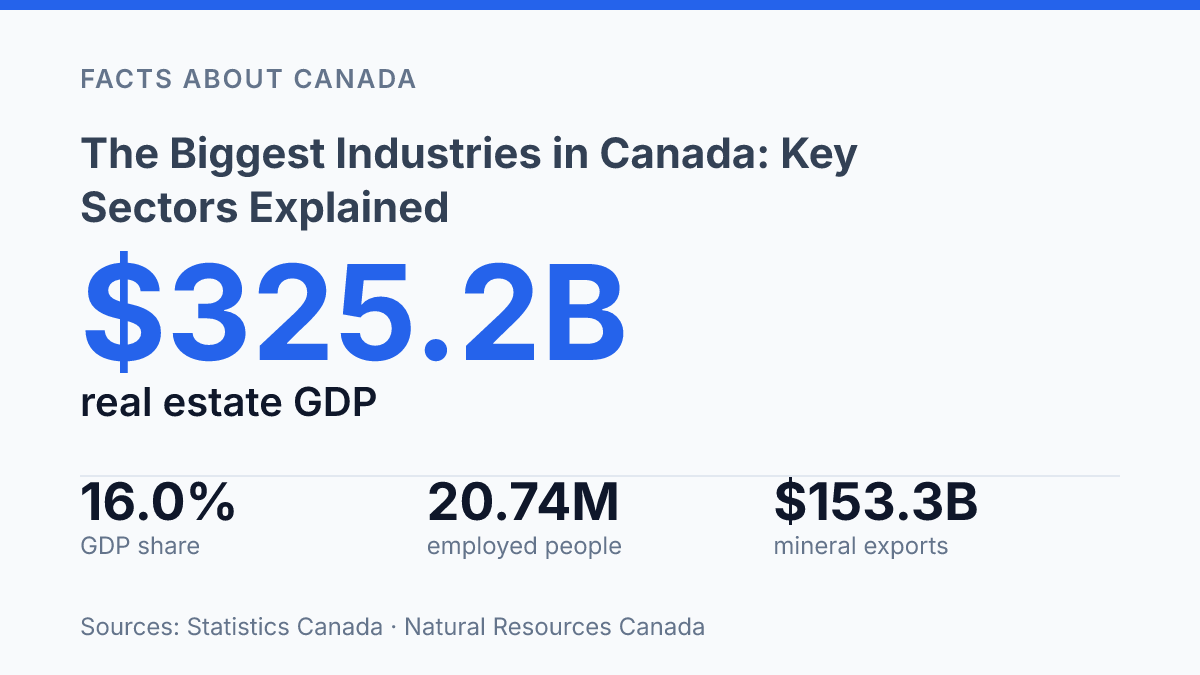
The biggest industries in Canada change depending on whether output or jobs are the measure: in 2024, real estate and rental and leasing produced $325.2 billion in value added, while wholesale and retail trade employed 2.93 million people in December. That split is the starting point for understanding Canada’s economy, because the sectors that generate the most GDP are not always the sectors that employ the most workers or drive the most exports. Manufacturing, mining, finance, professional services, health care, and retail each matter in different ways, from provincial supply chains to household employment.
The data also show a more complex picture than a simple resource-versus-services divide. Natural resources accounted for 16.0% of nominal GDP when direct and indirect effects were included, while services exports and non-U.S. markets gained ground in 2025. The result is an economy whose largest sectors are connected by capital, labour, trade, and geography.
Canada’s largest sectors by GDP and jobs
Canada’s largest output generator in 2024 was not an exporter or factory network but real estate and rental and leasing. According to Statistics Canada, Table 36-10-0710-01, real estate and rental and leasing was Canada’s largest detailed industry by GDP in 2024 at $325.2 billion in value added at basic prices, compared with $259.8 billion for manufacturing and $246.0 billion for mining, quarrying, and oil and gas extraction. This ranking shows why service industries dominate national output even though goods-producing sectors remain large by international trade, investment, and regional employment standards.
Measured by GDP, the largest sectors reflect the value produced rather than the number of workers on payrolls. Professional, scientific and technical services produced about $180.0 billion in GDP in 2024, slightly ahead of finance and insurance at $177.2 billion, placing both among the country’s major service contributors. Manufacturing and resource extraction stand out on the goods side because they generate high value added through capital-intensive production, processing, equipment, and commodity output rather than through sheer headcount alone.
The employment ranking looks different because labour-intensive industries require more workers for each dollar of output. In December 2024, Canada had 20.74 million employed people, with wholesale and retail trade employing 2.93 million, health care and social assistance 2.86 million, professional, scientific and technical services 1.96 million, and manufacturing 1.81 million, according to Statistics Canada’s Labour Force Survey. Retail and health care therefore sit near the top by jobs even when they do not lead the GDP table, while real estate ranks highest by output without being one of the largest direct employers.
The practical distinction is that “largest” depends on the economic question being asked. GDP identifies the sectors contributing the most measured value to national production, while employment identifies where Canadian workers are most concentrated. A clear view of the economy needs both measures, because output-heavy industries shape productivity, investment, and exports, while job-heavy industries shape household income, labour demand, and regional service needs.
Why finance, real estate, and professional services matter
Toronto concentrates decision-making for five national lenders whose branch networks, mortgage books, commercial loans, and capital-market operations reach across the country. The Big Five banks, Royal Bank of Canada, Toronto-Dominion Bank, Bank of Nova Scotia, Bank of Montreal, and Canadian Imperial Bank of Commerce, anchor the city’s role as Canada’s main financial centre. Their significance comes not only from retail banking, but from underwriting, wealth management, insurance links, payments infrastructure, and corporate finance, which help allocate capital to households, governments, and businesses in other sectors.
Recent growth data show why finance remains economically influential even when it is not the single largest industry category. According to Statistics Canada’s The Daily, finance and insurance GDP grew 4.0% in 2025, its strongest annual increase since 2021, with higher trading volume contributing to growth in other finance and insurance activities. That pattern illustrates a core feature of the sector: a relatively small number of high-value transactions, assets under management, and risk-pricing functions can generate substantial output.
Real estate, rental, and leasing carries similar weight for different reasons. In national accounts, the sector captures a broad set of housing and property services, including rental activity and the economic value associated with occupied housing, not just the commissions earned when homes change hands.
This helps explain why the category remains a major GDP contributor even when resale markets soften. Statistics Canada reported that real estate and rental and leasing grew 1.7% in 2025, while offices of real estate agents and brokers and related activities fell 2.1% as national home resales declined, showing that the wider property-service base is broader than transaction activity alone.
Professional, scientific, and technical services add another high-value layer through expertise rather than physical assets. Toronto, Vancouver, and Montreal host major clusters in fields such as legal services, accounting, engineering, architecture, computer systems design, research, and management consulting.
These activities often sit close to finance, technology, universities, headquarters, and export-oriented firms, which increases their influence beyond their direct output. The common thread across these service sectors is that national income is shaped by productivity, intellectual capital, financial assets, and property values as much as by payroll size.
Natural resources and manufacturing across the provinces
In 2024, natural resources directly and indirectly accounted for 16.0% of Canada’s nominal GDP, or $459 billion, while supporting 1.8 million jobs, according to Natural Resources Canada. That scale explains why resource-producing regions can shape national export earnings even though many of Canada’s largest employers sit in services. Energy, minerals, and forestry are capital intensive, so their output and trade value often run ahead of their headcount and are more exposed to commodity prices, exchange rates, and project cycles.
Oil and gas show this pattern most clearly. Alberta remains the centre of Canadian crude oil and natural gas production, with oil sands, conventional production, field services, pipelines, and corporate functions concentrated around Calgary, Edmonton, and northern producing regions. Newfoundland and Labrador has a different profile: offshore petroleum gives a smaller provincial economy a large resource base, but output is more closely tied to individual offshore projects, maintenance schedules, and global oil markets.
Forestry and mining create another layer of regional specialization without requiring a full province-by-province map. British Columbia’s forest products and mining activity link timber, pulp, metallurgical coal, copper, and port logistics, while Quebec combines forestry with mining, aluminum smelting, and mineral processing.
Saskatchewan’s resource identity is especially tied to potash and uranium, two commodities that connect the province to global fertilizer and nuclear fuel supply chains. Natural Resources Canada estimates that resource-sector jobs in 2024 included 692,000 in energy, 710,000 in minerals and metals, and 375,000 in forest industries, showing that the resource economy is broad but still smaller in employment intensity than its export weight suggests.
Manufacturing adds a different form of provincial concentration. Ontario’s automotive industry is built around assembly plants, parts suppliers, tooling, logistics, and cross-border supply chains in the Greater Toronto and southwestern Ontario corridor.
Quebec’s aerospace production is concentrated around the Montreal area, where aircraft, engines, simulation systems, components, and engineering expertise support one of the country’s most specialized advanced-manufacturing clusters. Statistics Canada reported that interprovincial trade in manufactured goods rose 0.7% to $167.4 billion in 2024, which underlines how production networks link provincial economies even when the most visible clusters are concentrated in a few regions.
What these industries mean for trade and future growth
Trade exposure means Canada’s largest sectors are not only domestic employers or GDP generators; they are also transmission channels for changes in U.S. demand, commodity prices, exchange rates, and industrial policy. Energy, autos, and agri-food remain central because they connect Canadian production directly to the United States under deeply integrated North American supply chains, while minerals, forestry products, machinery, and services broaden the export base beyond one market. Global Affairs Canada reported that in 2025, exports to non-U.S. markets reached 32.8% of total exports, the highest share in more than four decades, which indicates diversification is growing even though the U.S. still anchors many of the country’s highest-value trade flows.
That mix matters for investment because different industries respond to different signals. Oil and gas investment is shaped by prices, pipeline and port access, emissions rules, and demand from refineries and global buyers. Automotive investment depends on North American vehicle platforms, parts networks, battery supply chains, and trade rules.
Agri-food exporters are affected by harvest conditions, processing capacity, rail and port reliability, food safety standards, and market access in the United States, Asia, and Europe. These are not isolated industries; they pull demand through transportation, warehousing, engineering, finance, insurance, equipment maintenance, and wholesale distribution.
Domestic growth is being supported by population expansion as well as exports. Immigration and temporary migration have contributed significantly to recent population gains, according to Statistics Canada, and that affects sectors whose revenues depend on the size and age structure of the population.
Retail demand rises with household formation, housing demand affects construction and building materials, and an older and larger population increases pressure on health care and social assistance. The same growth can also strain infrastructure and housing supply, so its economic effect depends partly on whether construction, public services, and labour markets can adjust fast enough.
Smaller sectors today may account for a larger share of future growth if clean energy, artificial intelligence, and supply chain realignment keep changing investment priorities. Clean electricity, critical minerals processing, batteries, low-carbon fuels, and grid equipment link natural resources with advanced manufacturing rather than replacing older sectors outright. AI adoption is likely to matter most where Canada already has scale, including finance, professional services, logistics, health systems, and factory operations, though gains depend on data quality, skills, regulation, and capital spending.
The practical lesson is that current size is only one measure of economic importance. Large established sectors provide export earnings, jobs, tax revenue, and regional specialization, but the next decade’s growth may depend on how well those sectors adapt to lower-emission production, more diversified trade, digital tools, and less predictable supply chains.
What the export shift changes
The next test for Canada’s major sectors is not only scale, but adaptability. A large domestic base in real estate, finance, professional services, resources, manufacturing, retail, and health care gives the economy breadth, but growth is increasingly shaped by where demand is moving. In 2025, services exports rose 3.8%, and exports to non-U.S. markets reached 32.8% of total exports, the highest share in more than four decades.
That shift does not reduce the role of the United States or natural resources, but it changes the margin where future gains may appear. The practical consequence is clear: industries with strong provincial links and export flexibility are likely to matter more than size rankings alone suggest.
Frequently Asked Questions
Q: What are the largest industries in Canada right now?
A: Canada’s largest industries are typically services, natural resources, manufacturing, and construction. Finance, real estate, professional services, healthcare, retail, and energy-related activity account for a large share of output and employment. The exact ranking shifts by whether the measure is GDP, jobs, or export value.
Q: Why is the service sector so large in Canada?
A: The service sector is large because the Canadian economy is highly developed and urbanized, which increases demand for banking, healthcare, education, retail, and professional services. It also reflects the scale of domestic consumption, since services usually employ more people than heavy industry. This makes services the main source of jobs even when resource sectors are highly visible.
Q: How important is natural resource extraction to the Canadian economy?
A: Natural resource extraction remains important because Canada has major reserves of oil, gas, minerals, forestry products, and other commodities. These sectors support exports, regional employment, and investment in provinces with strong resource bases. Their economic weight can be concentrated geographically, so their national impact is large even when the workforce share is smaller than that of services.
Q: Which Canadian industries employ the most people?
A: Healthcare and social assistance, retail trade, and professional and technical services are among the largest employers in Canada. Public administration, education, and accommodation and food services also contribute substantial employment. Labour intensity matters here, so the biggest employers are not always the same sectors that generate the most GDP.
Q: What industries are driving growth in Canada?
A: Growth is often driven by technology, clean energy, advanced manufacturing, logistics, and business services, alongside established sectors such as finance and resource extraction. Rates of expansion vary by region and depend on investment, trade conditions, labour supply, and commodity prices. That means a fast-growing industry is not always the largest one, but it can become more influential over time.