
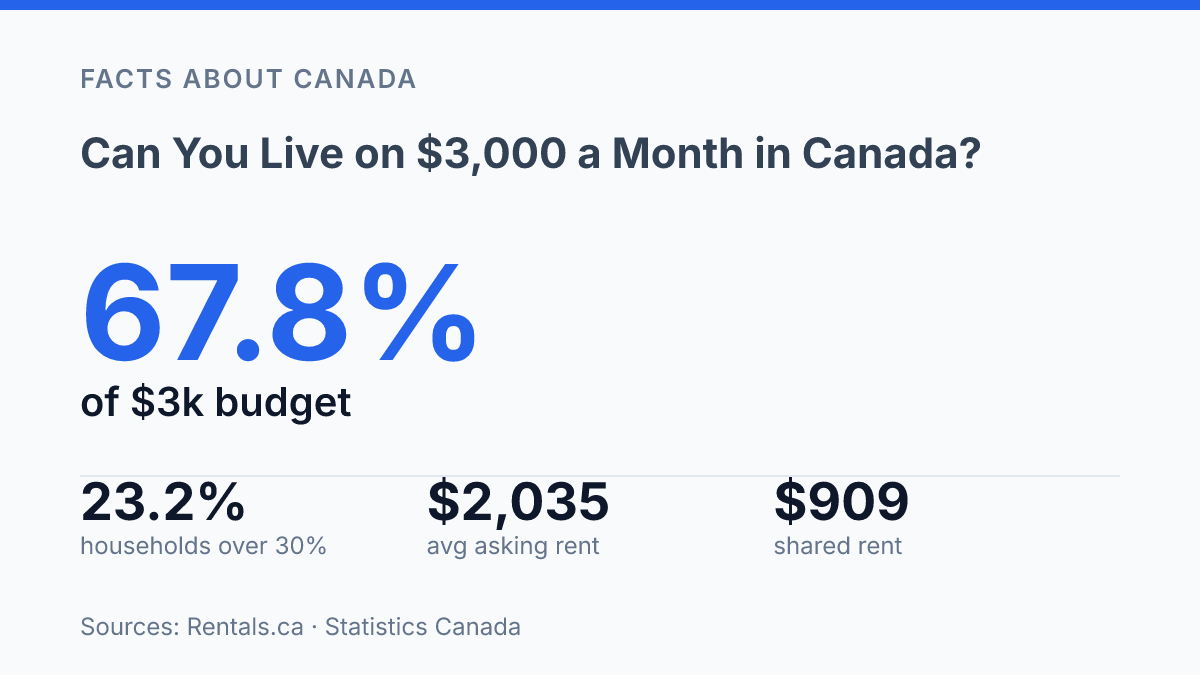
The answer to “Can you live on $3,000 a month in Canada?” starts with a $900 housing ceiling under CMHC’s 30% shelter benchmark, compared with a $2,035 national average asking rent in August 2026. That gap explains why the same income can be manageable in a shared apartment in Edmonton and unworkable for a solo renter in Toronto or Vancouver.
Housing is the main constraint, but it is not the only one: food prices are forecast to rise 4% to 6% in 2026, and recurring costs such as phone service, transit, insurance, and basic household expenses reduce the margin quickly. This article examines what a $3,000 monthly budget can realistically cover, how location changes the calculation, and which households are most likely to make the numbers work without relying on debt or skipped essentials.
What a $3,000 monthly budget covers
At $3,000 after tax, a market-average Canadian apartment can consume more than two-thirds of the entire monthly budget before food, transit, or phone service are paid. Using the common 30% shelter benchmark as a rough ceiling, this income leaves about $900 a month for rent and basic housing costs, which is well below prevailing rents in many urban rental markets. The pressure is visible nationally: Statistics Canada reported that 23.2% of Canadian households spent 30% or more of income on shelter in 2024, up from 22.0% in 2022.
Current rent benchmarks show why housing is the decisive category. According to Rentals.ca, the average Canadian asking rent in August 2026 was $2,035, equal to 67.8% of a $3,000 monthly budget; studios averaged $1,557 and one-bedrooms averaged $1,753.
Major-city averages were higher in the most expensive markets, with apartment and condo rents around $2,704 in Vancouver, $2,570 in Toronto, and $1,825 in Calgary. Winnipeg generally sits below those cities, with many current one-bedroom rents closer to the low-to-mid $1,000s, but even there a solo tenant can still spend close to half of take-home income on rent before utilities or food.
Non-housing essentials narrow the remaining room quickly. A single adult grocery budget commonly falls around $350 to $500 a month, while Canada’s Food Price Report 2026 estimated food costs for a family of four at about $1,464 a month, showing how sharply household size changes the calculation. Utilities for electricity, heating, water, or tenant-paid services often add roughly $100 to $250 a month depending on province, dwelling type, season, and what rent includes.
Public transit is usually cheaper than owning a car, but adult monthly passes in large cities commonly run around $110 to $160, with higher costs for broader regional travel. Basic connectivity can add another $60 to $125 or more, especially when mobile service and home internet are both needed.
A practical baseline therefore looks tight even before discretionary spending. With average one-bedroom rent of $1,753, $425 for groceries, $150 for utilities, $125 for transit, and $100 for basic phone or internet service, core monthly costs reach about $2,553, leaving roughly $447 for clothing, medication, insurance, household items, debt payments, emergencies, or any savings. In Toronto or Vancouver, rent alone can leave too little for ordinary necessities; in lower-rent cities or shared housing, the same income can cover basics with more stability.
Where the budget stretches and where it breaks
A renter facing a new lease can see the same $3,000 monthly income shift from barely workable to manageable simply by crossing from a top-tier rental market into a mid-sized Prairie city. According to Rentals.ca, average apartment and condo asking rents in August 2026 included $1,520 in Edmonton, compared with much higher rents in Canada’s priciest large urban centres.
Smaller Alberta markets were lower still, with Fort McMurray at $1,277, Lloydminster at $1,330, and Medicine Hat at $1,345. That spread matters because rent is not a marginal difference on this income; it can determine whether the remaining money covers essentials with a cushion or leaves almost no room for irregular costs.
The contrast is sharper for people arriving in a city and signing a fresh lease. CMHC’s 2025 Rental Market Report found that the average rent paid by a new tenant for a two-bedroom purpose-built apartment was $2,696 in Vancouver and $2,547 in Toronto, compared with $2,155 in Ottawa and $1,644 in Montréal.
CMHC also reported that vacant units were generally 13% more expensive than occupied units, which means movers often face a higher price than long-term tenants in the same market. This is one reason affordability can look better on paper than it feels for someone relocating for work, school, or a family change.
Shared housing changes the calculation more than most other adjustments. Rentals.ca reported that average asking rent for shared accommodations across B.C., Alberta, Ontario, and Quebec was $909 in August 2026, down 10.1% from August 2024.
A room in a shared unit, a basement apartment with utilities included, or a split two-bedroom lease can bring monthly housing pressure much closer to a sustainable range than a private one-bedroom in a major centre. The tradeoff is reduced privacy and, in some cases, less control over location, noise, lease terms, or household stability.
Lower-cost regions do not make the income generous, but they reduce the risk that housing alone absorbs the budget. Edmonton, smaller Prairie cities, and some secondary Ontario communities tend to offer more rental options below the levels common in the largest job markets. Halifax and other mid-sized cities can sit between these extremes, depending on neighbourhood and vacancy conditions. The practical distinction is not whether $3,000 is universally enough, but whether local rent leaves enough margin for the rest of the month.
What a realistic monthly budget looks like
In a workable $3,000 take-home month, the difference between balanced and exposed can be as little as $150. A sample allocation for one adult with modest rent, no car payment, and limited debt might look like this:
- Housing: $1,350 for rent or a room in a shared home.
- Food and household basics: $500 for groceries, toiletries, and routine supplies.
- Transit: $135 for local transportation.
- Phone and home internet share: $110.
- Utilities: $160 when heat, electricity, or water are not fully included in rent.
- Small buffer or emergency savings: $150.
That leaves $595 for everything not captured in the core bills. This remainder has to cover clothing, prescriptions, dental care, gifts, subscriptions, bank fees, personal care, replacement items, and any debt payments. If even $250 to $300 of that amount is committed to loans, insurance, or recurring obligations, discretionary spending becomes narrow very quickly.
The emergency line is modest but still meaningful as a benchmark. Saving $150 each month creates $1,800 after one year, which can absorb a single unexpected bill more easily than a zero-buffer budget. It is not enough protection against several shocks at once, such as a rent increase followed by a dental bill or a major car repair for someone who cannot rely entirely on transit.
The calculation changes materially if the $3,000 figure is gross income rather than deposited pay. Income tax, Canada Pension Plan contributions, and Employment Insurance premiums are normally deducted before wages reach a bank account, with the exact reduction depending on province, credits, and employment type. In that case, the same spending plan would need to be rebuilt from a lower net amount, because rent and other fixed bills do not shrink when payroll deductions apply.
Who can make this income work
In 2024, $3,000 after tax each month equalled $36,000 per year, below the median after-tax income for unattached adults reported by Statistics Canada. That comparison helps define the profile most likely to manage on this income: one adult, in stable low-cost housing, with predictable bills and limited fixed obligations beyond rent, food, utilities, communications, and transport.
A single adult has the clearest path because the budget is supporting one person’s groceries, clothing, health costs, and personal expenses. The income becomes more workable when housing is shared, because rent and some household costs can be divided rather than carried alone. Access to reliable public transit also matters, since it can keep transportation spending predictable and avoid the larger recurring costs tied to insurance, fuel, maintenance, parking, and vehicle replacement.
Household size changes the calculation quickly. A couple living on the same total monthly income may save on rent compared with two separate households, but food, phone plans, prescriptions, clothing, and other personal expenses rise with each adult. For families, the pressure is much greater because children add recurring costs that are not easily deferred, including food, childcare or school-related expenses, transit, clothing, medicine, and larger housing needs.
Debt payments can be the factor that turns a tight budget into an unworkable one. Student loans, credit card balances, personal loans, car financing, or support payments reduce the amount available for essentials before any discretionary spending is considered. Once several hundred dollars a month is committed to debt service, the room for emergency savings, irregular bills, or modest price increases becomes very limited.
The practical threshold is therefore less about a single national answer and more about fixed costs. This income is most feasible for one adult with roommates or a protected low rent, no car requirement, good transit access, and little or no debt. It is unlikely to be enough where the household includes children, a vehicle is necessary for work or daily life, or debt payments consume a substantial share of monthly cash flow.
Why the lease decides the margin
The practical question is not whether $3,000 is livable everywhere in Canada, but how much of that income is locked in by housing before food, transport, and bills appear. A tenant with a lower-cost room, no car, and stable fixed expenses may have a workable plan. A newcomer signing a market-rate lease in a high-rent city faces a different equation, especially when vacant units tend to cost more than occupied ones.
The clearest next step is to test the budget against actual rents in the target city before moving or signing a lease. On this income, a $200 rent difference is not minor; it can decide whether the month has savings, shortfalls, or no margin at all.
Frequently Asked Questions
Q: Is $3,000 a month enough to live in Canada?
A: It can be enough for a single person in some cities or smaller communities, but it is often tight in major urban centres. Housing, transportation, and food costs vary widely by region, so the same income can feel comfortable in one place and strained in another. The answer depends more on location and lifestyle than on the national average alone.
Q: Which cities in Canada are easiest to manage on a $3,000 monthly budget?
A: Smaller cities and many rural areas are generally easier to manage than Toronto or Vancouver. Lower rent and transportation costs are the main reasons, and they often make a fixed monthly budget more workable. Local job access and seasonal expenses still matter, especially where car ownership is necessary.
Q: Can a couple live on $3,000 a month in Canada?
A: A couple can sometimes do so, but only with modest housing costs and limited discretionary spending. Shared expenses improve affordability, yet rent and utilities can still consume a large share of the budget. The arrangement is more realistic outside the most expensive housing markets.
Q: How much of a $3,000 income usually goes to rent in Canada?
A: Rent often takes the largest share of a monthly budget, especially in larger cities. Many household budgets become strained when housing absorbs too much of total income, because that leaves less room for food, transit, insurance, and savings. A lower rent-to-income ratio usually provides much more stability.
Q: What expenses make a $3,000 monthly budget harder to stretch in Canada?
A: High rent, car ownership, and childcare are among the biggest pressure points. Food inflation and utility costs can also narrow the margin between a workable budget and an unstable one. These costs matter because they are recurring, so even small increases can affect monthly cash flow.