
Winnipeg isn’t merely Manitoba’s capital. On July 1, 2024, its economic region held 56.8% of the province’s people.
That’s not a footnote. It’s the reason Manitoba’s politics, arts, food, transport, and winter life keep bending back toward one city.
The surprise is how practical that pull feels on the ground. The Forks draws more than 4 million visitors a year. It still works like a public meeting place, not a sealed tourist zone. The Exchange District sells heritage, but its old warehouses are also tied to new housing and festival crowds. In my honest opinion, that’s where the city gets interesting: it doesn’t ask you to choose between useful and memorable.
Read this as a guide to the city’s center of gravity, the places that explain it fastest. The reasons people leave planning another trip.
Why Winnipeg sits at Manitoba’s center
Winnipeg became Manitoba’s capital in 1870, the same year the new province joined Confederation, so its political role was built into the map from day one. That timing matters.
The city didn’t just grow into provincial importance later. It started as the seat of government when Manitoba entered Canada.
Today, it is the largest city in Manitoba and the main place many residents look to for higher-level services. Provincial government, major health care, post-secondary education, transportation links, and business services all concentrate here. In my view, the city’s centrality matters most when you see it as working infrastructure, not civic branding.
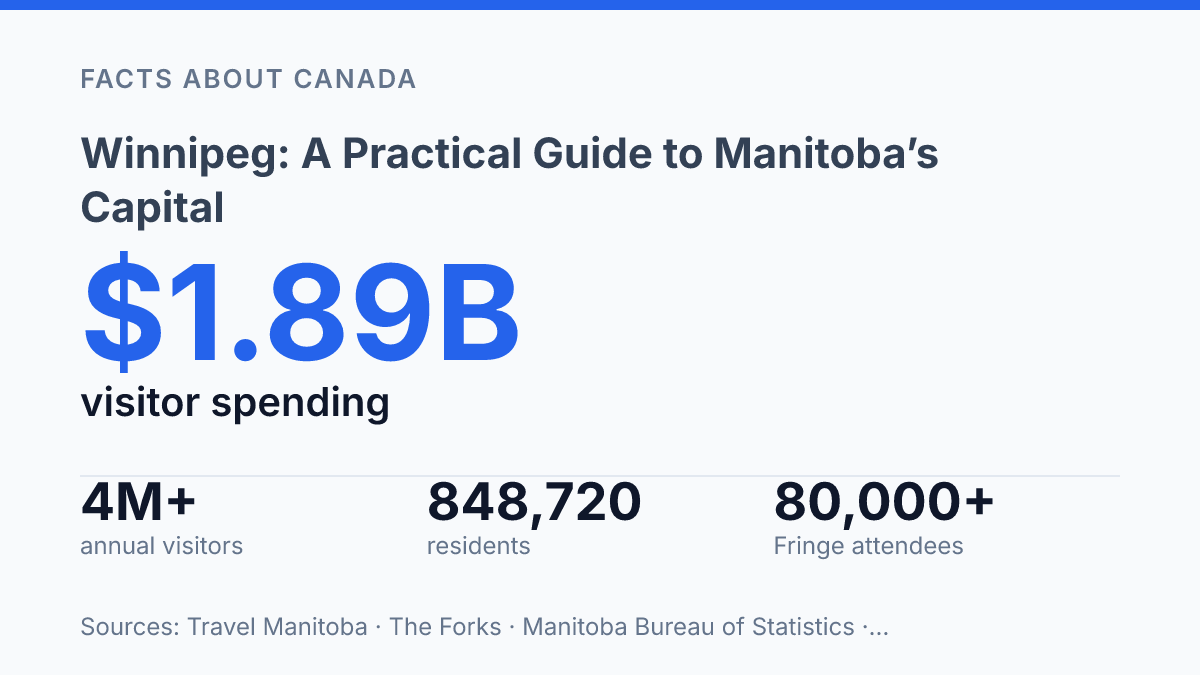
The scale backs that up. The Winnipeg economic region had 848,720 residents on July 1, 2024, equal to 56.8% of the province’s total population of 1,494,301, according to the Manitoba Bureau of Statistics, 2025 Annual Population Statistics regional report.
In plain terms, more than half the province’s people are tied to this urban region. That gives the capital unusual weight in provincial planning.
Geography explains a lot of that pull. The Red River and Assiniboine River meet here, creating a natural meeting point for movement, trade, settlement, and later rail and road connections across the Prairies.
You can still read that pattern in the city’s shape: routes bend toward the rivers. The urban core grew around their meeting place.
But the same rivers that made the city useful also made it vulnerable. Flood history isn’t a side note here.
It is part of how the capital understands risk, land use, and public works. Central locations come with power, but in this case they also come with water at the door.
What to see at The Forks
The Forks can draw over 4 million visitors each year, according to its current About page. It still works like a local shortcut, lunch stop, skating launch, and meeting point.
That scale matters. This isn’t a place built only for postcards.
Its age is not a museum label. The site sits at the junction of the Red and Assiniboine rivers, where people have gathered for more than 6,000 years.
The surprise is that the old meeting-place logic still holds. The daily rhythm feels current and practical.
Those old rail-era warehouses could have become sealed-off heritage props. Instead, they were converted into shops, restaurants, market halls, and public spaces that people actually use. In my honest opinion, that’s why the site works better than many preserved historic districts: it lets commerce, food, weather, and public life rub against the past without making the past feel fragile.
The riverside green space carries a lot of the load. Festivals, concerts, and exhibits spill across the grounds in warmer months, then winter gives the area a completely different job. The Nestaweya River Trail usually reaches more than 6 km when fully open and averages 50-plus winter days of operation; The Forks noted that its 2024 opening was only the fifth December opening since 2008.
That contrast is the real appeal. The Forks feels historic, but its strength is how aggressively modern it is in everyday use. You can come for the river history and end up staying because the place solves simple human needs: food, movement, shelter, open air, and something happening nearby.
Why the Exchange District stands out
A few blocks here hold more intact commercial ambition than many cities keep in their entire downtowns. The Exchange District contains more than 140 heritage buildings from the late 1800s and early 1900s, a rare concentration that makes the area feel less like a preserved exhibit and more like a working archive you can walk through.
Its strongest buildings came from an era when grain, banking, rail, and wholesale trade shaped the city’s economy. That history still shows in the heavy warehouse fronts, raised loading bays, carved stone entrances, and confident bank buildings. You don’t need to know the technical names of the styles to read the message: money once wanted to look permanent here.
The twist is that finance no longer gives the district its energy. The old commercial wealth remains in the walls. The present value comes from artists, designers, small venues, restaurants, and cultural groups that have made those spaces useful again. In my humble opinion, that shift is what keeps the area from becoming a beautiful dead zone.
Creative activity is not just a soft reputation either. According to the Exchange District BIZ 2024 Annual Report, the TD International Jazz Fest drew more than 25,000 attendees to Old Market Square, the Fringe Festival brought over 80,000 attendees, and Nuit Blanche/Culture Days drew more than 35,000 people across 50-plus events in the district. Those numbers matter because they show repeated local use, not one-off sightseeing.
Galleries, studios, theatres, and independent shops give the streets a slower rhythm than a conventional retail strip. You look up at ghost signs, step into a contemporary gallery, then pass a converted warehouse that now holds offices or apartments.
The contrast works. Old buildings provide the frame, but current creative work supplies the reason to stay.
That balance also explains why urban explorers tend to linger here. The district rewards curiosity at eye level: brick patterns, faded company names, narrow lanes, restored storefronts, and upper floors that hint at changing uses.
It preserves the city’s past. It doesn’t ask you to treat that past as fragile glass.
Best reasons people keep coming back
A city that can hit -30 C still sells itself through outdoor festivals, winter gatherings, and food that tastes built for survival. That contradiction explains why people come back.
The appeal isn’t perfect weather. It’s the stubborn amount of life that keeps happening anyway.
The Winnipeg Folk Festival has run since 1974, and Festival du Voyageur turns deep winter into a reason to leave the house. These events work because they don’t feel pasted onto the city. They fit its habits: music in open air, history with a local accent, and crowds that know how to dress for the forecast.
Food does the same kind of work. Menus here can move from prairie staples like beef, grain, and freshwater fish to Filipino, South Asian, and Ethiopian cooking without making a performance of it.
That mix matters. In my view, the best meals here don’t chase trends. They show how a prairie city absorbs new arrivals and lets them change the table.
Still, winter is not a charming detail. It affects when you travel, how long you stay outside, what shoes you pack, and whether an event feels easy or like a small act of commitment.
The cold can punish bad planning. It can also make a hot meal, a crowded concert, or a lit-up street feel sharper than it would somewhere milder.
Travel Manitoba reported that the province welcomed 10.6 million visitors in 2024, with spending reaching $1.89 billion. The capital benefits from that pull, but numbers only explain part of it. People return because the city has texture: serious seasons, strong public gatherings, and food that tells you who lives here now.
The smartest next visit starts before the hotel search
By 2025, the metro area is projected to sit close enough to 1 million people that old assumptions start to fail. A quick weekend still works. The better plan treats the city as a region with layers: river paths, festival nights, market lunches, and blocks where repair matters as much as preservation.
Watch what CentreVenture is doing with heritage buildings. Its work has helped trigger $481 million in capital investment over 25 years. That tells you something plain.
The past here isn’t sitting behind glass. It’s being rented, renovated, argued over, and lived in.
In my humble opinion, come for the sights, but pay attention to the conversions. A capital reveals itself less by what it saves than by what it decides to put back to work.
Frequently Asked Questions
Q: What is Winnipeg best known for?
A: Winnipeg is best known for being Manitoba’s capital and for The Forks, where the Red and Assiniboine rivers meet. The area mixes history, food, and open space in a way that feels practical, not polished. In my view, that mix is exactly why it works.
Q: Is The Forks worth visiting in Winnipeg?
A: Yes. The Forks is one of the city’s main draws, with old warehouses turned into shops and restaurants, plus space for festivals, concerts, and exhibits. It gives you a lot in one stop. It never feels rushed.
Q: What can you do in Winnipeg if you like arts and architecture?
A: Head to the Exchange District. It’s known for well-preserved early 20th-century buildings and a strong concentration of art galleries. The contrast is the appeal… historic streets on one side, contemporary art on the other.
Q: How far is the main Winnipeg riverfront area from downtown attractions?
A: The Forks sits right near the center of the city’s activity, so it’s easy to pair with other downtown stops. That location matters because you don’t waste time getting around. You can keep the day compact and still see a lot.
Q: What’s a good first stop for a short trip to Winnipeg?
A: Start at The Forks. It gives you the city’s history, food, and public space in one place. You can move on to the Exchange District after that. The tradeoff is simple: one area gives you plenty. The second area shows a different side of the city.